How to Choose the Best Emergency Radios for Blackouts in 2026
When the power goes out, the lights die, the Wi-Fi drops, and the phone battery starts its slow countdown. The best emergency radios exist for exactly that moment. A good one keeps you informed about the storm or the outage, gives you light to move around safely, and puts enough charge back into your phone to call for help. It does all of that without mains power or a mobile signal.
Choosing one is not as simple as picking the cheapest box with a crank handle. Some are little more than a music radio with a torch glued on; others are survival tools that run for days on cranking, sunlight and stored power. This guide explains what the types do, which power options matter, and the checks that separate a radio that saves the evening from one that dies an hour into the outage.
Key Takeaways
- Power autonomy comes first: crank, solar, battery and USB charging together beat any single power source.
- Look for AM, FM and weather band reception: local information in a blackout comes from broadcast radio, not the internet.
- A built-in torch and a phone-charging output turn a radio into a blackout tool, not just a source of news.
- Test it monthly and keep its battery charged, or it will be flat on the one night you need it.
- Buy for the outage you actually face: a home kit needs a bigger set, a car or go-bag a small, tough one.
What Makes a Radio an Emergency Radio?
An emergency radio is built around one question: what keeps working when everything else has stopped? An ordinary radio needs mains power or fresh batteries. A kitchen radio is judged on sound quality and looks. An emergency radio is judged on different things: whether it can make its own power, whether it can hear a broadcast when the aerial is your only link outside, and whether it still works in the dark, in the rain, with cold hands.
The difference from a weather radio matters too. A weather radio is an alert device: it sits on standby listening for official warnings and wakes the house when one is issued, as our guide to the best weather radios explains. An emergency radio is a broader survival tool. It usually receives the same weather band, but its real job is keeping you informed, lit and connected through a long outage. A weather radio wakes you up; an emergency radio gets you through the night that follows.
The Main Types of Emergency Radios in 2026
Emergency radios split into four clear families, and each one suits a different kind of outage. Most households end up with two: a larger set for the home kit and a small portable one for the car or the go-bag.
Hand-Crank Radios
The hand-crank radio is the classic emergency set. A minute or two of cranking gives you enough power for a news bulletin, and the crank never runs out, needs no fuel and cannot be forgotten in a drawer with flat batteries. The best crank radios pair the handle with a rechargeable battery that stores the power you crank. The weak point is the crank itself: cheap handles feel flimsy and can snap, so choose one that turns smoothly with a solid, geared feel. Cranking is also tiring, so treat the crank as one power source among several.
Solar Emergency Radios
A solar emergency radio charges its battery from daylight through a small panel on the top or back of the set. On a bright day it can keep a radio running indefinitely, and it asks nothing of you at all. The limit is obvious: solar charging is slow, and on a dark winter afternoon during a storm it may add almost nothing. Treat solar as a trickle charger, not the main power source. The best solar models pair the panel with a crank and a USB input, so you are never relying on the sun alone.
Battery Emergency Radios
A battery emergency radio runs on disposable batteries or a built-in rechargeable pack. Disposable batteries are the simplest option of all: they keep for years in a drawer, and anyone can change them. Their weakness is that they run out, and in a long outage the shops may be closed or sold out. A big built-in battery lasts far longer per charge and can often charge a phone, but once flat it needs mains power or another charger to recover. The practical answer is a radio that takes both.
Crank, Solar and USB Combination Radios
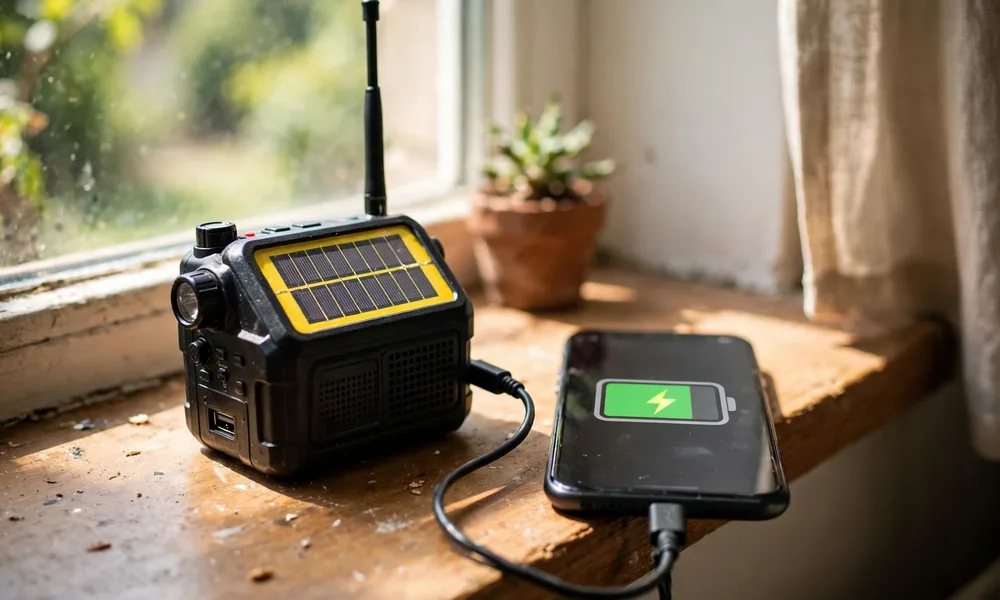
The combination radio is the best all-round choice for most homes in 2026, because it depends on no single power source. It cranks, it charges from the sun, it charges from a USB cable when the power is on, and it usually takes disposable batteries too. It also packs a torch, a reading light, a siren and a USB output for charging a phone. These sets cost more than a single-source radio, but the extra weight is the price of never being stuck. If you buy only one emergency radio, buy a combination model, and test every power source on the day it arrives.
Emergency Radios at a Glance
| Radio type | Best for | Power sources | Weakness |
|---|---|---|---|
| Hand-crank radio | Short outages, go-bags | Crank, battery | Tiring to crank for long |
| Solar emergency radio | Daytime outages, camping | Solar, battery | Slow charging in bad weather |
| Battery emergency radio | Bedside, simple backup | Disposable or built-in battery | Runs flat with no way to recharge |
| Combination radio | Home kit, long blackouts | Crank, solar, USB, battery | Heavier and more expensive |

What to Look For Before You Buy
Four checks decide whether an emergency radio will actually help you in a blackout, and they matter far more than the number of features printed on the box.
Power Options and Real Runtime
Be sceptical of the numbers on the packaging. Twenty hours on the box may mean twenty hours at whisper volume, not twenty hours of normal listening after a minute of cranking. Ask instead: how many minutes of cranking give how many minutes of radio, and how much phone charge does the USB output actually deliver? Know what it really delivers before the night you need it. Keep fresh disposable batteries with the radio, and top up the built-in battery every couple of months.
Reception Where You Live
An emergency radio is useless if it cannot hear a broadcast. Check which stations you can receive where the radio will live, and test it where you would actually use it. A long telescopic aerial pulls in far more than a short stubby one. Make sure it receives AM as well as FM: local AM stations often carry outage and road information, and the weather band carries official alerts. Tune the stations in now and write the frequencies on a card taped to the radio.
Phone Charging and the Torch
The USB output is what turns a radio into a lifeline. Check it is a proper charging output, not a token socket, and keep the right cable with the radio: a charging port without a cable is useless. The torch matters just as much: it should be bright enough to read by and to light a staircase, with a low-power mode that stretches the battery through a long night. A reading light or lantern mode is a bonus, freeing your hands for cooking or first aid.
Size, Toughness and Controls
An emergency radio gets used in the dark, in the rain, with cold hands, possibly dropped on a hard floor. Big, clearly labelled controls beat a fiddly menu every time, and a tuning knob you can grip with gloves is worth more than a dozen preset buttons you cannot find by feel. Look for a drop-proof case, a handle or strap, and some water resistance if it might live in a car or a go-bag. A home-kit radio can be bigger; a car radio needs to fit the glovebox without being forgotten.
How to Use Your Emergency Radio in a Blackout
When the lights go out, find your local station, then turn the volume down between bulletins to save power. Use the torch in short bursts rather than leaving it on, and charge the phone in short sessions: enough to send a message or make a call, then unplug it and let the radio recover. Crank little and often, and put a solar model in sunlight during the day, even on a cloudy day: a trickle still helps.
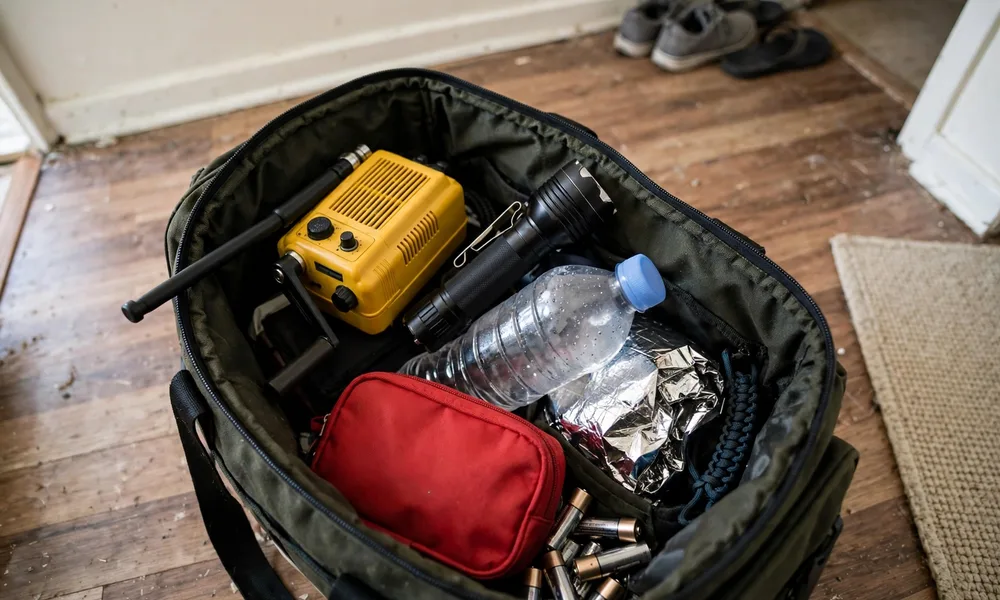
Keep the radio in one known place everyone in the house knows: a hallway shelf or the kitchen dresser, with the batteries, the charging cable and the station card beside it. A radio tells you what is happening, but it does not keep you warm, fed or dry. Our guide to the best emergency kits covers the full kit in detail, and the radio is one of the first items on that list for a reason. Our guide to the best solar chargers explains how to keep phones and lights running when the grid is down for days rather than hours.
Your 6-Point Emergency Radio Checklist
- Power: crank, solar, USB and disposable batteries, with at least two ways to make power.
- Reception: AM, FM and weather band, with a long telescopic aerial and your local stations pre-tuned.
- Light: a torch bright enough to read by, with a low-power mode for long nights.
- Charging: a USB output that genuinely charges a phone, with the right cable kept beside the radio.
- Controls: big knobs and buttons you can find in the dark, with gloves on.
- Routine: test it monthly, charge it every couple of months, and keep it in one known place.
Frequently Asked Questions
Do I need an emergency radio if I have a smartphone?
Yes. A phone is a wonderful tool until its battery dies or the mobile network fails. An emergency radio makes its own power, receives broadcasts that do not depend on the network, and can charge the phone itself.
How long should I crank an emergency radio?
Crank little and often. A minute or two of steady cranking usually gives several minutes of radio or torch. Crank during the news bulletin, then let the radio play on its stored charge while you rest.
Can an emergency radio fully charge a phone?
Usually not from empty. Most emergency radios give a phone enough charge for calls and messages, which is what matters in an outage. A dedicated power bank or solar charger is the right tool for a full charge.
Is a weather radio the same as an emergency radio?
No, although they overlap. A weather radio receives official alerts and wakes you when a warning is issued. An emergency radio is a broader tool with a crank, a solar panel, a torch and phone charging, built to get you through a long outage.
Where should I keep my emergency radio?
In one known place everyone can find in the dark, such as a hallway shelf, with its batteries, charging cable and station card beside it. A second, smaller radio belongs in the car or the go-bag.
How often should I test an emergency radio?
Once a month, and charge the built-in battery every couple of months even if you have not used it. Test every power source. A radio that has sat unused for a year may have a dead battery, a stiff crank or a corroded battery compartment.
The Bottom Line
The best emergency radios for blackouts in 2026 are the combination models: a crank, a solar panel, a USB input and a battery compartment, with a bright torch and a phone-charging output. Judge it on power, reception and light, test it monthly, and keep it where everyone can find it in the dark. The night the power fails is the wrong time to discover that your radio was a decoration.