
The top weather radios of 2026 are small boxes with a serious job: they wake you when a storm, flood or wildfire warning is issued, even when the power is out, the mobile network is down and the internet is gone. A weather radio listens to the official broadcast bands that carry alerts from the national weather service, and the best models sound a loud alarm and switch themselves on the moment a warning for your area is issued. That is a different job from playing music or the news, and it needs a different kind of radio.
This guide explains how weather radios work, compares the main types, and shows you how to choose one for your home, your car or your emergency kit. We judged each type on alert reliability, reception, power options, ease of setup and behaviour in a real emergency: in the dark, in bad weather, with cold hands and no mains power.
Key Takeaways
- A weather radio receives official alert broadcasts and sounds an alarm for warnings in your area, even in the middle of the night.
- Look for SAME technology so the radio only alerts you for your county, not for storms a hundred miles away.
- Power options matter most in an emergency: mains plus battery backup, with hand-crank or solar charging on portable models.
- A weather radio is not a music radio: it is judged on alerts, reception and reliability, not on sound quality.
- Test your radio monthly and replace its batteries yearly, or it may be silent on the one night you need it.
How a Weather Radio Is Different from an Ordinary Radio
An ordinary radio plays whatever station you choose, and it stays silent until you switch it on. A weather radio does the opposite: it sits quietly on standby, listening to a dedicated weather band, and switches itself on with a loud tone the moment an official alert is broadcast for your area. That standby alert is the whole point. Tornadoes, flash floods and severe storms often arrive at night, when nobody is listening to anything, and the radio is the device that wakes the house.
That difference shapes everything about the design. An ordinary radio is judged on sound quality, station choice and looks, and our guide to radios for the kitchen and workshop covers that ground in full: warm sound, clear presets and a case that survives splashes and sawdust. A weather radio is judged on different things entirely: whether it can hear the weather band clearly from your home, whether it alerts only for your county, whether its alarm is loud enough to wake a sleeping household, and whether it keeps working when the power fails. Sound quality barely matters; a weather radio only needs to be loud and clear enough to understand a spoken warning.
The alert system itself is worth understanding. In the United States, the National Oceanic and Atmospheric Administration broadcasts continuous weather information and warnings on seven dedicated frequencies, and a weather radio tunes to those. SAME, which stands for Specific Area Message Encoding, lets the radio filter alerts by county, so you hear warnings for where you live and not for the next state.
The Main Types of Weather Radio
Weather radios split into three clear families, and each one suits a different place in your life. Most households end up with two: a desktop model at home and a portable one in the emergency kit or the car.
Desktop SAME Alert Radios
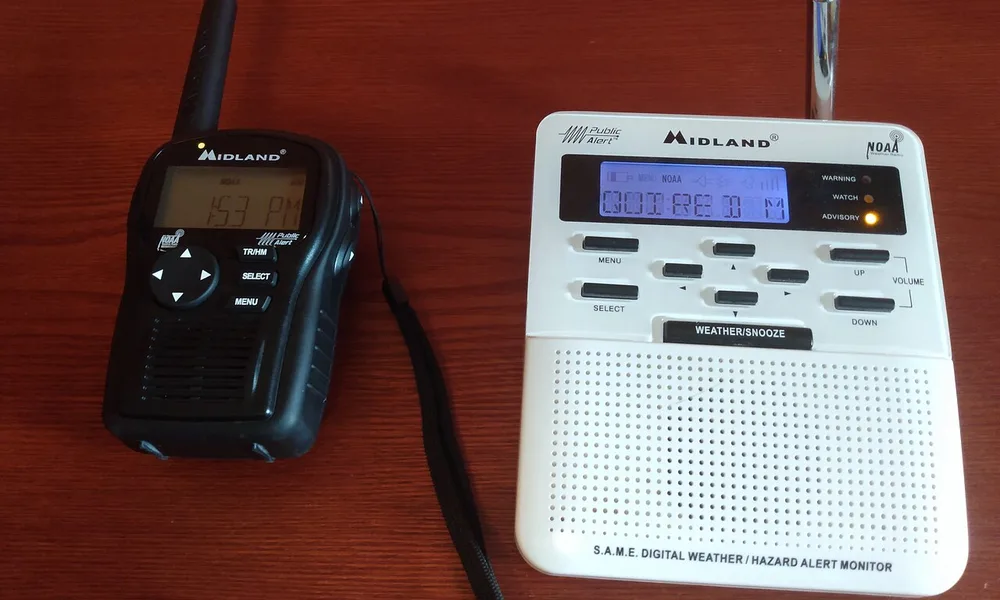
The desktop radio is the home guardian. It plugs into the mains, sits on a bedside table or kitchen shelf, and stays on standby around the clock with battery backup for power cuts. The best models have a clear display, warning, watch and advisory lights, and a loud alarm tone that can be set to wake the house. They are the most reliable type for home use because they have the best reception, with a long telescopic aerial, and the most complete alert filtering.
Hand-Crank and Solar Emergency Radios
The hand-crank radio is the portable survivor. It charges from a crank handle, a small solar panel and usually a USB connection, and it packs a torch, often a phone-charging output and sometimes a siren into one small box. These radios are built for power cuts, camping trips, car breakdowns and emergency kits, and they are the type you reach for when every other device is dead. Most crank radios receive the weather band and sound an alert tone, but few filter by county as precisely as a desktop SAME radio, and the small speaker is quieter. Buy this type for the kit, not as your only radio.

Handheld Portable Weather Radios
Handheld models sit between the two: small battery-powered radios with a weather band, an alarm and a clip or wrist strap, designed to be carried on walks, hikes and road trips. They are lighter than a crank radio and simpler to use, with fewer features to learn, and they are the best choice for a car glovebox or a hiking pack. A small aerial and battery mean shorter listening time and weaker reception, so they work best as a second radio.
What to Look For Before You Buy
Five checks decide whether a weather radio will actually protect you. They are all easy to verify before you spend anything.
Alert Filtering and the Alarm
Start with SAME or its local equivalent. Without county-level filtering, the radio will wake you for warnings that do not affect you, and after a few false alarms you will switch it off, which is the worst possible outcome. Check that the alarm tone is loud, at least loud enough to wake a sleeping adult from another room, and that the radio switches itself on for alerts rather than needing to be already playing.
Reception Where You Live
A weather radio is useless if it cannot hear the broadcast. Check the coverage of the weather band in your area before you buy, and place the radio where reception is strongest, usually near a window and away from thick walls and large appliances. If your home is in a valley or a basement flat, a desktop model with a good aerial will outperform a small portable every time. A weather station can tell you what is happening outside your window, but it cannot receive official warnings, so the two devices complement each other rather than replacing each other.
Power Options
Power is where emergencies are won or lost. A desktop radio needs mains power plus battery backup, so it keeps working through a power cut. A portable radio needs at least two ways to charge: hand-crank and solar, or crank and USB, so that one dead battery never leaves you silent. Keep spare batteries with the radio and rotate them yearly.
Ease of Setup and Use
Setup is the step most buyers skip, and it is the step that matters most. A weather radio needs its county code programmed, its alert types chosen and its volume set before it can protect you, and that takes ten minutes with the manual in hand. Choose a model with a clear display and simple menus, and set it up the day it arrives, not the day a storm is forecast.
Extra Features Worth Having
A torch is the most useful extra on a portable radio, followed by a phone-charging output and a siren for attracting attention. AM and FM bands are useful for news when the weather band is quiet. Skip long lists of gimmicks: extra features you never use only make a radio harder to operate under stress. Judge every extra by one question: will this help in the dark during a power cut?
Weather Radios Compared
| Radio type | Best for | Power | Watch out for |
|---|---|---|---|
| Desktop SAME alert radio | Home, bedside, kitchen | Mains plus battery backup | Stays at home; needs setup |
| Hand-crank and solar | Emergency kits, camping, car | Crank, solar, USB | Weaker county filtering; quieter speaker |
| Handheld portable | Glovebox, hiking, travel | Batteries, sometimes USB | Shorter battery life; weaker reception |
Your Weather Radio Checklist
- Confirm SAME or local county filtering so alerts only sound for warnings in your area.
- Check the alarm is loud enough to wake a sleeping household and that the radio switches itself on for alerts.
- Test reception where the radio will live, with the aerial fully extended and the radio near a window.
- Make sure there are at least two power options, mains plus battery backup at home, or crank plus solar when portable.
- Set the radio up the day it arrives: county code, alert types, volume and a monthly test date.
- Keep the radio with your emergency supplies, and keep it in your survival kit if you keep one packed and ready.
Frequently Asked Questions
Do I need a weather radio if I have a smartphone?
Yes, because phones depend on networks and power that fail in severe weather. A weather radio receives alerts directly from a broadcast transmitter, so it keeps working when mobile networks are down, the internet is out and your phone battery is dead.
What is SAME and why does it matter?
SAME stands for Specific Area Message Encoding, and it lets a weather radio filter alerts by county. Without it, the radio sounds for every warning the transmitter issues, including storms far away, and the false alarms quickly train you to ignore it or switch it off. With SAME programmed for your county, the radio only wakes you for warnings that affect where you live.
How do I set up a weather radio?
Find your county code, enter it into the radio, choose which alert types you want to hear, set the volume and the alarm tone, and test it. The whole job takes about ten minutes with the manual. Then test the radio monthly, using its test function or by checking reception, and replace the backup batteries at least once a year.
Can a weather radio work outside the United States?
NOAA weather radio is a United States system, and its seven broadcast frequencies cover the United States and nearby areas. Other countries run their own alert systems, so check what is available where you live before you buy. Some portable radios also receive international weather broadcasts, but a radio bought for NOAA will not receive alerts in a country that does not broadcast them.
How long does a hand-crank radio run after cranking?
It depends on the model, but a common figure is about ten to fifteen minutes of radio listening from one minute of steady cranking, with the torch running longer. Treat the crank as a backup for when batteries are dead, and keep the radio charged and the batteries fresh as your first line.
Where should I put my weather radio at home?
Put the main radio in the bedroom, where its alarm can wake you, or in the kitchen if the household gathers there. Keep it near a window for the best reception, away from thick walls and large appliances, with its aerial fully extended.
The Bottom Line
The best weather radios of 2026 are the ones that wake you, filter for your county and keep working when everything else fails: a desktop SAME radio at home for reliable alerts and strong reception, and a hand-crank or solar portable in your emergency kit for power cuts and the road. Buy for alerts and reliability, not for sound quality or gimmicks, set the radio up the day it arrives, and test it monthly.


