
A Guide to Survival Kits for Emergencies in 2026
A survival kit is the box, bag, or backpack you reach for when normal life stops working: a power cut in winter, a car stranded in snow, a storm that closes the roads, or an evacuation order at midnight. In all of these, the first hours matter most. The best survival kits for emergencies in 2026 are not the biggest or the most dramatic: they are built around the basics that keep a person safe, water, warmth, light, food, and a way to call for help, packed where you can grab them in the dark. The worst are collections of gadgets that look impressive and fail when needed.
First, a distinction that matters. A survival kit keeps you alive and comfortable until help arrives: shelter, fire, water, food, light, and warmth. A first-aid kit treats injuries: stopping bleeding, cleaning wounds, cooling burns, and supporting sprains. They overlap, and a survival kit should include basic medical supplies, but they are different jobs, and our guide to first-aid kits covers the medical side in full. A first-aid kit treats the person; a survival kit protects the person from the situation around them.
Key Takeaways
- A survival kit covers shelter, fire, water, food, light and warmth, not gadgets.
- Keep three kits: one at home, one in the car, and a grab bag by the door.
- Water is the heaviest and most important item: store drinking water and a way to purify more.
- Check every kit twice a year, and replace anything used, opened, or past its date.
- A kit you have practised with beats a bigger one you have never opened.
What a Survival Kit Is Actually For
A survival kit exists for the gap between trouble starting and help arriving, usually hours, not days: the night the power fails, the afternoon a storm strands you, the morning an evacuation is ordered. In that gap the dangers are ordinary: you get cold and thirsty, you cannot see, charge your phone, or cook. A good kit solves those problems with simple, reliable tools, without needing mains power, a shop, or a signal.
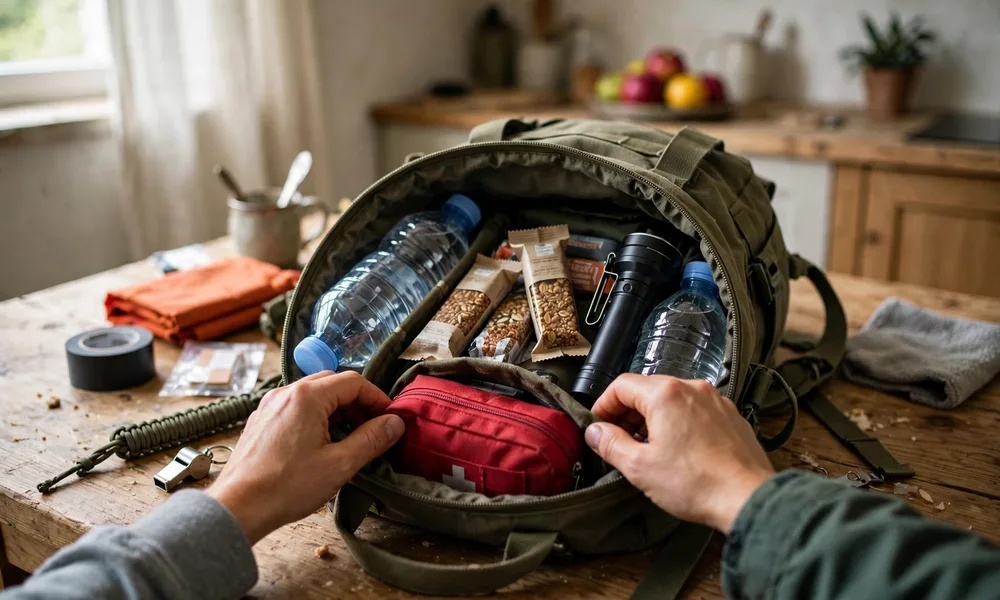
The best kits look boring: water pouches, a foil blanket, a torch, a whistle, energy bars, and a way to make fire. They are what matters at two in the morning in a cold house. Judge a kit by whether you could use every item in it in the dark, with cold hands, while stressed. If not, it does not belong in it.
A kit cannot replace emergency services. Its job is to buy you time and keep you warm, fed, watered, and able to call for help until proper help arrives. Know the signs that mean calling for help straight away, and keep your emergency numbers written on paper.
The Six Needs Every Kit Must Cover
Water comes first, because you cannot last long without it. Store at least two litres per person per day, and plan for three days at home. Bottled water is simplest, but heavy, so a home kit can hold more than a grab bag. Add a way to purify water, such as tablets or a small filter, because stored water runs out and a nearby tap may not be safe.
Warmth and shelter come second. A foil blanket weighs almost nothing and reflects body heat back at you, and a sleeping bag is better still. A small tent or tarpaulin can turn a bad night into a bearable one, and our guide to the best camping tents of 2026 explains what to look for in a shelter that packs small. Pack a warm hat and gloves: cold hands cannot work a lighter or a phone.
Fire is the third need, serving two purposes: warmth and cooking. A lighter, waterproof matches, and a ferro rod give you three ways to make a flame. Add a small stove or fuel tablets and a metal mug, so you can boil water. Never use a stove or fire indoors without ventilation: carbon monoxide is invisible, and it kills.
Food is the fourth need: pack food that needs no cooking, no fridge, and no preparation. Energy bars, dried fruit, nuts, and ring-pull tins are ideal; rotate them twice a year. Light is the fifth need, and the one people forget until dark arrives. A torch with spare batteries is essential, and a head torch is better, because it leaves both hands free. Our guide to the best flashlights of 2026 covers the brightness and runtime numbers that matter. Finally, communication: a charged power bank, a whistle, and a small battery radio, so you can call for help when the mobile network is down.
Home Kit, Car Kit and Grab Bag Compared
| Best for | Kit type | Water | Standout strength |
|---|---|---|---|
| Best overall | Home kit | Three days per person | Full supplies, stored where you live |
| Best for travel | Car kit | Two litres per person | Blankets, torch and food for a stranding |
| Best for evacuation | Grab bag | One litre per person | Light enough to carry, ready in seconds |
| Best for families | Family kit | Three days per person | Scaled up, with supplies for children |
Building a Home Survival Kit
A home kit can be the biggest, because it never has to be carried. A sturdy box or large backpack in a cupboard near the door is ideal. Start with water: two litres per person per day for three days, plus purification tablets. Add food for three days that needs no cooking, a manual tin opener, and a few plastic bags. Pack a torch and a head torch with spare batteries, a battery radio, and a power bank kept charged.
Warmth supplies come next: a sleeping bag or thick blanket per person, warm hats and gloves, and foil blankets as backup. Add a small first-aid kit, regular medication, and copies of documents in a waterproof bag. Cash in small notes is worth including, because card machines stop in a power cut. Finally, add a whistle, duct tape, and a multi-tool.
Store the kit where everyone can reach it, and tell everyone in the house where it lives. Check it twice a year, in spring and autumn, replacing batteries, rotating food and water, and updating documents and medication.
Building a Car Survival Kit
A car kit is smaller and tougher, because it lives in a boot through summer heat and winter cold. A blanket or sleeping bag is the most important item: if the car breaks down in snow, staying warm while you wait is the whole problem. Add a torch, a high-visibility vest, a warning triangle, and a whistle. Pack water, energy bars, a phone charger, and a small shovel if you drive where snow is common.
Food and water in a car need more frequent rotation, because heat spoils them faster. Check the car kit every three months, and replace anything opened or damaged. Keep the kit in a bag that stays put in the boot, and emergency numbers in the glove box. If you break down, stay with the car unless it is unsafe: it is a shelter, a signal, and far easier for rescuers to find than a person on foot.

Building a Grab Bag for Evacuation
A grab bag is the kit you take when you have minutes, not hours. It must be light enough to carry, ready by the door, and packed with the essentials only: water, a torch, a power bank, a foil blanket, energy bars, a whistle, copies of your documents, cash, medication, and a change of clothes. Everything else is a luxury, and a heavy bag is a bag you will leave behind.
Pack it in a backpack you are comfortable carrying, and keep it in the same place, so you can find it in the dark. Practise grabbing it: if it takes more than a minute to be out of the door, something is wrong with where it lives. For families, each adult should have a grab bag, and children old enough to carry one should have a small one of their own, with water, a snack, and a torch.
Common Mistakes to Avoid
The most common mistake is buying a ready-made kit and never opening it. Shop-bought kits are built to a price, and often include cheap torches, thin blankets, and food you would not want to eat. Open the kit, test everything, replace the weak items, and add the personal things no shop can know you need.
The second mistake is packing for a disaster film instead of a real emergency. You do not need a machete or a fishing kit: you need water, warmth, light, and food, working first time. The third mistake is forgetting to check the kit. Batteries leak, food goes stale, and medication expires. A kit that was perfect two years ago may be useless today.
The fourth mistake is storing everything in one place: a flood, fire, or break-in can take your only kit with it, which is why the home, car, and grab-bag kits exist separately. The fifth mistake is never practising: light the stove once, start a fire with the ferro rod once, and work the radio once, in daylight, when nothing is at stake.
Survival Kit Checklist
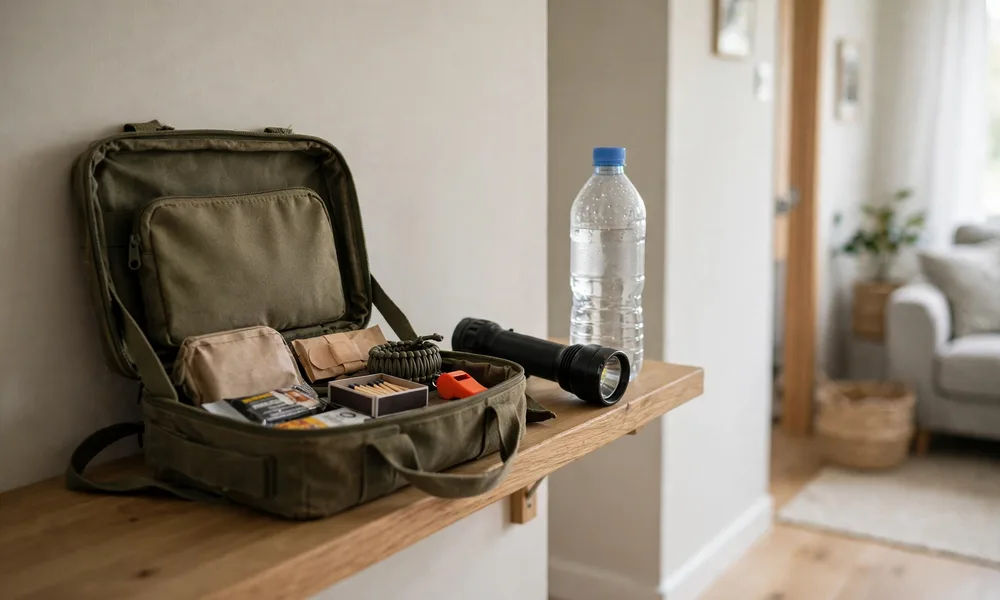
- Store two litres of water per person per day for three days at home, plus purification tablets.
- Pack a foil blanket, a sleeping bag or thick blanket, a warm hat and gloves per person.
- Carry three ways to make fire: a lighter, waterproof matches, and a ferro rod.
- Include a torch and a head torch with spare batteries, a power bank, and a radio.
- Pack three days of food that needs no cooking, and rotate it twice a year.
- Keep copies of documents, cash, medication, and a whistle in every kit.
Frequently Asked Questions
What is the difference between a survival kit and a first-aid kit?
A survival kit keeps you safe from the situation: water, warmth, shelter, fire, food, light, and a way to call for help. A first-aid kit treats injuries: bleeding, wounds, burns, and sprains. A survival kit includes basic medical supplies, but it is not a substitute for a proper first-aid kit.
How much water should a survival kit hold?
Plan on two litres per person per day, and store three days’ worth at home. A grab bag can hold less, around one litre per person. Always add a way to purify more water.
Should I buy a ready-made survival kit or build my own?
A ready-made kit is a fine starting point, but build on it. Test every item, replace anything cheap or weak, and add the personal items no shop can include, like medication and documents.
Where should I keep my survival kit?
Keep the home kit in a cupboard near the door, the car kit in the boot, and the grab bag by the front door in the same place always. Tell everyone in the house where each kit lives.
How often should I check my survival kit?
Check every kit twice a year, in spring and autumn, and the car kit every three months. Replace batteries, rotate food and water, and test the torch and radio each time.
Do I need a survival kit if I live in a city?
Yes, arguably more so. Cities depend on power, water, and transport networks, and a storm or power cut can shut them all down at once. A home kit and a grab bag are just as important in a flat as in a farmhouse.
The Bottom Line
The best survival kit for emergencies in 2026 is not the biggest or the most expensive. It is the one built around water, warmth, fire, food, light, and a way to call for help, kept where you can grab it, and checked twice a year. Build the home kit first, add the car kit and the grab bag, and test everything once. The kit is there so that when trouble comes, you can think clearly instead of scrambling.


