
A clear aquarium looks effortless, but the water only stays that way because something is working quietly in the background. A filter pulls in dirty water, traps the waste you can see, gives helpful bacteria a place to live, and sends clean, oxygen-rich water back into the tank. Without one, waste builds up fast, the water turns cloudy, and fish start to suffer within days. The best aquarium filters of 2026 are not the biggest or the most expensive models. They are the ones that match the tank, run quietly, hold enough filter media, and keep working for years without fuss. It is the one purchase that matters more than decorations, lighting or the fish themselves.
What an Aquarium Filter Actually Does
A filter does three jobs at once. Mechanical filtration traps solid waste in foam pads or floss before it can rot. Biological filtration is the quiet, essential job. Helpful bacteria colonise the porous media inside the filter and convert ammonia from fish waste into nitrite, then into nitrate, which is far less harmful and is removed by water changes and plants. Chemical filtration is the third job, usually done by activated carbon, which removes dissolved smells, colour and some pollutants.
Flow matters just as much as filtration. Moving water carries oxygen around the tank, stops dead spots where waste settles, and keeps the surface rippling so gases can exchange. Too little flow and the far corners of the tank go stale. Too much flow and small or slow-swimming fish get pushed around and stressed. A good filter gives steady, even circulation without turning the tank into a washing machine.
The Four Main Types of Aquarium Filter
Hang-on-back filters, often called HOB filters, hang on the rim of the tank and pull water up through an intake tube, pass it through cartridges or a media basket, then pour it back over the surface like a small waterfall. They suit tanks up to about 40 gallons and are easy to fit, clean and run. Their weakness is capacity: the media chamber is small, so they hold less bacteria than a canister, and the waterfall return can be noisy if the water level drops.
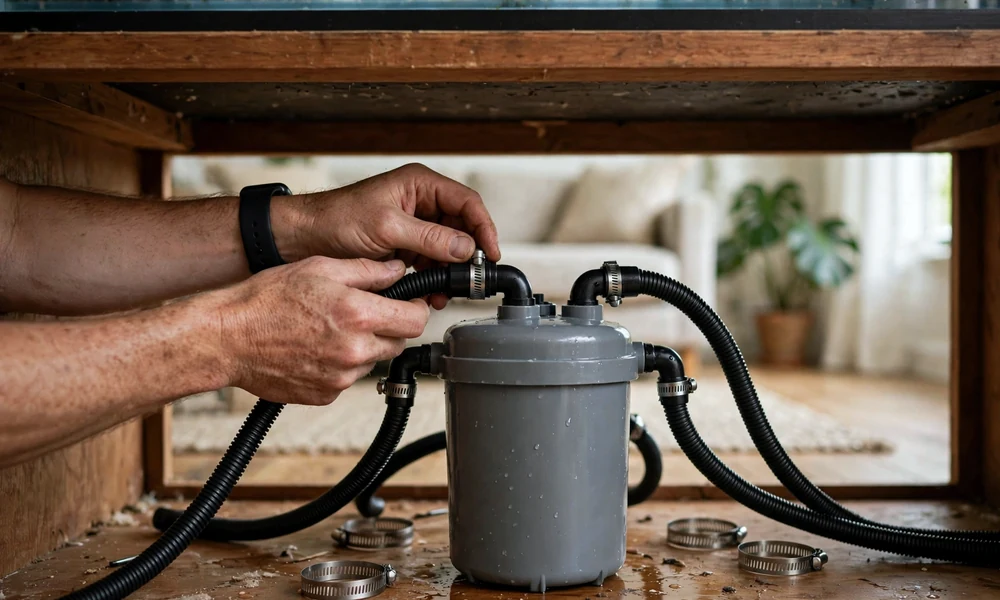
Canister filters sit outside the tank, usually in the cabinet underneath, and connect by two hoses. Water is pumped down into a sealed canister full of layered media trays, then back up into the tank. They hold far more media than any HOB, so they suit large tanks, heavily stocked tanks and planted aquascapes where equipment should stay out of sight.
Sponge filters are the simplest design of all: a foam sponge on a weighted base, driven by an air pump. Bubbles rising through the lift tube pull water through the sponge, which traps debris and grows a large colony of bacteria on its huge surface area. They are gentle, cheap and almost impossible to break, which is why breeders use them for fry, shrimp and betta tanks.
Internal filters sit inside the tank, stuck to the glass with suction cups, and suit small tanks where there is no room for a HOB and no cabinet for a canister. They are compact, quiet and simple to install, and many have an adjustable outlet to soften the flow.
How to Choose the Right Filter
Start with the tank, not the filter box. The old rule of thumb is to choose a filter rated for four to five times the tank volume per hour: a 20-gallon tank needs roughly 80 to 100 gallons per hour of flow. That is a starting point, not a law. Check the rating, then check whether the flow is adjustable.
Next, look at the media space. A filter is only as good as the home it gives bacteria, so a roomy media basket with separate foam, ceramic rings and space for carbon beats a slim cartridge that holds a single thin pad. Cartridge filters are convenient, but the cost of replacement cartridges adds up, and throwing a cartridge away also throws away the bacteria living on it. Reusable media rinsed in old tank water keeps the bacteria colony intact and costs almost nothing.
Noise is the complaint owners mention most after a few weeks, and it is easy to miss in a shop. Hang-on-back filters gurgle when the water level drops below the spillway, canister filters hum if air is trapped inside, and air pumps for sponge filters vibrate against the table. Read real owner reports about noise, place the filter on a level surface, and keep the water topped up. If the tank and filter are being bought together, start with a guide to the best aquariums of 2026.
The Best Filters by Tank Size
For tanks up to 10 gallons, a small sponge filter or a gentle hang-on-back model wins. Small tanks change fast: a missed feeding or a dead plant leaf can spike ammonia in hours, so the filter needs to be reliable and easy to clean, not powerful. A sponge filter gives gentle flow that will not batter a betta or suck in shrimp, and cleaning is a quick squeeze in a bucket of old tank water.
For tanks of 20 to 40 gallons, a mid-sized hang-on-back filter with a proper media basket is the sweet spot for most keepers. It holds enough foam and ceramic media for a community of tetras, guppies or corydoras, it is easy to service without getting wet to the elbow, and it leaves the cabinet free. Look for a model with a self-priming pump, so it restarts by itself after a water change or a short power cut, and a pre-filter sponge over the intake, which stops small fish and shrimp being drawn in and stretches the time between cleans.
For tanks of 50 gallons and above, a canister filter is the honest answer. The volume of water is large, the fish are usually bigger and messier, and the media capacity of a HOB simply does not keep up. A canister with layered trays can be cleaned every couple of months instead of every couple of weeks. The intake should sit near the substrate where waste collects, and the outlet should be aimed to sweep across the surface. Outdoor water features are a different job entirely, and the pumps used there are covered in a guide to pond pumps that keep water clear, which is worth reading before borrowing pond equipment for an indoor tank.
Filter Media, Explained Simply
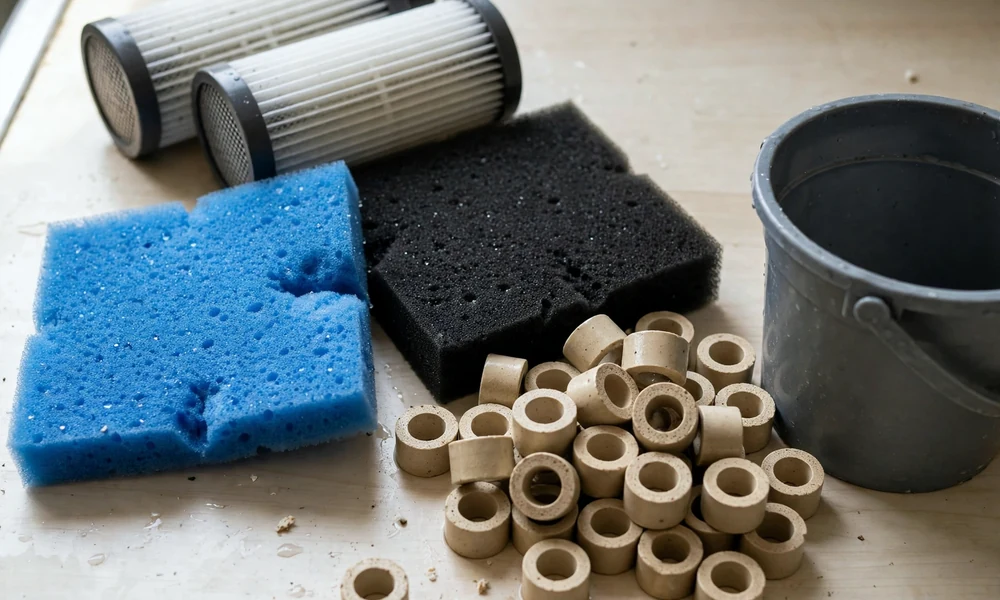
Foam is the workhorse. Coarse foam catches large debris and is easy to rinse, fine foam polishes the water, and both grow bacteria on their surfaces. Ceramic rings, bio-balls and sintered glass are biological media: their porous structure gives bacteria far more surface area than smooth plastic, so a small basket of rings supports a much larger colony than a sponge of the same size. Activated carbon is chemical media: it removes smells and yellow colour, but it exhausts after a few weeks and must then be replaced.
The order of media matters. Water should meet coarse foam first, then fine foam, then biological media, then carbon last. That way the foam catches the solids before they can clog the pores of the ceramic rings, and the bacteria get clean, oxygen-rich water. Never wash media in tap water: chlorine kills the bacteria the tank depends on. Always rinse it in a bucket of water taken from the tank during a water change.

Setting Up a New Filter
Setting up a filter well takes an afternoon, and rushing it causes most of the problems beginners blame on the filter itself. Fit the filter, fill the tank, and run it with no fish while the cycle establishes. Add a source of ammonia, either a small amount of fish food left to rot or a measured dose of pure ammonia, and test the water every few days. First ammonia rises, then nitrite rises as bacteria convert the ammonia, then nitrate appears as a second colony of bacteria grows. When ammonia and nitrite both read zero for several days running and nitrate is present, the tank is cycled and fish can be added a few at a time. Test kits are cheap and worth owning: guessing at water chemistry is how most new tanks go wrong. The whole process takes two to six weeks, and there is no safe shortcut.
Feeding, Cleaning and Everyday Care
A filter can only cope with the waste the tank produces, so feeding habits matter as much as the filter itself. Overfeeding is the single biggest cause of cloudy water and clogged filters: food that is not eaten within two or three minutes sinks, rots and feeds ammonia straight into the water. Feed small amounts once or twice a day and skip a day each week. Choosing food that suits the fish helps too, and a guide to the best fish food of 2026 explains which foods are cleanest for the water.
Clean the filter on a schedule, not when it looks dirty. Rinse foam pads every two to four weeks in old tank water, squeeze sponge filters until the water runs mostly clear, and check the impeller for hair, plant fibres or grit every couple of months. A drop in flow is the earliest warning sign: if the return stream looks weaker than usual, something is clogged, and cleaning it now is far easier than dealing with an ammonia spike later.
Mistakes to Avoid
The most common mistake is buying a filter rated exactly for the tank size and then stocking the tank to its limit. Ratings assume a lightly stocked tank. Buy one size up, or choose a model with an adjustable flow so the extra capacity can be tamed. The second mistake is turning the filter off at night because of the noise. Bacteria begin to die within hours without oxygenated water flowing over them, and a filter that is off overnight has to rebuild its colony every morning.
The third mistake is cleaning too thoroughly. Scrubbing every pad under the tap and replacing all the media in one go wipes out the bacteria and restarts the cycle, which is why fish sometimes die a few days after a big clean. Clean gently, in tank water, one part at a time. The fourth mistake is ignoring the intake. A bare intake on a strong filter can trap small fish and shrimp, so fit a pre-filter sponge and check it weekly.
The Bottom Line
The best aquarium filter is the one that fits the tank, the fish and the keeper. A sponge filter suits a betta tank, a hang-on-back filter suits a community tank, and a canister suits a large display tank, and none of them is the best choice for every setup. Choose a filter with roomy, reusable media, adjustable flow and a quiet, proven design, size it generously, cycle the tank before adding fish, and clean the media gently in old tank water. A filter that is too small will always be a chore, while one sized generously and cleaned gently will run for years. Do that, and the filter fades into the background while the fish and plants take centre stage.


