
The best walkie-talkies in 2026 do one simple job brilliantly: they keep your group talking when phones cannot. On a mountain trail with no signal, on a ski slope, at a festival, or on a work site, a pair of walkie-talkies connects you instantly, with no network, no monthly fee, and no waiting for a call to connect. You press a button, you talk, and everyone on your channel hears you. This guide explains how walkie-talkies work, compares the types worth buying, and shows you how to pick the right pair for hiking, family trips, and work.
The best pair is the one matched to your group, your terrain, and your local rules. Get those three right, and a modest pair will serve you for years.
Key Takeaways
- Walkie-talkies work with no mobile signal and no fees: press to talk, and everyone on your channel hears you.
- Ignore the headline range on the box: real range is one to three miles in hills and woods, and far more over open water.
- Licence-free radios suit families and hikers, while higher-power licensed radios suit work crews and serious outdoors use.
- Look for rechargeable batteries with AA backup, an IP54 weather rating or better, and a belt clip that stays put.
- Test every radio with your whole group before the trip, agree a channel, and carry spare batteries.
How Walkie-Talkies Work
A walkie-talkie is a two-way radio: a handheld transmitter and receiver in one unit. You press the push-to-talk button, speak, and your voice travels by radio waves to every other radio tuned to the same channel. Release the button, and you can hear replies. There is no network in between, which is why they work in valleys, forests, and basements where phones show no bars.
There are two broad types. Licence-free radios, such as FRS in the United States and PMR446 in the United Kingdom and Europe, are low power, simple to use, and legal to use straight out of the box. Higher-power radios, such as GMRS in the United States, reach further and use repeaters, but need a licence in some countries. Rules differ by country, so check the rules where you live before you buy, and never assume a radio bought abroad is legal at home.
The Best Walkie-Talkies of 2026
The picks below cover the whole range, from a simple family pair to a rugged work radio. Match the pick to your group and your terrain, not to the biggest range number on the box.
Best Overall: Licence-Free Pair with Rechargeable Batteries
The best walkie-talkies for most people in 2026 are a simple licence-free pair with rechargeable batteries and AA backup. They offer around 22 channels with privacy codes, a range of one to three miles in real terrain, and about 10 to 12 hours of battery life.
Best Long Range: Higher-Power Licensed Radio
The best long-range walkie-talkies are higher-power licensed radios, with up to 5 watts of output and access to repeater channels. In open country they reach several miles, and with a repeater they reach much further still. They suit work crews, search teams, and serious hikers who need reliable contact across a valley.
Best for Families and Kids: Compact Simple Pair
The best walkie-talkies for families and kids are small, light, and simple, with big buttons, few settings, and a bright colour that is easy to spot in a bag. They use the same licence-free channels as the best overall pair, but trade range for size and simplicity, which is the right trade for a campsite, a theme park, or a ski slope.
Best Rugged: Waterproof Radio for Work and Weather
The best rugged walkie-talkies are built for rain, dust, and drops, with an IP67 rating, a tough rubberised shell, and a battery that lasts a full working day. They suit builders, farm workers, event crews, and anyone who works outdoors in bad weather. Look for a loud speaker that cuts through engine noise, a big push-to-talk button you can find with gloves on, and a belt clip or chest harness mount.

Walkie-Talkie Comparison
| Type | Power | Real Range | Best For | Licence |
|---|---|---|---|---|
| Licence-free pair | 0.5 to 2 watts | 1 to 3 miles | Families, hiking, festivals | No |
| Higher-power radio | Up to 5 watts | Several miles | Work crews, long hikes | Sometimes |
| Compact family pair | 0.5 watts | About 1 mile | Kids, campsites, ski slopes | No |
| Rugged waterproof | 2 to 5 watts | 2 to 4 miles | Work, boats, bad weather | Depends on model |
Range: What the Box Promises vs What You Get
Range claims on the box are measured in perfect conditions: flat open ground and a straight line of sight. In woods and hills, expect one to three miles from a licence-free pair. Over open water or from a hilltop, the same radios reach far further. Height helps more than power: a radio on a ridge reaches much further than a radio in a valley. Test the range on your first day, while you can still walk back and regroup.
Batteries and Charging
Battery life decides whether your radios are still working at the end of the day. Most modern walkie-talkies use rechargeable lithium batteries and last 10 to 18 hours on a charge, depending on how much you talk. Talking uses far more power than listening. Look for a charging dock that charges both radios at once, and a USB charging option, so you can top up from a power bank on the trail.
AA battery backup is worth having, because a radio that only charges from a dock is useless when the dock is at home. Some radios take AA cells directly, and others take them in an adapter tray. Carry spare AAs in a dry bag, and keep the radio switched off when you are not using it.
Features Worth Paying For
A weather alert function is worth having if you hike or work outdoors, because it picks up official weather broadcasts and warns you of storms. VOX, or hands-free voice activation, lets you talk without pressing a button, which suits cyclists and workers with full hands, but it can trigger on wind noise, so test it before you rely on it.
Weatherproofing is measured with an IP rating: IP54 handles rain and dust, while IP67 survives brief immersion. Skip gimmicks such as built-in games: they add cost and drain the battery. For serious night use, our guide to the best flashlights of 2026 covers brighter options than a radio torch.
An earpiece is a small extra that makes a big difference on a noisy site or a quiet campsite. A simple earpiece with an inline microphone lets you hear calls without broadcasting them to everyone nearby, and it keeps the radio clipped to your belt instead of in your hand. Check the plug type before you buy, because not every earpiece fits every radio, and a cheap earpiece with a thin cable will fail first. Buy one per radio, and test it with the group before the trip.
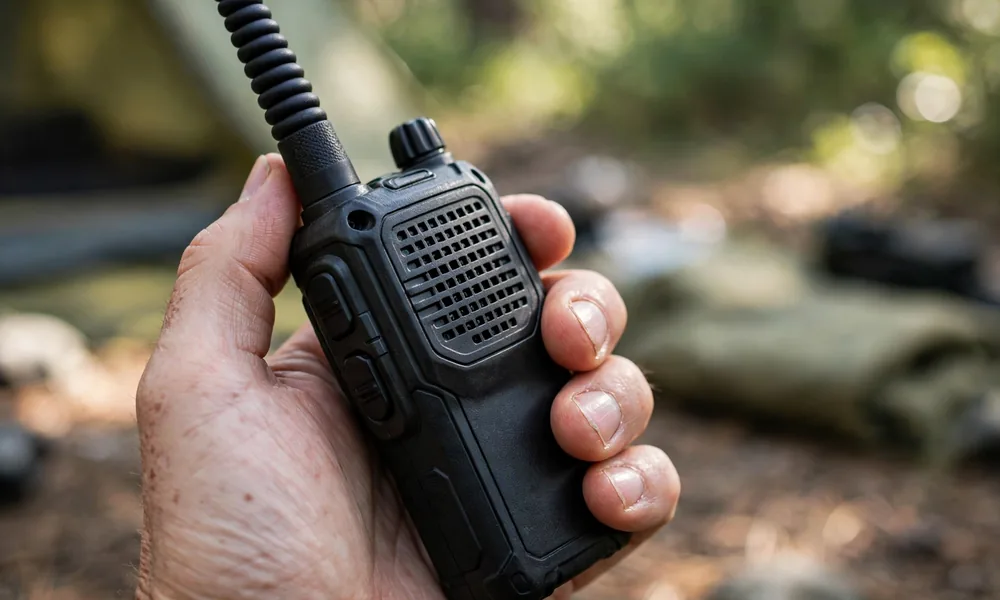
Walkie-Talkies for Hiking, Family Trips and Work
For hiking, the priorities are range, battery life, and weight. A licence-free pair with rechargeable batteries and AA backup covers most walking groups, and a higher-power radio suits groups that split across valleys. Agree a channel before you set off, do a radio check at the trailhead, and carry the radio where you can reach it without taking your pack off. Our guide to the best hiking essentials of 2026 covers the rest of the kit that belongs beside the radio.
For family trips, simplicity wins. One channel, one button, and a rule that everyone answers with their name keeps things calm at a theme park or on a ski slope. For work, the priorities flip: loud speakers, glove-friendly buttons, a full-day battery, and a clip that survives a working day.
Mistakes to Avoid When Buying Walkie-Talkies
The most common mistake is believing the range on the box. A 30-mile claim means 30 miles across flat open ground with nothing in the way, not 30 miles through hills and trees. The second mistake is buying one radio instead of a pair: a walkie-talkie is useless alone, and a pair is the minimum for any group. The third mistake is never testing them before the trip. Charge them, agree a channel, walk apart, and check they work, because a fault found at home is a fix, while a fault found on a mountain is a problem.
The fourth mistake is buying different models for different people, which means different chargers, different controls, and confusion when it matters. The fifth is forgetting the rules: some radios need a licence in some countries, and using the wrong type can get you in trouble.
The sixth mistake is buying the cheapest no-name radios you can find. Very cheap radios often use low-quality batteries, have quiet speakers, and lack basic weather sealing, so they fail exactly when you need them. Spend a little more on a known brand with a warranty, and check that spare batteries and chargers are actually available before you buy.
Walkie-Talkie Checklist
- Buy a pair, not one radio, and buy the same model for the whole group.
- Check the rules where you live: licence-free for families, licensed for higher power.
- Pick rechargeable batteries with AA backup, and a dock that charges both radios.
- Look for an IP54 weather rating or better, a loud speaker, and a solid belt clip.
- Agree one channel and a check-in routine before you set off, and test the range on day one.
- Charge the radios the night before, pack spare batteries, and keep them dry and warm.
Frequently Asked Questions
How far do walkie-talkies actually reach?
In hills and woods, expect one to three miles from a licence-free pair. Over open water or from a hilltop, the same radios reach much further.
Do walkie-talkies need a licence?
Licence-free radios such as FRS in the United States and PMR446 in the United Kingdom and Europe need no licence. Higher-power radios such as GMRS need a licence in some countries. Check the rules where you live before you buy.
Do walkie-talkies work without mobile signal?
Yes. Walkie-talkies use radio waves directly between radios, with no network in between. They work in valleys, forests, and basements where phones show no bars, and there are no fees or subscriptions.
Can different brands of walkie-talkie talk to each other?
Yes, if they use the same frequency band and channel. Licence-free radios from different brands usually work together on the same channel, though privacy codes and extra features may differ, so test mixed brands before you rely on them.
How long do walkie-talkie batteries last?
Most modern radios last 10 to 18 hours on a charge, depending on how much you talk. Talking uses far more power than listening.
Are walkie-talkies good for kids?
Yes, with a simple pair. Choose a small, light model with big buttons, few settings, and a bright colour. Teach one channel, one button, and a rule that everyone answers with their name, and set a range limit for how far children may roam.
The Bottom Line
The best walkie-talkies in 2026 are the ones your whole group can use without thinking: a simple licence-free pair for families and hikers, a higher-power radio for work crews and long hikes, and a rugged waterproof model for bad weather. Buy a pair, agree a channel, test them before you go, and charge them the night before. When the signal dies, the radios keep talking, and that is the whole point.


