
The best fitness trackers in 2026 do one job brilliantly: they watch your body around the clock and turn what they see into advice you can actually use. They count your steps, measure your heart rate day and night, break your sleep into stages, and log your workouts without you having to think about any of it. The best fitness tracker is the one you forget you are wearing — until it tells you something useful.
That is the real difference between a fitness tracker and a smartwatch. A smartwatch is a small computer that happens to track your health, while a tracker is a health device first: lighter, slimmer, cheaper, and with a battery that lasts one to two weeks instead of one to two days. If your main goal is to move more, sleep better and understand your body, a tracker is usually the better buy.
This guide compares the best fitness trackers of 2026 by what matters most for health: heart-rate accuracy, sleep tracking, workout detection, battery life, comfort, and how honest the app is about your numbers. It covers bands and rings, budget picks and premium ones, and who each tracker suits best.
Key Takeaways
- The best fitness tracker for most people is a slim band with 24/7 heart-rate tracking, sleep stages and at least seven days of battery life.
- Sleep tracking is where trackers beat smartwatches: they are light enough to wear all night and their batteries survive the night easily.
- Heart-rate accuracy matters most during exercise, so check chest-strap comparisons, not just the marketing claims.
- A tracker that auto-detects workouts is worth more than one with a hundred sport modes you will never open.
- Subscription fees change the real price: check what the app charges monthly before you buy the hardware.
How to Choose the Best Fitness Tracker in 2026
Start with what you want to change. If you want to walk more, any tracker with a good step counter and a comfortable strap will do. If you want to sleep better, you need a tracker with proper sleep stages, a light body you can wear all night, and an app that explains your sleep score in plain language. If you train seriously, you need accurate heart-rate tracking, built-in GPS or a reliable phone connection, and recovery scores that tell you when to push and when to rest. If you are still deciding between a band and a full watch, our guide to the smartwatch vs fitness band comparison explains the trade-offs in detail.
Band, Ring or Watch-Style Tracker?
Most fitness trackers are slim bands: light, cheap, and easy to forget on your wrist. Rings are the newest option, and they suit people who dislike wearing anything on their wrist, especially at night, though they cannot show notifications or start a workout with a tap. Watch-style trackers sit in between, with a bigger screen and better workout controls, but they cost more and need charging more often. For most buyers, a band is the right starting point: it does the core job for the least money and the least fuss.
Accuracy Is the Feature That Matters Most
A tracker is only useful if its numbers are right. Heart-rate accuracy has improved a lot in 2026, and the best bands now match a chest strap closely during steady exercise, though they still struggle during short, sharp intervals. Step counting is accurate on all the major brands, usually within a few percent. Sleep tracking is good at telling you how long you slept and when you woke, and reasonable at separating deep, light and REM sleep, though it is not a medical device. Treat the numbers as trends, not as exact measurements, and they will serve you well.
The Best Fitness Trackers of 2026 at a Glance
| Tracker | Best For | Battery Life | GPS | Subscription |
|---|---|---|---|---|
| Fitbit Charge 7 | Best all-round tracker | Up to 7 days | Built-in | Optional |
| Garmin Vivosmart 6 | Serious training data | Up to 14 days | Connected | None |
| Xiaomi Smart Band 10 | Best budget tracker | Up to 14 days | Built-in | None |
| Whoop 5.0 | Recovery and strain scores | Up to 14 days | Connected | Monthly |
| Oura Ring 4 | Sleep and readiness | Up to 8 days | None | Monthly |
| Samsung Galaxy Fit 3 | Android users, simple setup | Up to 13 days | Connected | None |
Sleep Tracking: The Tracker’s Greatest Strength
Sleep is where fitness trackers earn their place on your wrist. A tracker you wear every night builds a picture of your sleep that no single night can give you: how long you actually sleep, how much of it is deep sleep, when you wake, and whether your resting heart rate is trending up or down. Over weeks, that picture becomes genuinely useful, and it is the feature most tracker owners say they would miss most.

What a Good Sleep Score Tells You
The best trackers give you one sleep score each morning, built from duration, consistency, restfulness and your overnight heart rate. A score in the high eighties or nineties usually means you slept well; a score in the sixties usually means you went to bed late, drank alcohol, or trained hard the day before. The number matters less than the trend: if your score falls three nights in a row, something in your routine has changed, and the tracker is the first to notice it.
Heart Rate, All Day and All Night
Continuous heart-rate tracking is the foundation of everything a fitness tracker does. Your resting heart rate, measured while you sleep, is one of the simplest and most useful health numbers you can follow: a lower resting rate usually means better fitness, and a sudden rise often means illness, stress or overtraining is coming.
Heart-Rate Zones and Your Workouts
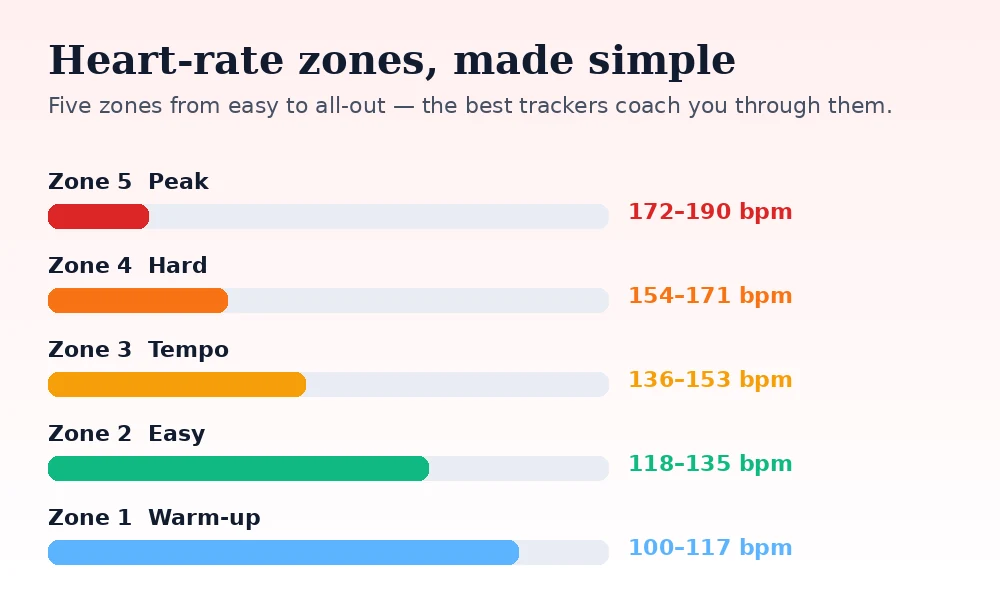
During exercise, your tracker sorts your effort into five heart-rate zones, from an easy warm-up to an all-out peak. Most training should sit in zones two and three, where you build endurance without exhausting yourself, while short efforts in zones four and five build speed and power but need recovery afterwards. The best trackers show your time in each zone after every workout and, over time, tell you whether you are training hard enough or too hard.
Workout Tracking: The Features That Actually Get Used
The best fitness trackers of 2026 detect workouts automatically. Go for a run, a walk, a swim or a ride, and the tracker notices, logs it, and asks you to confirm the details afterwards. That matters because the tracker you have to remember to start is the one you forget to start. Automatic detection, built-in GPS on the better bands, and 5 ATM water resistance mean you can train without thinking about the device at all.
For runners, built-in GPS is worth paying for: accurate pace and distance without your phone. For gym training, look for a strength mode that counts sets and rest time, and for swimmers, a pool-swim mode and a 5 ATM rating. Our guide to the best gym essentials for 2026 covers the kit that pairs well with a tracker.
Trackers vs Smartwatches: Which One Should You Buy?
The choice comes down to what you want on your wrist. A fitness tracker is lighter, cheaper, lasts a week or two on a charge, and focuses entirely on health. A smartwatch is a small computer with apps, calls and payments, but it needs charging every day or two and costs more. Runners and sleep trackers usually prefer a band; busy professionals usually prefer a watch.

Who Should Buy a Fitness Tracker
Buy a tracker if you want health data without distraction, if you hate charging devices, if you sleep with a device on your wrist, or if you want the best health tracking for the least money. A tracker is also the better choice for children and older relatives: it is simple, light, and it does not demand attention. If you run, the right shoes matter as much as the tracker: our guide to the best running shoes of 2026 pairs well with any tracker in this guide.
The Best Fitness Tracker for Your Goal
Best Tracker for Sleep
The Oura Ring 4 is the best tracker for sleep, because it is the easiest to wear all night and its readiness score is the clearest in the business. The Fitbit Charge 7 is the best band for sleep, with detailed sleep stages and a smart alarm that wakes you at the lightest point of your sleep cycle.
Best Budget Fitness Tracker
The Xiaomi Smart Band 10 is the best budget tracker by a clear margin. It costs a fraction of the premium bands, lasts up to fourteen days, has built-in GPS, and tracks sleep and heart rate well enough for most people. The screen is bright, the strap is comfortable, and there is no monthly subscription. It is the tracker to buy if you want to try tracking without spending much.
Fitness Tracker Buying Checklist
- Decide band or ring first: bands show data on your wrist, rings are lighter and better for sleep.
- Check battery life honestly: seven days is the minimum worth buying, fourteen days is ideal.
- Make sure the tracker has continuous heart-rate tracking and proper sleep stages, not just step counting.
- Check for a monthly subscription and work out the true yearly cost before you buy.
- Look for automatic workout detection and 5 ATM water resistance if you swim or train often.
- Try it on: a tracker you find uncomfortable at night will not track your sleep, which is half the point.
Frequently Asked Questions
What is the best fitness tracker in 2026?
For most people, the Fitbit Charge 7 is the best fitness tracker overall: built-in GPS, good sleep tracking, seven days of battery life and a clear app. The Garmin Vivosmart 6 is better for serious training data, the Xiaomi Smart Band 10 is the best budget choice, and the Oura Ring 4 is the best for sleep.
Are fitness trackers accurate?
Yes, for the things that matter most. Step counting is accurate within a few percent, resting heart rate is very accurate, and heart rate during steady exercise is close to a chest strap. Sleep duration is accurate and sleep stages are a good guide, though not medical grade. Treat the numbers as trends over weeks, not exact readings on any single day.
How long does a fitness tracker battery last?
Most fitness trackers last seven to fourteen days on a charge, five to ten times longer than a typical smartwatch. The Garmin Vivosmart 6, Xiaomi Smart Band 10 and Whoop 5.0 all last up to fourteen days, while the Fitbit Charge 7 lasts about seven days and the Oura Ring 4 about eight.
Do I need a subscription with a fitness tracker?
It depends on the brand. Fitbit, Garmin, Xiaomi and Samsung give you the core features for free, while Whoop and Oura charge a monthly subscription for their full scores and insights. Check the subscription cost before you buy, because it can double the real price of a cheap tracker over two years.
Can a fitness tracker track swimming?
Yes. Almost every tracker in this guide is rated 5 ATM, which is enough for pool swimming, and several have dedicated swim modes that count laps and strokes. Rinse the tracker in fresh water after swimming in a pool or the sea, and avoid hot tubs, which can damage the seals.
Is a fitness tracker better than a smartwatch for health?
For pure health tracking, yes. A tracker is lighter, lasts far longer on a charge, is easier to wear all night, and focuses entirely on health data. A smartwatch is better if you also want apps, calls and payments.
The Bottom Line
The best fitness trackers of 2026 prove that you do not need a big screen or a daily charging ritual to understand your health. A light band on your wrist, worn day and night, tells you how you sleep, how hard you train, and whether your body is recovering or asking for rest. Pick the tracker that matches your goal, wear it every day for a month, and the data will start to change how you live.


