The Fountain Pump That Keeps Garden Water Moving in 2026
The best fountain pump is the small machine that turns still water into moving water, and it is the part of a garden fountain that matters most. Without one, a fountain is just a stone bowl. This guide explains how they work, which types suit which fountain, and how to size one.
Key Takeaways
- Match the pump to the fountain: flow rate and lift height decide how high the water sprays.
- A submersible mains pump is the best all-round buy.
- Solar pumps suit small sunny fountains and bird baths, but they slow on cloudy days and stop at night.
- Choose a pump with a flow adjuster, so you can turn the spray down on a windy day.
- Keep the intake clean and the water topped up.
What a Fountain Pump Is, and What It Is Not
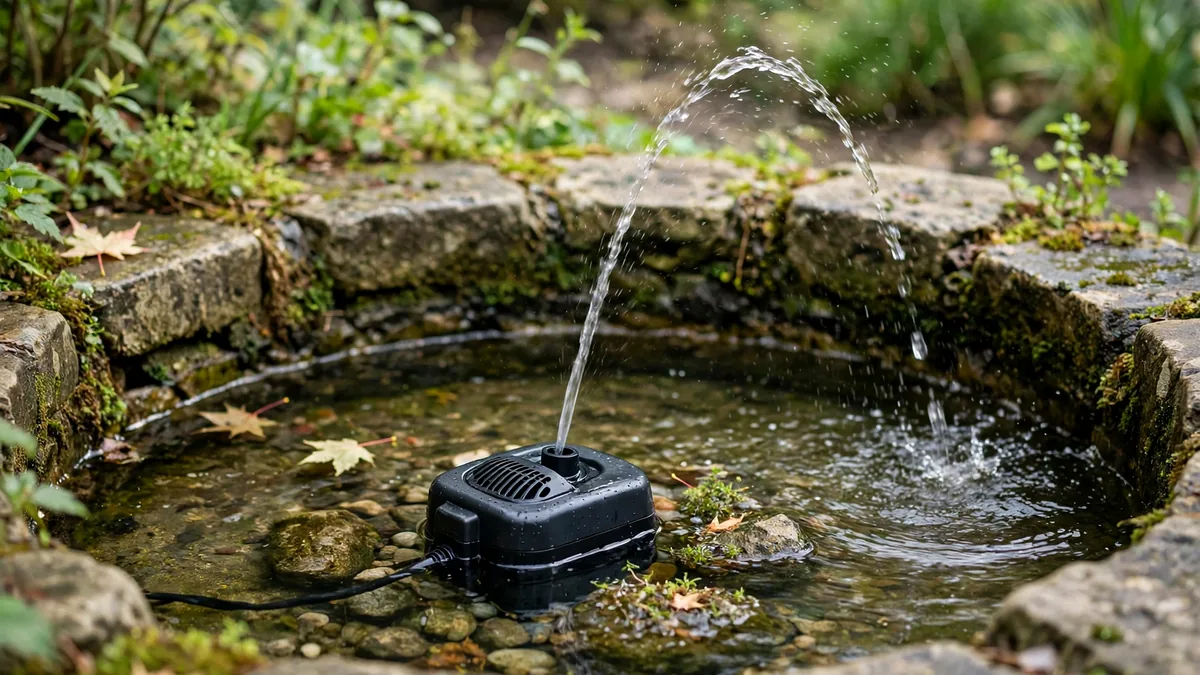
A fountain pump is a small water pump that sits in the basin of a fountain and pushes water up through a nozzle, so it sprays, arcs, or bubbles back down into the basin. Most are submersible, sitting underwater, and made for moving clean water in a display rather than filtering a pond. Water loops from the intake, through the spray head, and back into the basin.
It is not a pond pump, although the two look alike. A pond pump circulates pond water through a filter to keep it clear and oxygenated, and our guide to the best pond pumps covers that job in full, with a fountain pump as one small row in its table. A fountain pump does a different job: it lifts water into the air for a display, judged on flow rate, lift height, and spray shape. It is not a garden fountain either: the fountain is the whole feature, while the pump is the part inside that moves the water. Our guide to the best garden fountains covers the feature itself.
The Main Types of Fountain Pump
Almost every fountain pump falls into one of four designs, and the design decides where it can sit, what powers it, and how much water it can lift.
Submersible Mains Pumps
A submersible mains pump is the standard choice, and the best all-round buy for most garden fountains. It sits on the bottom of the basin, plugs into a weatherproof outdoor socket, and runs steadily day and night, in sun and in rain. Underwater it runs quietly, and the spray stays the same height all day. Look for a flow adjuster, a mesh intake cage, and a cable long enough to reach your socket. The trade-off is the cable, which must be buried or clipped out of the way.
Solar Fountain Pumps
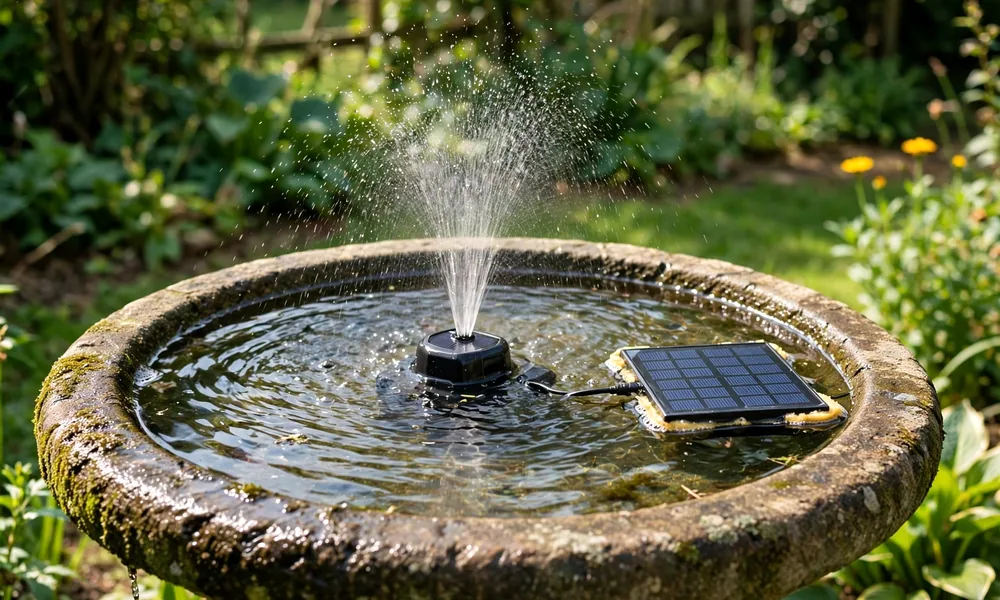
A solar fountain pump is the simplest pump to own, and the best choice for a small sunny fountain, a bird bath, or a container pond far from the house. A small panel powers the pump, or charges a battery for the evening, with no cable to bury and no running cost. The trade-off is the sun: on a cloudy day the spray weakens, in shade it may not start, and at night it stops unless the model has a battery. It suits a gentle bubbling spray.
External Pumps
An external pump sits outside the water, usually in a dry housing beside the fountain, and it suits large fountains and long pipe runs. Not limited by the size of the basin, it can move far more water and lift it higher, which is what a tall tiered fountain needs. It is also easier to service. The trade-off is cost and setup: it costs more, needs a weatherproof shelter and proper plumbing, and is louder than a submersible pump.
Tabletop and Container Pumps
A tabletop pump is a very small submersible pump made for indoor fountains, tabletop water features, and small container ponds. It is quiet, uses very little power, and pushes a gentle bubble or a low trickle over stones. The trade-off is power: it cannot lift water more than a few centimetres, and it clogs easily if the water has grit or leaves in it. It suits a table or a shelf, not anything outdoors that needs a real spray.
How to Size a Fountain Pump
Sizing comes down to two numbers, both printed on the box. The first is the flow rate, usually in litres per hour, which says how much water the pump moves. The second is the maximum lift height, sometimes called the head, which says how high the pump can push water. High flow with low lift gives a weak spray; high lift with low flow gives a thin jet. For a small basin fountain, 400 to 800 litres per hour with a lift of about one metre is usually enough. For a medium tiered fountain, look for 1,000 to 2,000 litres per hour with a lift of 1.5 metres or more.
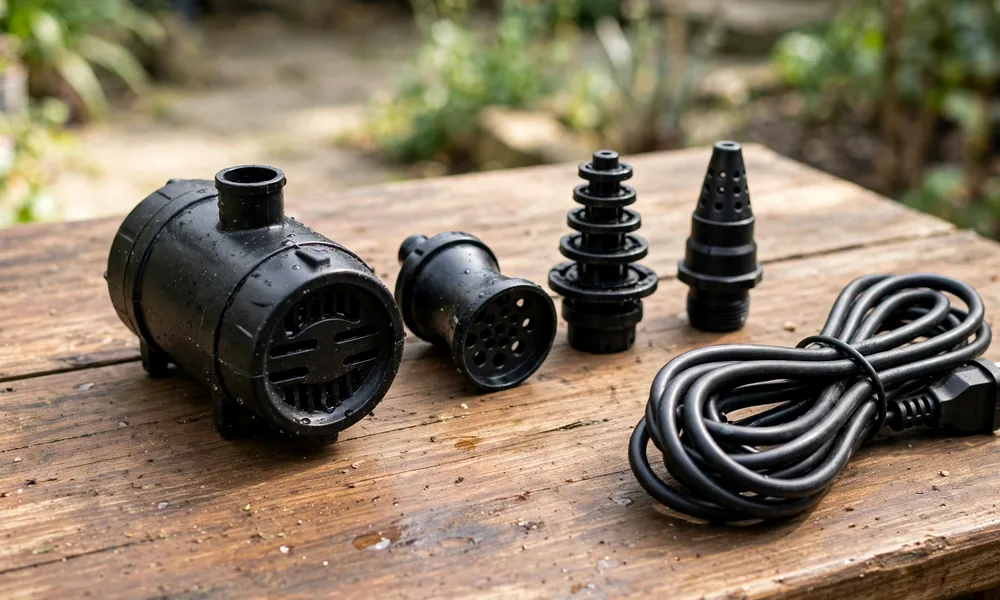
The spray head matters as much as the pump. Most pumps come with two or three nozzles: a single jet that throws a tall thin stream, a bell head that makes a wide umbrella of water, and a tiered head that makes several small arcs. A tall jet needs the most lift, a bell head needs a steady flow but less height, and a bubbling head needs almost no lift. Try the heads before you settle. In wind, a tall spray blows sideways and drains the basin, so turn the flow down.
Fountain Pump Types, Compared
| Type | Best for | Strengths | Watch out for |
|---|---|---|---|
| Submersible mains pump | Most garden fountains | Steady flow, quiet, runs in any weather | Needs an outdoor socket and a buried cable |
| Solar pump | Small sunny fountains, bird baths | No running cost, no cable, easy to move | Weak on cloudy days, stops at night without a battery |
| External pump | Large fountains, long pipe runs | Powerful, high lift, easy to service | Costs more, needs shelter and plumbing, louder |
| Tabletop pump | Indoor fountains, small containers | Quiet, tiny, very low power | Very low lift, clogs easily, indoor use only |
What to Look For When Buying
A flow adjuster is the single most useful feature: it lets you match the spray to the day, turning it down in wind and up for a party, without buying a new pump. A dry-run guard is the second most useful: it switches the pump off if the water level falls too low, which saves the motor from burning out in a single hot afternoon. Not every pump has one, but the ones that do are worth the extra money.
The intake is the third thing to check. A good pump has a mesh cage or a foam pre-filter around the intake, which stops leaves, grit, and algae from reaching the impeller, and the cage should come off easily for cleaning, because you will clean it every few weeks in summer. Fourth, cable length: measure from the basin to your socket, add a metre for safe routing, and buy a pump whose cable reaches. A submersible pump should be almost silent under water.
Setting Up and Placing the Pump
Set the pump on a flat, stable base at the bottom of the basin, not balanced on pebbles where it can tip over. A flat slab or rubber mat steadies it on an uneven floor. Put the spray head on before you switch the pump on, start with the flow adjuster turned low, and raise it slowly until the spray looks right and the water stays inside the basin. Turn it down or swap the nozzle until the water falls back into the basin even in a light breeze.
Place the fountain where you can see and hear it from your favourite seat, and where the pump is easy to reach for cleaning. A pump you cannot reach without wading is a pump that stays clogged. Keep the cable clipped along the basin edge.
Care and Common Mistakes
A fountain pump needs very little care, but it needs it regularly. Clean the intake cage every two or three weeks in summer, when algae grows fastest, by lifting the pump out and rinsing the cage under a hose. Top the water up often in hot weather: a basin losing a few centimetres a day runs dry in a week. In winter, keep it running so the water does not freeze, or store it dry indoors.
The biggest mistake is buying a pump that is too small, because the spray never rises high enough and there is no fix except a new pump. The second is the opposite: a pump so strong that it empties the basin onto the paving, fixed by turning the flow down, but only if the pump has a flow adjuster. The third is forgetting that a sunny fountain evaporates faster and needs topping up daily in a heatwave. For clear pond water as well as a display, our guide to the best outdoor fountains explains how the two work together.

Before You Buy: A Six-Point Checklist
- Measure the lift you need, from the pump to the top of the spray, and buy a pump whose maximum lift is higher.
- Check the flow rate in litres per hour, and buy a little more than you need so you can turn it down.
- Make sure the pump has a flow adjuster and, if you can, a dry-run guard for low water.
- Check the intake cage comes off easily for cleaning.
- Measure the cable: it must reach your outdoor socket with a metre to spare for safe routing.
- Try the spray heads in the box before you choose.
Frequently Asked Questions
How do I know what size fountain pump I need?
Measure the lift first, from the pump to the top of the spray, then pick a pump whose maximum lift is higher than that. A small basin needs 400 to 800 litres per hour, a medium tiered fountain needs 1,000 to 2,000,
Can a fountain pump run all day?
A mains submersible pump is made to run all day, and most run quietly for years with a clean intake and topped-up water. A solar pump runs only while the sun shines.
Why has my fountain pump gone weak?
The usual cause is a clogged intake: leaves, algae, and grit block the mesh cage and starve the pump of water. Lift the pump out, rinse the cage, and check the impeller spins freely. If it is still weak, the impeller may be worn or the pump too small for the lift.
Do solar fountain pumps work on cloudy days?
They work, but weakly. A solar pump without a battery slows as the light fades and stops in heavy cloud or at night. A model with a battery keeps the spray going into the evening.
Can I use a fountain pump in a pond?
You can use one to make a spray in a pond, and many pond owners do, but it will not filter the pond or keep the water clear. That is a pond pump’s job. In a pond it is a decoration; the pond still needs a proper pump and filter.
Should I leave the pump running in winter?
Either keep it running, so the moving water resists freezing, or take it out, clean it, and store it dry indoors until spring. What damages a pump is sitting frozen or in dirty water all winter.
The Bottom Line
The best fountain pump is the one that matches your fountain: enough lift to reach the spray height you want, enough flow to make the spray look full, a flow adjuster to tame it on windy days, and a dry-run guard to save it when the basin runs low. For most gardens that means a submersible mains pump with a mesh intake and a spare set of nozzles,