The best grandfather clocks in 2026 are the tallest, slowest and most deliberate purchase most people will ever make for their home. A grandfather clock does not just tell the time: it stands in a hallway or living room for decades, chiming through the house, becoming part of the room. Choosing one is less like buying a gadget, more like choosing furniture that keeps time. This guide explains how to choose a grandfather clock that fits your home, your ceiling and your tolerance for chimes.
A grandfather clock, also called a longcase clock, is a floor-standing clock with a tall wooden case, a pendulum and gravity-driven weights. The case is usually 180 to 240 cm tall, the pendulum swings behind a glass door, and the chime sounds hourly and quarterly. Modern clocks use quartz as well as mechanical movements, and the choice decides how much care the clock needs. The rest is about the room: a flat floor, a wall to lean against, enough ceiling height, and a household that enjoys hearing it chime.
Key Takeaways
- Measure the ceiling first: most stand between 180 and 240 cm tall and need at least 5 cm of clearance above the case.
- Mechanical movements need weekly winding and servicing; quartz needs a battery and almost no care.
- Westminster is the classic chime; check it can be silenced at night before you buy.
- Match the case wood to the room: warm oak and mahogany suit classic rooms, lighter woods suit modern ones.
- Buy for the room it will stand in for decades, not the one you imagine redecorating next year.

Start With the Room, Not the Clock
Every good decision starts with the room, because the clock is nearly two metres tall and cannot be tucked away. Measure the ceiling first: most are 180 to 210 cm tall, and taller models reach 230 or 240 cm, so a standard 240 cm ceiling leaves only a few centimetres above the tallest. Allow at least 5 cm above the case; coving and picture rails eat into the height too. Next, measure the floor: the clock needs a flat, level stretch at least 60 cm wide against a wall, and it should never stand on thick carpet, because an uneven case makes the pendulum swing unevenly, which stops the clock. Hard floors are ideal. Light matters too: a clock opposite a bright window is hard to read and its wood fades, so a wall beside the window suits it better. And think about sound: the chime carries, so a hallway clock beside a bedroom will be heard at night. Our guide to the best wall clocks covers the smaller end of the same decision.
Mechanical or Quartz: The Movement Decision
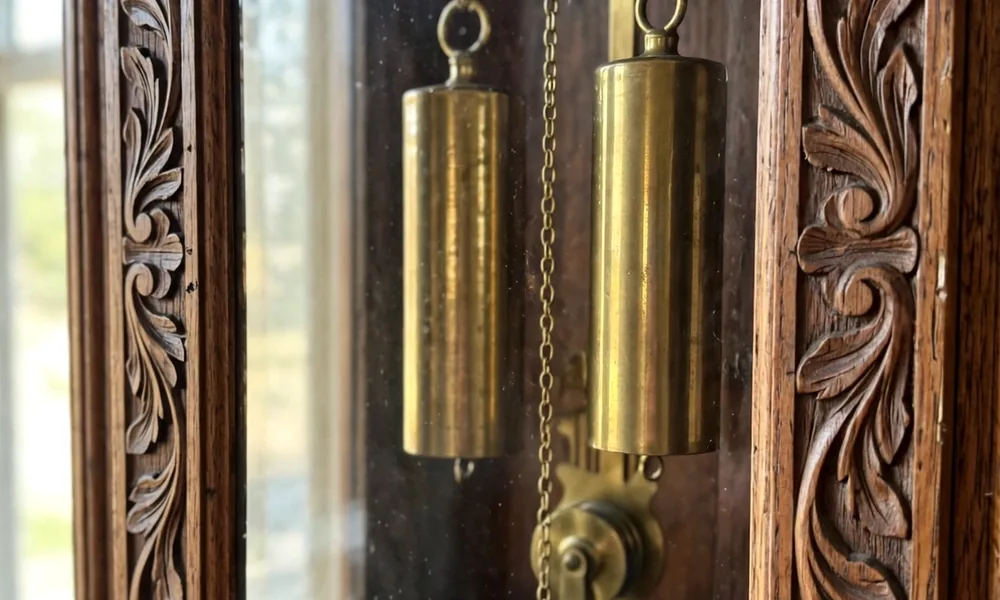
The movement is the heart of the clock, and the mechanical-or-quartz choice decides how it behaves for twenty years. A mechanical movement is driven by weights on chains or cables, regulated by a pendulum, wound by hand once a week. It is the traditional choice: an audible, steady tick, a chime struck by real hammers on real rods, and a clock that can be serviced for generations. The cost is care: weekly winding, levelling so the pendulum beats evenly, and a service every five to eight years. A quartz movement is driven by a battery and regulated by a crystal, needing almost nothing: a new battery every year or two. The tick is usually silent, the chime a recording through a small speaker, and the timekeeping more accurate than a mechanical clock. The compromise is character: a quartz clock looks the same from across the room, but up close the sound is thinner and the pendulum often decorative. Choose mechanical if you enjoy winding and want a clock to hand down; choose quartz for the look without the weekly commitment.
The Main Types of Grandfather Clock
Grandfather clocks fall into a few families, differing in style, sound and height. Knowing the family narrows the choice to the two or three clocks that belong in your room.
Traditional Longcase Clocks
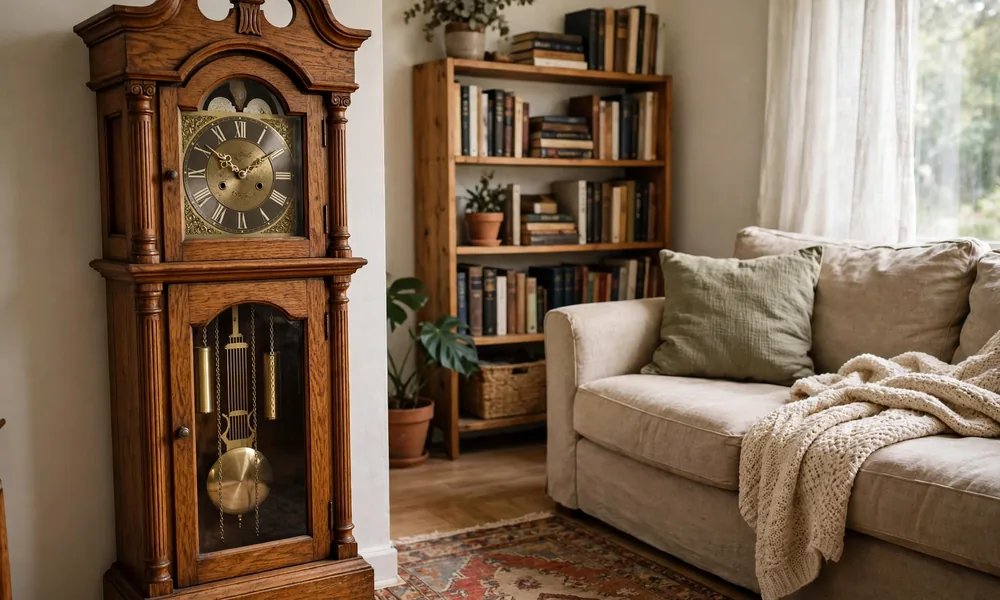
The traditional longcase clock is the shape most people picture: a tall wooden case with a hooded top, a round or arched dial, and a glazed door showing pendulum and weights. The case is usually mahogany, oak or walnut, the dial brass or painted, and the chime Westminster. They are the tallest, often 210 to 240 cm, suiting hallways, dining rooms and classic living rooms with high ceilings. They are also the most demanding: most are mechanical, needing weekly winding and a level floor, and hardest to fit under a modern ceiling.
Contemporary Grandfather Clocks
Contemporary clocks keep the height and pendulum but simplify everything else: flat panels instead of carving, lighter woods or painted finishes, a plain dial, often a quartz movement. They stand 180 to 210 cm tall, fitting under standard ceilings more easily, and suit modern living rooms where a traditional case would look too formal. The chime is usually Westminster with a night silence setting, and the lighter case moves more easily. If your room is modern and your ceiling standard height, a contemporary clock is the safer fit.
Chiming and Musical Clocks
Some clocks go beyond a simple chime: a triple-chime clock offers Westminster, St Michael and Whittington melodies on a selector, and a musical clock plays a short tune on the hour. These are the most enjoyable to live with and the most complicated to choose, because extra melodies need more rods and hammers. Before buying any chiming clock, check three things: the chime can be silenced at night, the volume can be adjusted, and the selector is easy to reach without opening the case. A chime you cannot silence will be silenced by disconnecting it, which wastes the best part of the clock.
Curio and Cabinet Grandfather Clocks
Curio clocks add glass side panels or shelves, so the clock doubles as a display cabinet for porcelain or glassware. They are wider than a standard longcase, usually 60 to 70 cm, suiting living rooms where the clock is furniture as much as timekeeper. The trade-off is dust on the glass, shelves that need cleaning, and a wider case that needs more wall. Buy a curio clock if you have something to display and a room wide enough to show it; otherwise the standard case is cleaner.
Size, Chime and Case: What to Check Before You Buy
Size is the first check and the easiest to get wrong: a clock that looks right in a showroom can dominate a hallway at home. Measure the ceiling and the wall width, and mark the footprint on the floor with tape before you order. A clock too tall for the ceiling cannot be shortened, and it will sit in the box until it is returned. The chime is the second check: Westminster is the classic four-note sequence and the safest choice, because it is familiar and easy to live with. Triple chimes add variety, and a silent night setting is a necessity in any house where a bedroom is near the clock. Listen to the chime before you buy if you can: a recording flatters every chime, and one that sounds rich in a shop can sound thin in a hallway. The case is the third check: solid wood ages gracefully and can be repaired, while veneer is lighter and cheaper but chips at the edges. Match the wood to the room: mahogany and dark walnut suit dark furniture, oak suits light wood, and a painted case suits a modern room. Finally, check the dial: Roman numerals suit a traditional case and read well across a room, Arabic numerals suit a contemporary case, and a moonphase dial is a classic extra that costs little. Our guide to the best table clocks explains how the same choices play out at a smaller scale.
Grandfather Clocks at a Glance
| Feature | Traditional Longcase | Contemporary | Quartz |
|---|---|---|---|
| Typical height | 210 to 240 cm | 180 to 210 cm | 180 to 210 cm |
| Movement | Mechanical, weekly winding | Mechanical or quartz | Quartz, battery |
| Chime | Westminster, often triple | Westminster, night silence | Recorded, adjustable |
| Best room | Hallway, classic living room | Modern living room | Any room, low care |
| Care needed | Weekly winding, service | Moderate | Battery every year or two |
| Suits | Heirloom buyers | First-time buyers | Busy households |
Where a Grandfather Clock Belongs, and Where It Does Not
A grandfather clock belongs in a room with height, a flat floor and a household that likes hearing the time. Hallways are the classic home: the clock fills a tall blank wall, is heard throughout the house, and greets everyone who comes in. Living rooms work well too, especially beside a fireplace or a bookshelf, where the clock anchors one end of the room. Dining rooms suit a clock that chimes on the quarter hour, because the sound marks the meal without interrupting it. A grandfather clock does not belong in a bedroom, because the chime will wake light sleepers even with a night silence setting, nor in a room with thick carpet, a sloping floor or a ceiling under 235 cm for the tallest cases. It also does not belong in a house that is moved often: the clock is heavy, must travel upright with weights and pendulum removed, and every move risks the movement. If you rent, or you expect to move within a few years, a table clock or a wall clock is the wiser buy. Our guide to the best desk clocks covers the smallest end of the same family, for rooms where a tall case will never fit.
Grandfather Clock Buying Checklist
- Measure the ceiling and allow at least 5 cm of clearance above the case.
- Check the floor is flat and hard, and level the clock with its feet.
- Decide mechanical or quartz before you fall in love with a case style.
- Confirm the chime can be silenced at night and the volume can be adjusted.
- Match the case wood to the room’s furniture, not to the clock alone.
- Check delivery: the clock must travel upright with weights and pendulum removed.
Frequently Asked Questions
How tall is a grandfather clock?
Most stand between 180 and 210 cm, and traditional longcase clocks reach 230 to 240 cm. Measure your ceiling and allow at least 5 cm above the case, because the tallest do not fit under a standard 240 cm ceiling once coving is counted.
Do grandfather clocks need winding?
Mechanical clocks need winding once a week, by pulling the chains or turning a crank. Quartz clocks need only a battery every year or two and no winding at all, which is why they suit busy households.
Can the chime be turned off at night?
Almost all modern clocks have a night silence setting that stops the chime between about 10 pm and 7 am. Check this before you buy, because a chime you cannot silence is a clock you will stop enjoying.
Can a grandfather clock stand on carpet?
Thick carpet is a poor base, because an uneven case makes the pendulum swing unevenly, which stops the clock. A hard floor is ideal.
How often does a mechanical grandfather clock need servicing?
Every five to eight years, by a clockmaker who can clean and oil the movement. Regular servicing keeps a mechanical clock running for decades.
Is a grandfather clock a good investment?
A well-made mechanical clock from a respected maker holds its value and can be handed down, but most modern clocks are bought for the pleasure of living with them. Buy the clock you love for the room it will stand in, not as an investment.
Bottom Line
The best grandfather clocks in 2026 are bought with a tape measure first and a heart second. Measure the ceiling, check the floor, choose mechanical for the ritual or quartz for the ease, and make sure the chime can be silenced at night. Done right, a grandfather clock is the one purchase in the room that still matters in twenty years.