How to Choose Closet Shelves That Hold More Without Sagging in 2026
The best closet shelves of 2026 do not give you a bigger closet. They give you the closet you already have, used properly. A closet shelf is a flat board that turns empty air into folded storage, and most closets waste that air completely: one high shelf piled with whatever did not fit anywhere else, and nothing in between. Fill the gaps with shelves at the right heights, and the same small closet suddenly holds jumpers, jeans, bedding and boxes without a single item on the floor.
The mistake most people make is buying shelves by looks alone. A closet shelf only works when the board is deep enough for folded clothes, strong enough for the load, spaced for what you actually fold, and fixed to a wall that can hold it. This guide covers the shelf types worth buying, the materials that hold up, and the spacing that keeps stacks standing.
Key Takeaways
- Measure the closet first: width, depth and height, and the height of the rail, before buying any shelf.
- A shelf about 30 to 35 centimetres deep holds folded clothes without wasting space or letting stacks overhang.
- Keep spans under 80 centimetres for a loaded shelf, or add a centre bracket, because long boards sag.
- Adjustable shelves beat fixed shelves where contents change with the seasons.
- One category per shelf keeps the system working; a shelf with no job becomes a junk pile within a month.
Why Most Closets Waste Their Shelves
Look at a standard closet. There is one rail, about chest height, with clothes hanging from it. Above the rail is a single shelf, usually piled with whatever did not fit anywhere else. Below the hanging clothes is the floor, where shoes gather in a heap. The closet is full, but half of its volume is air: the air above the hanging clothes, the air between the rail and the shelf, and the air on the shelf itself, where one tall stack leaves the rest of the space empty.
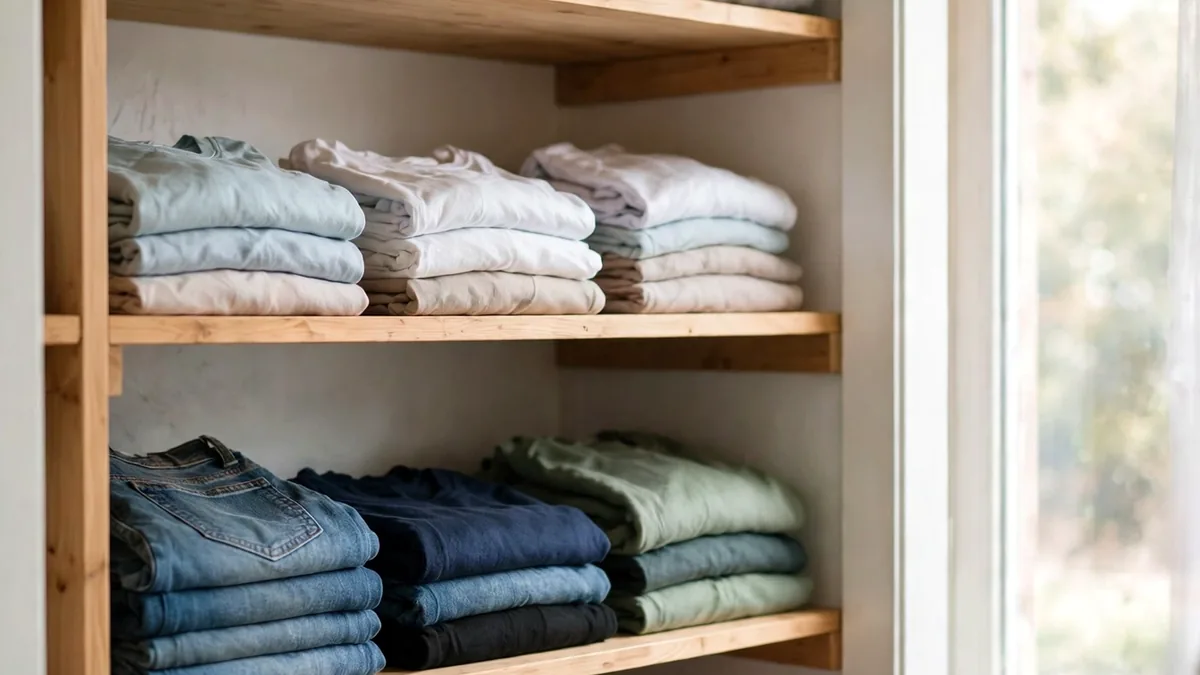
Closet shelves work by claiming that air. A shelf above the rail holds folded jumpers at a height you can reach. A shelf below short jackets turns the dead zone under them into a home for shoes or boxes. Two or three shelves at the right spacing hold more folded clothes than a chest of drawers, because every centimetre of height is used and nothing hides behind anything else. None of this needs a carpenter, and none of it needs drilling into a wall you do not own, if you choose the right fixings.
The Main Types of Closet Shelves
The right closet shelf depends on how wide the closet is, what you fold, and whether you can drill into the wall. Most closets need a mix rather than a single type,
Fixed Wood Shelves
A fixed wood shelf is a solid board screwed to brackets or side supports, and it is the strongest option for a heavy load. A 25-millimetre pine or plywood board on two good brackets holds a stack of jeans, a pile of bedding or a row of boxes without complaint, The price is permanence: once it is fixed, moving it means filling holes and repainting,
Wire Shelves
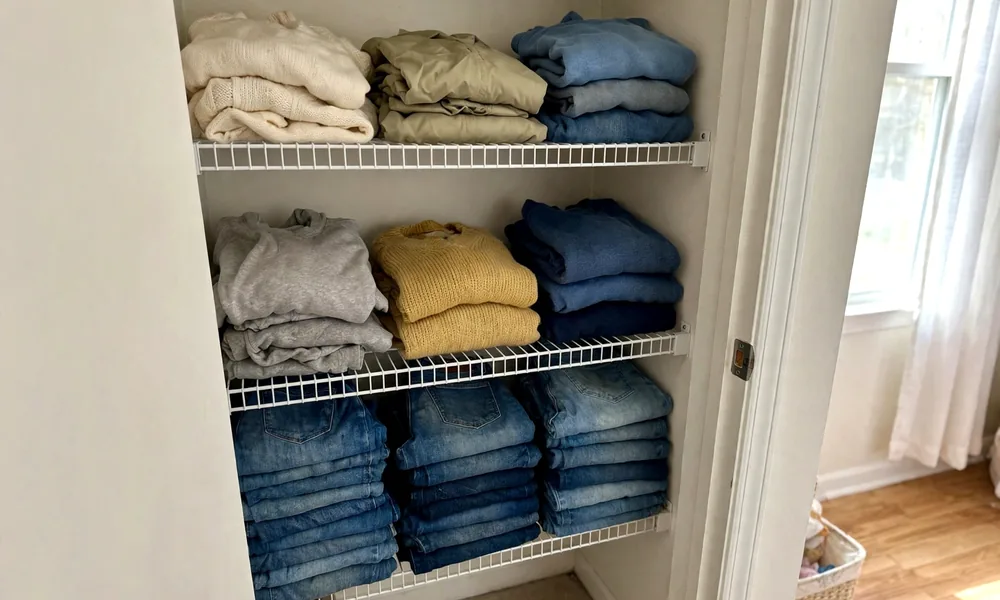
A wire shelf is a grid of coated steel rods, and it is the cheapest way to add a lot of shelf quickly. Wire lets air move through, so folded clothes stay fresh, The trade-off is the grid itself: small items slip through, and folded stacks leave ridges on the bottom layer.
Adjustable Shelves on Wall Standards
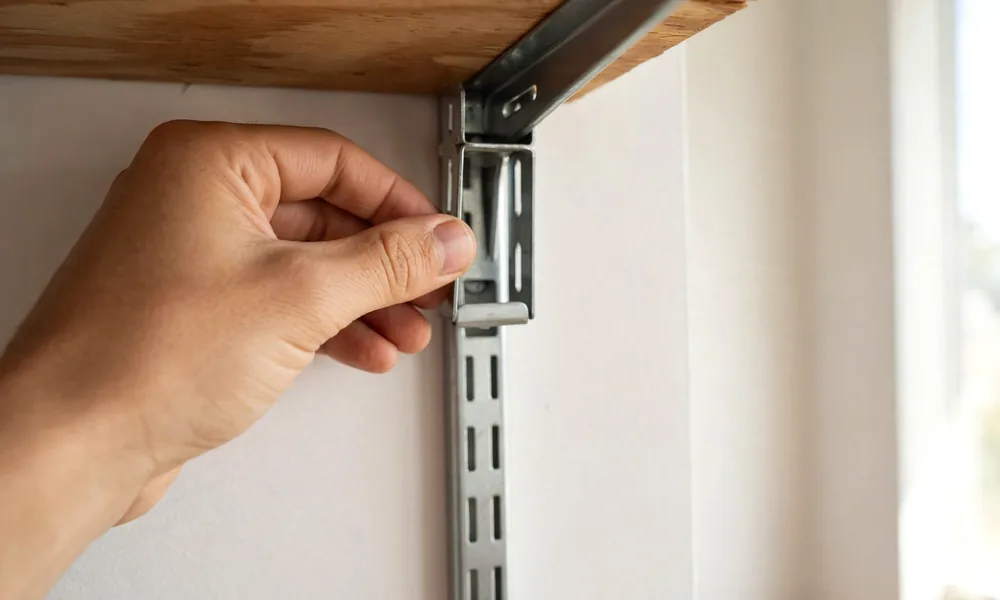
Adjustable shelves hang on slotted metal standards fixed to the wall, with brackets that slot in at any height. This is the most flexible option, and the one to choose if the closet contents change with the seasons: move the brackets up for winter jumpers, down for summer shirts, and the shelf follows. Buy steel brackets, not plastic.
Laminate and Melamine Shelves
A laminate shelf is a chipboard core wrapped in a hard, wipe-clean skin, usually white, and it is the shelf most flat-pack closet systems use. The skin chips at the edges if it is cut or knocked, and the board sags faster than solid wood over a long span, so keep spans short and put an edge strip on any cut end.
Pull-Out Shelves and Trays
A pull-out shelf slides out on runners like a shallow drawer, and it solves the one problem fixed shelves cannot: reaching the back. Folded clothes at the back of a deep shelf are forgotten, but a pull-out tray brings them to you. Pull-outs suit deep closets and high shelves you cannot see into, and the bottom of the closet, where a sliding tray holds shoes or bags.
Closet Shelves Compared
| Type | Best for | Load | Flexibility | Watch out for |
|---|---|---|---|---|
| Fixed wood | Heavy stacks, top shelf | High | Low | Permanent holes |
| Wire | Cheap, quick extra shelves | Medium | Medium | Needs a liner |
| Adjustable on standards | Changing contents | High | High | Bracket quality |
| Laminate | Matching systems | Medium | Low | Sags on long spans |
| Pull-out tray | Deep or high shelves | Medium | Medium | Cost and fitting |
Materials That Hold Up
The board matters more than the bracket, because a good bracket cannot save a board that bends. Solid pine is the forgiving choice: it is light, easy to cut, takes paint well, and a 25-millimetre board holds a heavy stack without sagging over an 80-centimetre span. Plywood is stronger still, and an 18-millimetre plywood board with a solid front edge carries as much as a thicker pine board while staying flat.
Coated steel wire is the lightest option and the only one that lets air through, which matters in a damp closet. Laminate boards are the tidy option, and their weakness is the edge: an unsealed cut edge drinks in moisture and swells, so every cut end needs an iron-on edge strip.
Getting the Size and Spacing Right
Depth first. A folded jumper stack is about 28 to 30 centimetres deep, a folded pair of jeans about 30, and a stack of bedding about 35. A shelf 30 to 35 centimetres deep holds all of them without wasting space at the back, and it leaves no overhang at the front.
Spacing second. The gap between shelves should match the stack, not the wall. Folded shirts need about 25 centimetres, folded jumpers about 30, and a stack of bedding about 35. Leave a hand’s width above the top item, so you can lift it out without dragging the stack, and no more, because every extra centimetre is a centimetre of storage wasted.
Span third, and this is the one people get wrong. A shelf is a bridge, and a bridge sags in the middle. An 18-millimetre laminate board sags under jeans at a span of 90 centimetres within a year; a 25-millimetre pine board holds the same load at 80 centimetres without complaint. Keep spans under 80 centimetres for a loaded shelf, and if the closet is wider than that, add a centre bracket or a vertical divider.
Installing Without Wrecking a Rented Closet
Renters can have good closet shelves, but the fixings have to come out cleanly. The simplest option is a freestanding shelf unit that stands inside the closet and touches no wall at all: a narrow tower of shelves that fits the closet width, holds folded clothes on every level, and moves out with you.
If the walls are yours to drill, fix into studs wherever you can, and use proper hollow-wall anchors where you cannot. Keep the shelf level with a spirit level, not your eye, because a shelf that slopes by even a few millimetres sends every stack sliding slowly towards the low end.
Closet Shelves and the Rest of the Closet
Shelves are one part of a closet, not the whole of it. Hanging clothes still belong on a rail, and a good closet gives each its own zone: hanging above, folding on the shelves, shoes on the floor or a low shelf, and small things in boxes or drawers. The best way to plan it is to count what you own before you buy anything, because a closet full of jumpers needs shelves and a closet full of dresses needs rail. A full closet organizer system ties those zones together.
The same thinking applies to the furniture around the closet. A wardrobe is a freestanding closet, and its shelves follow the same rules for depth, span and spacing, so the advice here works inside one too. Display shelves are a different job: floating shelves trade load for looks. Keep the jobs separate: closet shelves carry weight, display shelves carry the eye.
Common Mistakes to Avoid
The first mistake is buying the shelf before measuring the closet. Closet widths are rarely the round numbers on the packet, and a shelf cut a centimetre too long does not fit, while a shelf a centimetre too short leaves a gap that swallows socks. The second mistake is one long shelf across a wide closet with no centre support.
The third mistake is spacing shelves for the wall instead of the stack. Even gaps look tidy on a drawing and waste space in real life, because a 40-centimetre gap above a 25-centimetre stack is 15 centimetres of nothing. The fourth mistake is overloading the top shelf, which pulls brackets out of the wall. Keep the top shelf light.

Your Closet Shelf Checklist
- Measure width, depth and height at three points, and cut to the smallest width.
- Choose 30 to 35 centimetre depth for folded clothes, 35 for bedding.
- Keep loaded spans under 80 centimetres, with a centre bracket or divider on wider closets.
- Pick adjustable standards if the closet contents change with the seasons.
- Fix into studs or proper hollow-wall anchors, never a single screw in bare plasterboard.
- Leave a hand’s width above each stack, and one category per shelf.
Frequently Asked Questions
How deep should closet shelves be?
About 30 to 35 centimetres for folded clothes, and 35 for bedding. A folded jumper stack is roughly 28 to 30 centimetres deep, so a 30-centimetre shelf holds it with nothing hanging over the front and nothing lost at the back.
How far apart should closet shelves be?
Match the gap to the stack: about 25 centimetres for folded shirts, 30 for jumpers, and 35 for bedding. Leave a hand’s width above the top item so you can lift it out without dragging the stack.
Why do my closet shelves sag?
Usually the span is too long for the board. An 18-millimetre laminate board sags under jeans at 90 centimetres, while a 25-millimetre pine board holds at 80. Add a centre bracket or a vertical divider, use a thicker board, or shorten the span.
Are wire closet shelves any good?
Yes, for light and medium loads, with a liner. Wire lets air through, so clothes stay fresh, and it is cheap and quick to fit. Without a liner, small items slip through and folded stacks take the shape of the grid.
Can I put closet shelves in a rented home?
Yes. A freestanding shelf unit inside the closet needs no fixings at all, and adjustable shelves on standards come down cleanly with only small holes to fill.
Should I hang or fold my jumpers?
Fold them. Knitwear stretches on a hanger and loses its shape at the shoulders, while a folded stack on a shelf keeps it flat. Hang shirts, blouses and dresses, and fold jumpers, jeans, T-shirts and bedding.
The Bottom Line
A good closet shelf is a board at the right depth, at the right height, fixed to a wall that can hold it. Measure the closet, keep spans under 80 centimetres, space each shelf for the stack that sits on it, and choose adjustable standards if the contents change with the seasons. Done right, the closet you already have holds twice as much.