
Best Grill Covers 2026
A grill left uncovered does not age gracefully. Rain finds every seam, sun fades the paint and dries out the seals, and a single winter of freeze and thaw can turn a smooth lid into a patchwork of rust. The cover is the cheapest part of the whole setup, and it is the part that decides how long the expensive part lasts.
Get the cover right, though, and a grill that would have rusted in three years can cook happily for ten. These are the best grill covers of 2026, chosen for fit, waterproofing, breathability, and the small details that keep a cover on in a storm instead of halfway down the garden.
Key Takeaways
- Measure the grill before you shop, because a cover that is too tight tears at the seams and a cover that is too loose flaps, fills with rain, and blows away.
- Waterproof is not the same as breathable, since a cover that traps damp air underneath will grow mould and rust the grill it was meant to protect.
- Heavy vinyl suits wet, windy gardens, while canvas and woven polyester suit hot, sunny patios where a plastic cover would crack and stick.
- Look for vents, a drawstring hem, and straps or buckles, because those three details decide whether the cover stays put and stays dry inside.
- Let the grill cool completely before covering it, and take the cover off to air the grill after heavy rain, so trapped moisture never sits against the metal.
Grill Covers 2026 at a Glance
| Best for | Cover type | Material | Standout strength |
|---|---|---|---|
| Best overall | Fitted heavy-duty cover | Vinyl over polyester | Rainproof, tough, and stays put in wind |
| Best for charcoal grills | Kettle cover | Polyester with lining | Snug round fit with a drawstring hem |
| Best for gas grills | Cart-style cover | Heavy vinyl | Covers the shelves and wheels as well |
| Best for sunny patios | Canvas cover | Woven canvas | Breathes in heat and resists fading |
| Best for small grills | Compact cover | Light polyester | Light, cheap, and easy to fold away |
| Best for winter storage | Thick insulated cover | Layered polyester | Extra padding against frost and knocks |
What a Grill Cover Is Really For
A grill cover does four jobs at once. First, it keeps rain off the burners, the grates, and the grease tray, where standing water starts rust. Second, it blocks sun, which fades paint, dries out rubber seals, and makes plastic handles brittle. Third, it keeps out leaves, dust, pollen, and bird droppings, so the grill is clean when you want to cook. Fourth, it stops wind-blown grit scratching the finish every time a gust rattles the lid.
It helps to know the difference between a cover and the grill it protects. The grill itself is the cooking machine, and our guide to the best grills for backyard cooking in 2026 covers kettles, gas models, and the rest. A cover is the protection around that machine, and the right choice depends on your grill, your climate, and where the grill lives.
Getting the Size Right
Size is where most grill cover purchases go wrong. Measure the grill, not the box it came in, and measure it the way the cover will see it: width from the widest point, including side shelves if they stay on, depth from the front to the back, and height from the ground or the wheels to the top of the closed lid. Write the three numbers down before you open a single product page.
A good rule is to buy a cover two to five centimetres larger than the grill in each direction. That gap is enough to slide the cover on without a fight, and small enough that the cover does not billow like a sail. If your grill has side shelves that fold down, measure with them folded if that is how you store it, and measure with them up if they stay up. A cover bought for the folded size will never fit the open one.
The Main Types of Grill Cover
Grill covers fall into a handful of types, and each suits a different kind of grill and garden. The right choice depends less on taste than on the shape of your grill and the weather it has to survive.
The fitted heavy-duty cover is the safest choice for most homes: a thick, shaped cover with a drawstring hem and straps, made to fit one size range closely. Its strength is weatherproofing, so rain runs off and wind cannot lift it. Its weakness is weight, since a heavy cover is awkward to fold and store when you grill every day in summer.
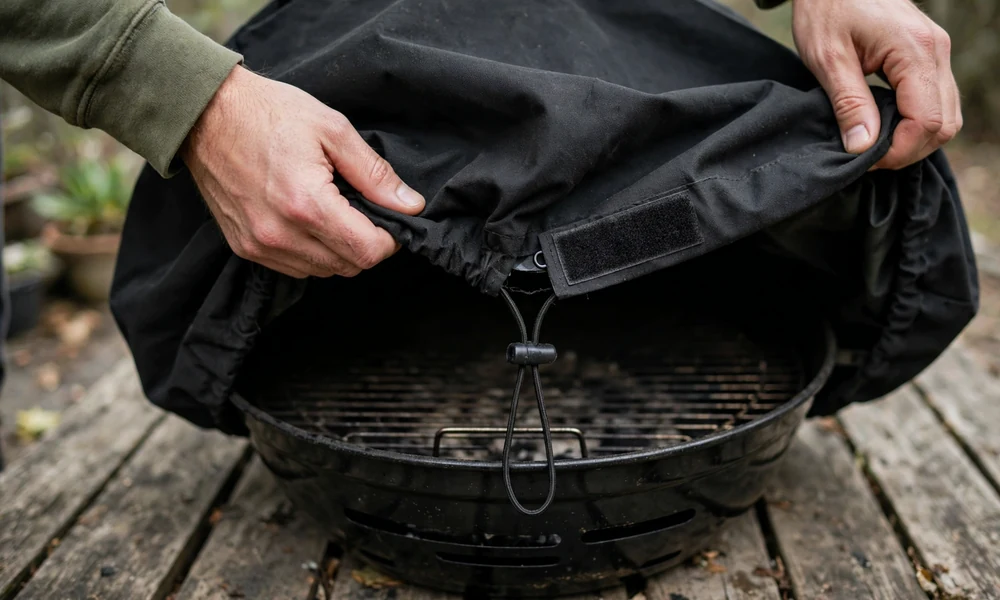
The kettle cover is the round, compact version, shaped for charcoal kettles and small round grills. It is light, cheap, and easy to pull on and off, which matters when you grill three times a week. The trade-off is coverage, so check that it reaches low enough to cover the legs and the ash catcher, not just the lid.
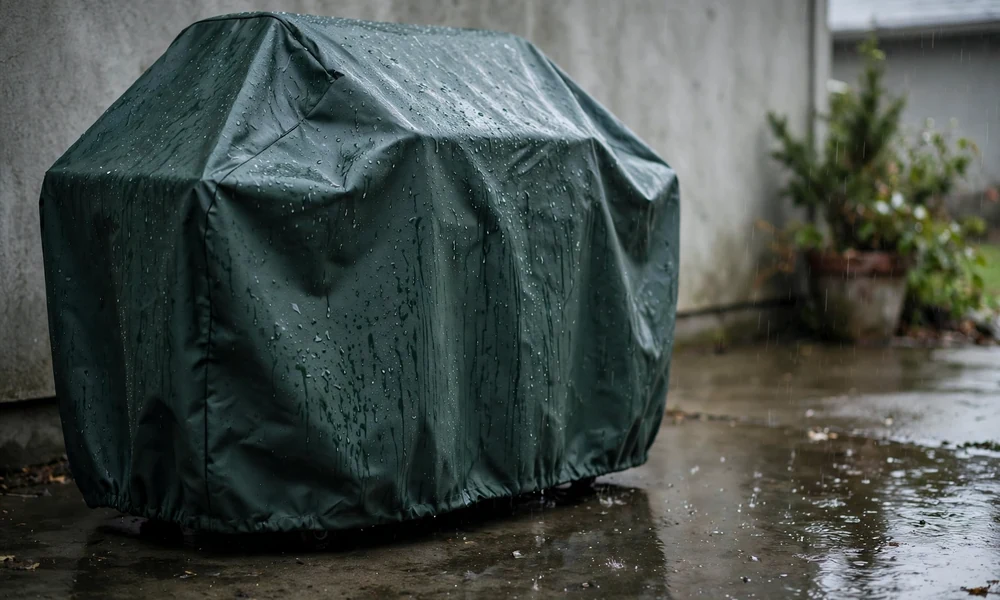
The cart-style cover is the answer to a gas grill on wheels. It is tall and boxy, with room for side shelves, a warming rack, and the wheels underneath, and it usually has a front opening or a flap so you can reach the gas bottle without taking the whole cover off. Cart covers are the most likely to pool water on a flat top, so look for a peaked or sloped top that sheds rain.
Covers for smokers, flat-top griddles, and portable grills are the specialist options. A smoker cover needs height and a chimney opening that does not let rain in, a griddle cover needs a flat top that does not sag onto the cooking surface, and a portable cover needs to fold small enough to travel. If you would rather start with the grill itself, our guide to the best charcoal grills of 2026 covers kettles, kamados, and portable models, so you can match the cover to the grill you actually own.
Materials and Build Quality
Vinyl over polyester is the classic choice, and it earns its place. The vinyl outer layer sheds rain, the polyester backing gives it strength, and the combination is tough enough to survive being dragged across a patio. Vinyl can crack in hard frost and go sticky in strong sun, though, so in very hot gardens it needs shade or a lighter cover for summer.
Waterproofing, Breathability, and Vents
Waterproofing is the headline, but breathability is the quiet half of the job. A cover that is fully sealed keeps rain out and also keeps damp air in, and damp air trapped against warm metal is exactly how rust starts. The best covers solve this with vents: small mesh panels near the top or the sides that let air move without letting rain in.
Fit, Straps, and Staying Put in Wind
A cover that blows off in the first gale is worse than no cover, because it leaves the grill exposed and the cover itself tangled in the fence. The fix is a hem that cinches tight and straps that hold it down. A drawstring hem is the minimum, and it should pull the bottom of the cover in snugly around the legs or the wheels, not just gather loosely.

Buckle straps are the next step up. Two straps that clip underneath the grill, or hook onto the legs, will hold a cover through a storm that would lift a drawstring-only cover clean off. Velcro tabs are quicker but weaker, and they clog with dust and lose their grip after a season. If your garden is exposed to wind, choose straps over Velcro, and check that the straps are long enough to reach under your grill without straining.
Care, Cleaning, and Winter Storage
A grill cover needs care of its own, and a little of it goes a long way. Hose the cover down once a month in summer, brush off leaves and bird droppings before they stain, and let it dry fully in the sun before you put it back on. A damp cover put straight back on a damp grill is a mould farm, and mould stains fabric and smells for weeks.
Before You Buy: A Short Checklist
- Measure the grill’s width, depth, and height, including side shelves and wheels, and buy a cover two to five centimetres larger.
- Check the shape against your grill, so a kettle gets a round cover and a cart grill gets a boxy one.
- Look for double-stitched, taped or welded seams, and a waterproof rating rather than just water-resistant.
- Check for vents on both sides, so damp air can escape and the grill stays dry underneath.
- Look for a drawstring hem and buckle straps, and check the straps reach under your grill.
- Choose the material for your climate: vinyl for wet gardens, canvas for hot sun, layered polyester for frost.
- Test the weight and the fold, and confirm you can pull the cover on and off with one hand.
Frequently Asked Questions
Can I leave a grill cover on all winter? Yes, if the grill is clean, dry, and cool before you cover it, and the cover has vents and straps. Brush snow off the top before it melts, and take the cover off to air the grill after heavy rain, so trapped moisture never sits against the metal.
Do I need a different cover for a charcoal grill? Yes, in shape at least. A charcoal kettle needs a round cover that follows its curve, while a gas grill on a cart needs a tall, boxy cover. The material rules are the same, and a good kettle cover is light enough to pull on and off several times a week.
How do I clean a grill cover? Hose it down, brush off leaves and droppings, and wash it with mild soap and water, then let it dry fully in the sun before putting it back on. Do not put a vinyl cover in a washing machine, and do not fold it while it is still damp.
The Bottom Line
The best grill cover of 2026 is the one that fits your grill, suits your weather, and stays on in a storm, and then quietly disappears into the background. It is a few centimetres larger than the grill, waterproof on the outside, vented on the inside, and held down by a drawstring and straps you can trust.
Start with the tape measure, not the catalogue. Measure the grill, note the shape and the shelves, think about your rain, sun, and wind, and then choose the type that fits: a heavy fitted cover for a wet garden, a kettle cover for a charcoal grill, a cart cover for a gas grill, or a canvas cover for a sunny patio. The right cover will not make the food taste better, but it will make sure the grill is still there to cook it, year after year. And when the grill itself needs attention, our guide to the best BBQ tools for grilling in 2026 covers the brushes, tongs, and starters that keep a covered grill in good working order.


