
Best Snorkel Masks 2026
A snorkel mask decides whether an hour in the water feels like floating over another world or like wrestling with a leaking window. When the seal is right, the glass stays clear, the strap sits flat, and you forget the mask is there at all. When it is wrong, every breath fogs the lens, salt water creeps in at the corners, and the reef below becomes a blur you keep wiping at.
The masks below are the best snorkel masks of 2026 for ordinary holiday snorkelling, chosen for fit, field of view, fog resistance, and comfort over a long swim. They cover the two big families, full-face masks and classic two-window masks, and the guide explains which one suits your face, your swimming, and the water you will be in.
Key Takeaways
- Fit beats brand every time, because a mask that seals on your face in the shop is the only one that will seal in the sea.
- Full-face masks suit relaxed surface snorkelling and easy breathing through the nose, while two-window masks suit divers, stronger swimmers, and anyone who wants to duck under.
- Tempered glass, a soft silicone skirt, and a dry-top snorkel are the three features worth paying for on almost any mask.
- Test a mask without the strap first, since a good seal holds for a few seconds on suction alone when you breathe in gently through your nose.
- Rinse the mask in fresh water after every swim, keep it out of direct sun, and store it flat so the skirt keeps its shape.
Snorkel Masks 2026 at a Glance
| Best for | Mask type | Snorkel | Standout strength |
|---|---|---|---|
| Best overall | Full-face mask | Built-in dry top | Wide view and natural breathing |
| Best for beginners | Full-face mask | Built-in dry top | Nothing to learn, just breathe |
| Best for diving down | Low-volume two-window | Separate dry-top snorkel | Easy to clear and equalise |
| Best for glasses wearers | Two-window, optical-ready | Separate dry-top snorkel | Prescription lenses can be fitted |
| Best for travel | Compact two-window | Folding dry-top snorkel | Packs flat in a small bag |
| Best for wide faces | Wide-skirt two-window | Separate dry-top snorkel | Soft skirt seals on broader cheeks |
What a Snorkel Mask Is Really For
A snorkel mask does two simple jobs, and both of them matter. It holds a pocket of air in front of your eyes so you can see clearly underwater, and it keeps salt water out of your nose while you breathe through the snorkel. Everything else, the shape of the lens, the softness of the skirt, the valves and the strap, exists to make those two jobs easier.
It also helps to know what a snorkel mask is not. It is not a swimming goggle, which is a small, tight pair of cups made for laps in a pool, with no nose pocket and no snorkel attached. Our guide to the best swim goggles of 2026 covers that very different piece of kit. A snorkel mask covers the eyes and the nose, seals against the whole face, and is built for looking down at a reef for an hour at a time.
Full-Face or Two-Window: The First Choice
The full-face mask is the newer design, and it has changed snorkelling for nervous swimmers. One large curved lens covers the eyes and the mouth, and you breathe in and out through your nose and mouth exactly as you do on land. The view is wide, almost panoramic, and there is no mouthpiece to hold between your teeth, which many first-timers find far more relaxing.
The classic two-window mask is the older design, and it is still the choice of stronger swimmers and anyone who dives. Two separate lenses sit in a frame with a soft nose pocket, and the snorkel is a separate tube held by a clip. You breathe through your mouth, pinch your nose through the pocket to equalise, and clear the mask with a sharp breath out through your nose.

Fit: The Test That Matters Most
Fit is the whole game, and the test takes ten seconds. Hold the mask against your face without putting the strap on, look up slightly, and breathe in gently through your nose. A good mask will stay put on suction alone for a few seconds. A mask that falls off at once, or that only seals when you press it hard, will leak in the water no matter how much you tighten the strap.
Fog, Leaks and Clearing the Mask
Fog is the most common complaint, and it is almost always preventable. New masks ship with a thin film on the inside of the lens, and that film fogs at once. Wash the lens with a drop of washing-up liquid or a specialist mask cleaner before the first swim, rinse it well, and the fogging drops away. A little spit or a drop of anti-fog solution rubbed over the dry lens before each swim does the rest.
Clearing a two-window mask is a skill worth learning on dry land. Tilt your head back slightly, press the top of the frame against your forehead, and breathe out firmly through your nose. The water is pushed out through the bottom of the skirt or the purge valve. Practice it in shallow water until it feels automatic, because the moment you need it is the moment you least want to be thinking about it.
Snorkels, Valves and Dry Tops
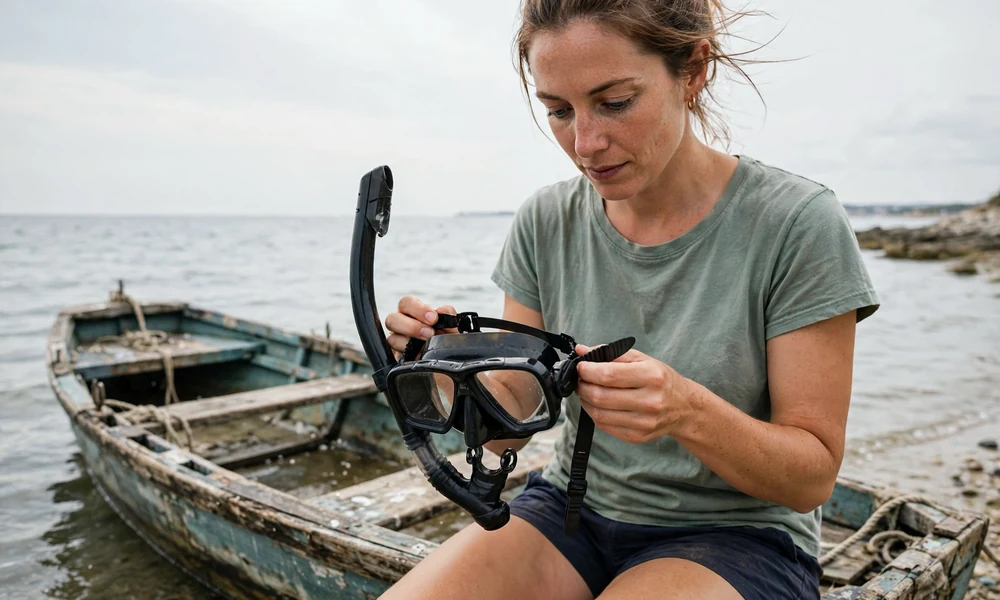
The snorkel matters as much as the mask, and the single most useful feature is a dry top. A dry-top valve closes when a wave washes over the tube, so you do not get a mouthful of sea water every time the surface chops up. On a calm day you will barely notice it. On a breezy day, or when a boat goes past, it is the difference between a relaxed swim and a coughing fit.
Lenses, Prescription and Seeing Clearly
Tempered glass is the standard to insist on. It resists scratches far better than plastic, stays clear for years, and is the safe choice if the lens is ever knocked hard. Plastic lenses scratch on the first grain of sand, and a scratched lens fogs and glares in a way no cleaner will fix. Check the box for the words tempered glass before you pay.
Clear lenses suit most snorkelling, since the water itself filters the light and a tinted lens only makes a dim reef dimmer. A camera changes that calculation, because a good underwater photograph needs the mask out of the way and the light doing its work. If you plan to film your swim, our guide to the best action cameras of 2026 covers the tough, waterproof models that pair well with a snorkel mask and a calm reef.
Comfort, Straps and Skirts
Silicone is the skirt material to look for, and the softer the better. A soft skirt moulds to the small differences between one face and another, while a stiff skirt only seals on the face it was moulded for. Press the skirt between your fingers in the shop. If it folds easily and springs back, it will probably seal well. If it feels firm and plasticky, it will probably leak on anyone whose face is not exactly average.
Try the mask with the snorkel attached before you buy, because the clip and the tube change how the strap sits. Breathe through the mouthpiece for a minute in the shop, and notice whether the tube pulls at one side or the mouthpiece feels large against your teeth. A mouthpiece that feels bulky on land will feel worse after an hour in the water, so a small, soft mouthpiece is worth choosing deliberately.
Who Should Buy Which Mask
First-time snorkellers on a beach holiday are the people full-face masks were made for. If you can swim, can float, and want to look at fish without learning a new breathing technique, a full-face mask removes the hardest part of the experience. Choose one with a dry top, a chin valve, and a size that genuinely fits, and stay in water where you can stand up.
Confident swimmers, divers, and anyone snorkelling from a boat over deeper water should look at a low-volume two-window mask. Low volume means the lenses sit close to the eyes, so there is less air to clear and less pressure to equalise on the way down. It is the mask that grows with you, from a first reef swim to a lifetime of snorkelling trips.
Care, Packing and Travel
A snorkel mask lasts for years if it is treated gently, and for one season if it is not. Rinse it in fresh water after every swim, including the snorkel tube, and let it dry in the shade before you pack it. Salt left to dry on the skirt stiffens the silicone, and sun left to bake the lens clouds it over time.
Packing for a snorkel trip is a short list, and the mask sits at the top of it. Fins, a rash guard or swim top, sun cream that is safe for reefs, and a dry bag for the walk back cover most of it. The rest of the kit is ordinary beach wear, and our guide to the best swimwear of 2026 is a useful place to sort the swim top and shorts before you think about the mask at all.
What to Skip and How to Choose
Skip the cheapest mask on the shelf, because a mask is not the place to save a few pounds. A bargain mask usually has a stiff skirt, a plastic lens, and a snorkel with no dry top, which is three reasons to leak, fog, and swallow water in a single purchase. Spend the difference on the mask and save it on something that does not sit on your face.
Skip any mask you have not tried on, and skip any mask sold as one size fits all. Faces are not one size, and a mask that fits everyone fits no one well. If you are buying online, order two sizes, test both with the suction test, and return the one that does not seal. The return postage is cheaper than a ruined swim.
Use a short checklist before you pay. Tempered glass, soft silicone skirt, dry-top snorkel, a purge valve, and a strap you can adjust with one hand. If a mask ticks all five and passes the suction test on your face, it is almost certainly a good buy, whatever the brand on the box.
The Bottom Line
The best snorkel mask of 2026 is the one that seals on your face, stays clear for an hour, and lets you forget about it while you watch the reef. For most holiday snorkellers that will be a full-face mask, and for everyone who dives down or swims further out it will be a low-volume two-window mask with a dry-top snorkel. Try both, trust the suction test, rinse the mask after every swim, and the reef will do the rest.


