Best Bird Houses 2026
A bird house is a small box with a big job. Put the right one in the right place and a pair of blue tits or chickadees will move in within weeks, raise a brood through the spring, and come back the following year. Put the wrong one up and it will sit empty all summer, or worse, it will attract a bird and then fail it when the rain comes in or a cat reaches the nest.
The difference between those two outcomes is rarely the price. It is the size of the entrance hole, the depth of the box, the wood it is made from, and where it hangs. These are the best bird houses of 2026, chosen for the birds they actually suit, the way they stand up to weather, and how easy they are to clean out at the end of the season.
Key Takeaways
- The entrance hole decides which birds can move in, because a 25-millimetre hole admits blue tits and keeps house sparrows out, while a 32-millimetre hole suits great tits and chickadees.
- Untreated cedar or pine is the best material for a bird house, since it insulates the nest, weathers slowly, and needs no paint or stain inside the box.
- Hang the house between 1.5 and 3 metres high, facing between north and east, so the entrance stays out of the hottest afternoon sun and the driving rain.
- A house with no perch, a metal hole guard, and a baffle below it is far safer than a pretty house with a perch, because perches help predators far more than they help nesting birds.
- Clean the house out every autumn, because old nests harbour parasites and damp, and a clean box is far more likely to be used again next spring.
Bird Houses 2026 at a Glance
| Best for | House type | Entrance hole | Standout strength |
|---|---|---|---|
| Best overall | Classic cedar box | 25 mm | Warm, dry, and suited to blue tits |
| Best for larger birds | Deep box, 32 mm hole | 32 mm | Room for great tits and chickadees |
| Best for robins | Open-front house | Open front | Shelf and roof suit robins and wrens |
| Best for purple martins | Gourd house | 54 mm | Rounded shape martins prefer |
| Best for small gardens | Compact wall-mounted box | 25 mm | Fits a fence or wall with no post |
| Best for families | House with a viewing panel | 28 mm | Watch the nest without disturbing it |
What a Bird House Is Really For
It also helps to keep the jobs separate. A house is for nesting, and a feeder is for eating, and the two should not be confused. Our guide to bird feeders that bring the birds without bringing the squirrels covers the feeding side in detail, and a garden with both food and shelter will always attract more birds than a garden with only one of them.
The Entrance Hole Decides Everything
If you remember one number from this guide, make it the entrance hole. A 25-millimetre hole admits blue tits, marsh tits, and coal tits, and it keeps out house sparrows, which are bigger and bolder and will take over a box meant for a smaller bird. A 28-millimetre hole admits great tits as well, and a 32-millimetre hole suits chickadees, nuthatches, and downy woodpeckers. Go up to 45 millimetres and starlings can get in, and at 54 millimetres you are building for purple martins.
Do not buy a house with a perch below the hole. It looks helpful, and it is one of the most persistent myths in garden birding. Nesting birds do not need a perch to enter their own house, since they can cling to the wood around the hole. A perch is far more useful to a sparrow trying to peer inside, a jay trying to reach the eggs, or a squirrel trying to widen the hole. A plain front with a rough surface the birds can grip is better in every way.
The Main Types of Bird House
The classic box is the safest choice for most gardens: a simple wooden box with a sloping roof, a round entrance hole, and a hinged side or roof for cleaning. It suits blue tits and great tits, it is easy to make well, and it lasts for years if the wood is thick enough. Look for walls at least 15 millimetres thick, since thin walls let the nest chill on cold spring nights.
The open-front house is the answer for robins and wrens, which do not like entering a dark hole. It is a box with the top half of the front left open, a small shelf inside, and a roof that overhangs the opening to keep the rain out. Hang it low, about 1.5 metres high, in a sheltered spot among shrubs, since robins nest close to cover and like to slip in and out unseen.

One bird that will never use any of these is the hummingbird. Hummingbirds build tiny cup nests of moss and spider silk on a branch, and no box will tempt them inside. If hummingbirds are the birds you want to see, a feeder is the way to attract them, and our guide to the best hummingbird feeders of 2026 explains which designs keep nectar fresh and which ones leak.
Materials and Build Quality
Untreated wood is the best material for a bird house, and cedar is the best of the woods. It is naturally resistant to rot, it insulates well, and it weathers to a soft grey without any treatment. Pine is the cheaper alternative and works well if the boards are thick, though it will not last as long as cedar. Rough-sawn timber is better than planed timber on the inside, since the chicks need something to grip as they climb toward the hole.
Where to Put It: Height, Direction, and Cover
Height is the first decision, and the right height depends on the bird. Small tits are happy between 1.5 and 3 metres, robins prefer about 1.5 metres in thick cover, and woodpeckers like a box higher up, at 3 to 5 metres. Higher is not always better: a box hung too high is hard to check and clean, and a box hung at eye level in a quiet corner will often be used sooner than a box nailed to the top of a tall tree.
Direction matters almost as much. Face the entrance between north and east, so the morning sun warms the box and the hot afternoon sun never shines straight through the hole. Avoid facing the entrance into the prevailing wind, since driving rain will soak the nest, and avoid a spot where the box is in full sun all day. A little dappled shade from a nearby tree is ideal.
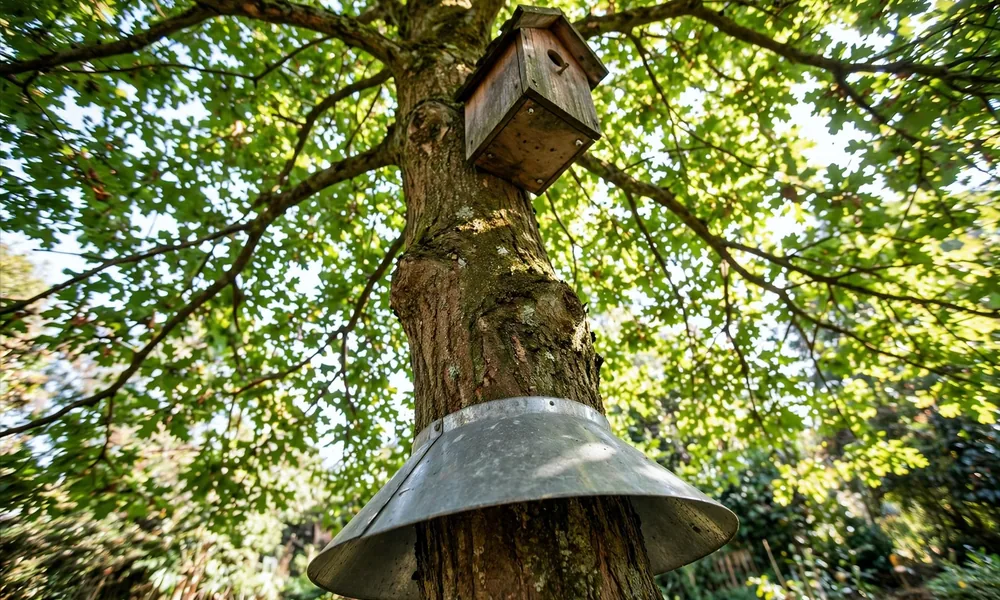
Cover is the third part of the decision. Birds want to be near bushes and trees so they can dart to safety, but they do not want the box hidden inside a thicket where a cat can wait unseen. The best spot is a few metres from cover, with a clear flight path to the entrance and a perch nearby where the parents can watch for danger. Do not hang two boxes for the same species close together, since tits are territorial and will fight over neighbouring boxes, but boxes for different species can sit quite close.
Water nearby helps too. Birds that nest in your garden still need to drink and bathe every day, and a reliable supply of clean water will keep them coming back long after the chicks have fledged. Our guide to why a bird bath brings more birds to the garden explains how to choose a bath and where to put it so the birds feel safe using it.
Predators, Weather, Ventilation, and Drainage
A bird house is a promise of safety, and predators will test it. Cats are the biggest threat in most gardens, and the best defence is height, a smooth pole or trunk with no footholds, and a baffle: a wide metal cone or cylinder fitted around the post below the box that a cat or squirrel cannot climb past. A metal plate around the entrance hole stops squirrels and woodpeckers widening it, and it is a cheap addition worth having on any wooden box.
Cleaning and the Annual Clean-Out
Cleaning is the chore that separates a house that is used once from a house that is used for years. Old nests harbour fleas, mites, and bacteria, and a box left full of damp material through the winter is a cold, unhealthy place to raise chicks. Clean the box out every autumn, once you are sure the birds have finished nesting, and never clean it out while birds are still using it.

Common Mistakes to Avoid
The most common mistake is buying a house with a perch below the hole, which helps predators and not the nesting bird. The second is choosing the entrance hole by looks rather than by species, so the box is taken over by sparrows or ignored altogether. The third is hanging the box in full sun facing south or west, where the nest bakes on a hot afternoon. The fourth is using a thin, painted, or plastic house that sweats, chills, or falls apart after one winter.
Before You Buy: A Short Checklist
- Choose the bird first, then the entrance hole: 25 millimetres for blue tits, 28 for great tits, 32 for chickadees and nuthatches.
- Pick untreated cedar or thick pine with walls at least 15 millimetres thick, and leave the inside bare and rough.
- Check the roof overhangs the front by five centimetres and the floor has drainage holes.
- Make sure the roof or side opens for cleaning, and that the fixings are screws, not nails.
- Hang the house 1.5 to 3 metres high, facing north to east, a few metres from cover.
- Fit a metal hole guard and a baffle below the box if cats or squirrels visit your garden.
- Clean the box out every October, and leave it up all winter for roosting birds.
Frequently Asked Questions
What size entrance hole do I need for blue tits? A 25-millimetre hole is the standard size for blue tits, marsh tits, and coal tits. It is small enough to keep house sparrows out, which is the main reason to get the size right rather than guessing.
Do bird houses need a perch? No, and a perch does more harm than good. Nesting birds cling to the wood around the hole to get in and out, while a perch gives sparrows, jays, and squirrels a platform to work from.
How high should a bird house be? Between 1.5 and 3 metres suits most small garden birds, with robins at the low end in thick cover and woodpeckers higher up. The exact height matters less than the direction it faces and how safe it is from cats.
The Bottom Line
The best bird house of 2026 is the one that fits the birds in your garden, not the one that looks prettiest in the shop. It is a thick-walled wooden box with the right entrance hole, no perch, a roof that keeps the rain out, and a side that opens so you can clean it every autumn.