
A hummingbird feeder is a small purchase that can change a whole garden. One morning there is nothing but an empty hook by the window, and a week later a ruby-throated hummingbird is hovering at the same spot every hour, wings humming, throat flashing red in the sun. The best hummingbird feeders make that happen quickly and keep it happening all season: they hold nectar that stays fresh, they come apart for cleaning, and they do not leak.
Buying one is not as simple as grabbing the prettiest red bottle on the shelf. Some feeders are almost impossible to clean and grow black mould within days in summer heat. Others leak at the base, drip sticky nectar onto the patio, and attract wasps faster than hummingbirds. The feeders below were judged on what actually decides whether hummingbirds keep coming back: ease of cleaning, leak resistance, nectar freshness, capacity, and durability.
Key Takeaways
- A glass bottle feeder with a wide mouth is the best hummingbird feeder overall in 2026, because it is easy to fill, easy to clean, and keeps nectar fresh.
- A saucer feeder is the best hummingbird feeder for hot weather, since its shallow dish keeps nectar cool, rarely leaks, and lets birds perch while they drink.
- A porch or window feeder is the best hummingbird feeder for close-up watching, putting the birds a few feet from your chair without scaring them away.
- Change the nectar every two to three days in hot weather, clean the feeder every time you refill it, and never use honey, brown sugar, or red dye.
How We Judged the Best Hummingbird Feeders
We judged every feeder on cleaning first, because a dirty feeder is worse than no feeder at all. A good design comes apart in seconds, has a mouth wide enough for a brush, and has no hidden corners where old nectar can hide. Next came leak resistance: a feeder that drips wastes nectar, stains wood and stone, and draws ants and wasps. We also weighed capacity against freshness, since nectar in a huge bottle can ferment before the birds finish it, and build quality, with glass and sturdy plastic outlasting thin designs that yellow and crack in sunlight. Finally, we considered perches and port spacing, so more than one hummingbird can drink without constant chasing.
If you already feed other garden birds, a hummingbird feeder is a different job from a seed feeder. Our guide to the best bird feeders covers tube, hopper, and squirrel-proof seed feeders: seed feeders bring finches and cardinals, while a nectar feeder brings the hummingbirds that seed alone never will.

1. Best Overall: Classic Glass Bottle Feeder
The classic glass bottle feeder is the best hummingbird feeder overall in 2026, because it does the basics better than anything else. A red glass bottle with four or five flower-shaped feeding ports holds enough nectar for several days of steady visits, and the glass keeps the liquid cooler than clear plastic in direct sun. The wide mouth makes filling easy without a funnel, and the base unscrews so you can reach every surface with a brush.
Hang it from a shepherd’s hook or a tree branch at about head height, where you can see it from a window but the birds still feel safe approaching. The red glass and flower ports do the attracting, so there is no need for red dye. Look for a model with a built-in ant moat, which stops ants marching down the hook into the sugar water.
The only real drawback is weight. A full glass bottle is heavy, so use a sturdy hook and check the hanging wire at the start of each season. In very hot weather, choose the smaller size if only one or two birds visit, because fresh nectar matters more than a big supply. For most gardens, this is the feeder to buy first.
2. Best for Hot Weather: Saucer Feeder
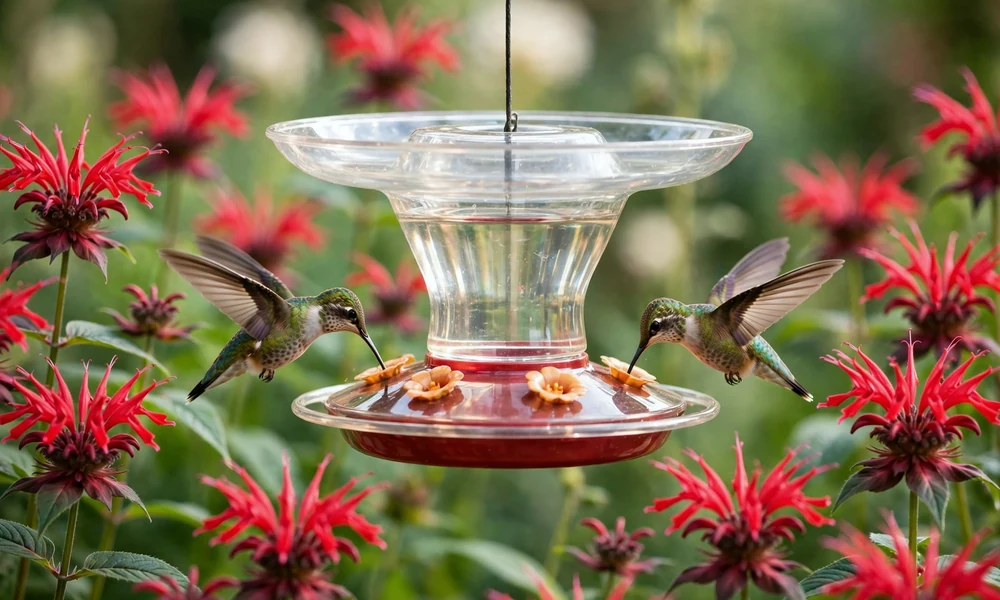
A saucer feeder is the best hummingbird feeder for hot weather, and it is the design experienced birdwatchers reach for when summer temperatures climb. Instead of a bottle hanging above the ports, the nectar sits in a shallow, wide dish with feeding ports in the lid. Gravity cannot pull the liquid out, so it almost never leaks, and the low shape keeps the nectar cooler than a tall bottle in the sun.
Saucer feeders are also the easiest to clean. The lid lifts off, the dish is shallow enough to scrub in seconds, and there are no narrow tubes to clog. Most models have a raised rim that doubles as a perch, so the birds can sit and drink rather than hovering, which means they stay longer. Because the ports sit on top, bees have a harder time reaching the nectar.
The trade-off is capacity. A saucer feeder holds less than a large bottle, so in a garden with many hummingbirds you may refill it more often. That is a fair exchange in July and August, when freshness is everything.
3. Best for Close-Up Watching: Porch and Window Feeder
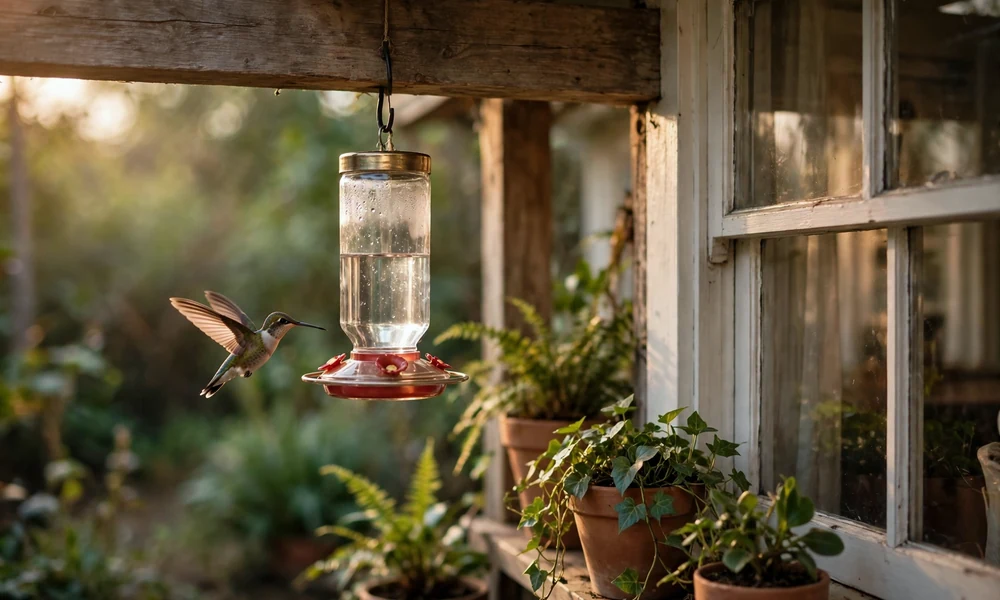
A porch or window feeder is the best hummingbird feeder for close-up watching, because it brings the birds to within a few feet of where you sit. These feeders are smaller than garden models, holding just enough nectar for a day or two, and they hang from a porch beam, a bracket, or suction cups on a window. The small size is a feature: the nectar is always fresh, and the feeder is so close you can watch a hummingbird’s throat flash red without binoculars.
Placement matters more with this style than any other. Hang it near a window you use often, but give the birds a clear flight path and a nearby shrub where they can perch before approaching. If a feeder is too close to a window, birds can strike the glass, so keep it either within a few inches of the pane or well away from it.
Once the birds find a porch feeder, they return at the same times each day, and watching them becomes part of the morning routine. Pair the view with a good pair of optics from our guide to the best binoculars for birdwatching and you can tell individual birds apart by their markings.
4. Best Large Capacity: Wide-Base Feeder With Perches
A wide-base feeder with perches is the best hummingbird feeder for a busy garden, where half a dozen birds may visit in a single hour. These models hold a generous amount of nectar and offer six or more feeding ports around a broad base, so several birds can drink at once. The perches are the key detail: hummingbirds burn enormous energy hovering, so a feeder that lets them sit keeps them there longer and brings them back more often.
Look for a wide, stable base that unscrews fully for cleaning, and for ports that can be removed and brushed individually. A leak-proof seal between the bottle and the base is essential at this size, because a large feeder that drips will empty itself in a day. The best large models also include an ant moat and bee guards that keep bees out.
Only buy a large feeder if your garden has the traffic to empty it within a few days. A big bottle of nectar sitting half-finished in the heat is worse than a smaller feeder refilled often. If you are unsure how many birds you have, start small and upgrade later.
How to Make Nectar and Keep It Fresh
The best nectar is the simplest: one part white sugar dissolved in four parts water, boiled briefly and cooled. No honey, which can grow fungus that harms hummingbirds, no brown sugar, no artificial sweetener, and no red dye. The red of the feeder is enough to attract them.
Freshness is the whole game in summer. Change the nectar every two to three days when it is hot, and every four to five days in cooler weather. If the liquid looks cloudy, smells sour, or has black spots, throw it out and clean the feeder before refilling. Clean with hot water and a bottle brush every time you change the nectar, and once a week give it a soak in a weak vinegar solution, rinsed thoroughly. Never use soap unless you can rinse it completely, because residue can harm the birds.
Where to Hang a Hummingbird Feeder
Hang your feeder where you can see it and the birds can reach it safely. A spot with morning sun and afternoon shade is ideal: the birds like the warmth early in the day, but shade keeps the nectar cooler and slows fermentation. Keep the feeder near flowers the birds already visit, such as bee balm, salvia, and trumpet vine, because a feeder beside real flowers is found faster.
Give the birds a perch nearby, a branch or shrub within a few feet, so they can rest between drinks. Keep the feeder away from places where cats hide, and avoid hanging it over a patio table or a path, since a little dripping is inevitable. If you have more than one feeder, space them out of sight of each other; hummingbirds are fiercely territorial, and two feeders in view of each other will be guarded by a single bird. A well-watered garden helps too, and the picks in our guide to the best garden hoses keep the flowers that bring hummingbirds in the first place.
Mistakes to Avoid
The most common mistake is leaving old nectar in the feeder for too long. Fermented sugar water can make hummingbirds ill, and a mouldy feeder will be abandoned, sometimes for the rest of the season. The second mistake is using honey or red dye, both of which do more harm than good. The third is hanging the feeder in full sun all day and forgetting about it.
Another mistake is putting the feeder too close to a wasp nest or a busy bee route, which turns every refill into a battle. Move the feeder a few feet, or switch to a saucer style with bee guards, and the problem usually disappears. Finally, do not give up after a few quiet days. Hummingbirds take time to find a new feeder. Keep the nectar fresh, keep the feeder clean, and the birds will come.
Frequently Asked Questions
When should I put a hummingbird feeder out? Put it out a week or two before hummingbirds are expected in spring, and leave it up until a couple of weeks after the last bird has been seen in autumn, so late migrants can fuel up on their way south.
Do hummingbird feeders attract bees and wasps? They can, especially bottle feeders that leak. Saucer feeders, bee guards, and a feeder hung in shade all help, and moving the feeder a few feet often breaks the insects’ habit.
How often should I clean a hummingbird feeder? Clean it every time you change the nectar, which means every two to three days in hot weather. A quick scrub with hot water and a brush is enough most of the time.
The Bottom Line
The best hummingbird feeders in 2026 are the ones that stay clean, stay fresh, and stay full, and for most gardens that means a classic glass bottle feeder, kept in partial shade and refilled every few days. If your summers are very hot, a saucer feeder will serve you better, and if you want the birds close enough to watch from your chair, a small porch feeder is worth adding as a second. Whichever style you choose, the routine is the same: fresh nectar, a clean feeder, and a little patience.


