
The binoculars that make birdwatching worth it are not the most expensive pair in the shop, but the ones you actually want to carry, lift, and look through for hours on end. Too many new birdwatchers buy binoculars that are heavy, dim, or hard to focus, and then wonder why the hobby feels like hard work. A good pair of birdwatching binoculars disappears in your hands: the view is bright and sharp, the focus wheel turns smoothly, and the birds you are watching look close enough to count feathers. This guide explains how binoculars work, what the numbers on the box mean, and how to choose a pair in 2026 that will still be your favourite years from now.
The first thing to understand is that a binocular is two small telescopes joined together, and its quality is decided by its optics, not by its zoom. The two numbers on every pair, such as 8×42 or 10×50, tell you the magnification and the size of the front lens. Magnification decides how close things look, while the front lens decides how much light the binocular gathers, which decides how bright the view is at dawn, at dusk, and in a shady wood.
Key Takeaways
- An 8×42 binocular is the best starting point for birdwatching, because it gives a bright, steady view with a wide field that makes finding birds easy.
- A wider field of view matters more than higher magnification, because a bird you cannot find is a bird you cannot watch.
- Good glass and good coatings beat extra zoom: a sharp 8x pair will show you more than a blurry, dim 12x pair every time.
- Eye relief of at least 15 millimetres matters if you wear glasses, and a close focus under two metres is a joy for butterflies and dragonflies.
- Try before you buy when you can, and carry the pair around your neck for ten minutes, because comfort decides whether you use them or leave them at home.
What the Numbers Mean: 8×42 and Beyond
Every binocular carries two numbers, and understanding them is the fastest way to narrow down your choice. The first number is the magnification: 8x means the bird looks eight times closer than it does with the naked eye, and 10x means ten times closer. The second number is the diameter of the front lens in millimetres: a 42mm lens gathers more light than a 32mm lens, and a 50mm lens gathers more still, which makes the view brighter in poor light.
Why 8×42 is the birdwatching standard
The 8×42 combination has become the standard for birdwatching for good reason. Eight times magnification is strong enough to see detail on a warbler at a reasonable distance, but not so strong that the image shakes with every small movement. A 42mm front lens gathers enough light for a bright view at dawn and dusk, when birds are most active, without making the binocular heavy. An 8×42 pair is also easier to hold steady than a 10x pair, and it gives a wider field of view.
When 10x makes sense, and when it does not
A 10×42 binocular brings birds closer, but it comes with real trade-offs. The image shakes more, the field of view is narrower, and the view is slightly dimmer. Ten times magnification suits open country, wetlands, and sea watching, where birds are far away. In a wood or a garden, 10x makes finding a small, fast-moving bird harder, not easier.
Compact binoculars: light, but with limits
Compact binoculars, such as 8×25 or 10×28 pairs, fold down small and weigh very little, which makes them tempting for travel and for walks when you do not want to carry a full-size pair. They are genuinely useful as a second pair, or for a child, or for a holiday when space is tight. But a small front lens gathers far less light, so the view is dimmer at dawn and dusk, and the field of view is usually narrower. A compact pair is better than no pair, but it is not the best first pair for serious birdwatching.
What Makes a Binocular Good: Glass, Coatings, and Build
Two binoculars can carry the same numbers and feel completely different to look through, and the difference is in the glass, the coatings, and the build. These are the things that decide whether the view is bright and sharp or dull and fuzzy, and they are worth understanding before you spend your money.
Glass quality and prisms
Most modern birdwatching binoculars use roof prisms, which make the barrels straight and slim, and the quality of the glass inside decides how much detail and colour reaches your eyes. The best glass in an affordable pair is usually described as ED or HD glass, which reduces the coloured fringing you sometimes see around a bright bird against a pale sky. Look at a bird against a bright sky: clean edges mean good glass.
Coatings: the invisible difference
Every glass surface inside a binocular reflects a little light, and without coatings much of that light is lost before it reaches your eyes. Fully multi-coated lenses have several layers of coating on every glass surface, and they are the minimum you should accept. Phase-corrected coatings improve contrast and sharpness, and waterproof coatings help rain bead off instead of smearing. A pair with good coatings looks noticeably brighter than one without them.
Build, weight, and waterproofing
A birdwatching binocular should be waterproof and filled with nitrogen or argon gas, which stops the inside from fogging when you move from a cold morning into a warm hide. It should feel solid without being heavy, and the focus wheel should turn smoothly with one finger. Weight matters: a pair that weighs 800 grams feels fine for five minutes and heavy after three hours, so a pair around 600 grams or less is a real pleasure on a long walk.
| Binocular | Best for | Brightness | Weight |
|---|---|---|---|
| 8×42 | General birdwatching, woods, gardens | Bright | Medium |
| 10×42 | Open country, wetlands, sea watching | Good | Medium |
| 8×32 | Daylight walks, travel, lighter carry | Good | Light |
| 8×25 compact | Travel, second pair, children | Fair | Very light |
| 10×50 | Low light, astronomy, long-distance viewing | Very bright | Heavy |
Mistakes That Ruin a Binocular Purchase
The most common mistake is buying the highest magnification you can afford. A 12x or 16x pair sounds impressive, but the image shakes so much that you will see less detail than through a steady 8x pair, and you will spend your time searching for birds in a tiny field of view. Magnification is not a score, and more is not better.
The second mistake is buying a pair without trying it. Binoculars are personal: the distance between the barrels, the position of the focus wheel, the shape of the eyecups, and the weight all feel different to different people. If you can, visit a shop or a bird fair and try several pairs side by side, looking at the same distant sign. Ten minutes of looking through a pair will tell you more than ten reviews.
The third mistake is choosing a pair that is too heavy for the way you watch birds. A heavy pair gets left at home, and a pair left at home shows you nothing. If you walk for hours, a lighter pair that you actually carry will show you far more birds than a heavier pair with slightly better glass that stays in the car.
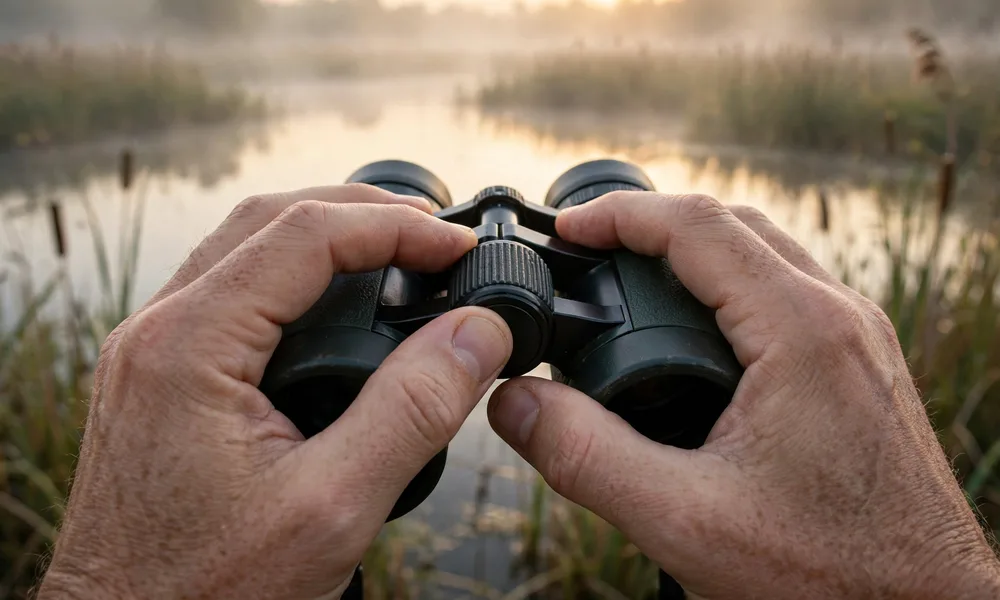
The fourth mistake is forgetting about eye relief if you wear glasses. Eye relief is the distance from the eyepiece at which you can see the full field of view, and if it is too short, glasses wearers see only a small circle in the middle. Look for eye relief of at least 15 millimetres, and check that the eyecups twist down so you can hold the binocular close to your glasses.
The fifth mistake is spending all your money on the binocular and nothing on the strap, the case, and the cleaning kit. A wide, comfortable neck strap makes a heavy pair feel lighter, and a lens cloth and a small brush keep the glass clean. Dirty lenses ruin the view of even the best binocular, so learn to clean them properly: blow off dust first, then wipe gently with a clean cloth.
Binoculars also pair naturally with other outdoor kit. A camera is the natural companion for recording what you see, and our guide to the best cameras in 2026 covers the models that work well for wildlife. If you want to watch birds over open water, the best drones in 2026 guide explains which ones are worth the money. And because good birdwatching means long walks over rough ground, read our guide to the best hiking boots in 2026 before your next trip out.
Binocular Buying Checklist
- Choose an 8×42 pair as your first binocular, and only consider 10x if you watch mostly open country or wetlands.
- Check the field of view and the close focus distance, and look for a close focus under two metres for insects and nearby birds.
- Make sure the eye relief is at least 15 millimetres if you wear glasses, and that the eyecups twist down smoothly.
- Check that the pair is waterproof and nitrogen-filled, so it will not fog up on cold mornings.
- Hold the pair for ten minutes and use the focus wheel with one finger, because comfort decides whether you use them.
- Budget for a wide neck strap, a rain guard, and a proper lens cloth, not just the binocular itself.
Frequently Asked Questions
What is the best binocular magnification for birdwatching?
Eight times magnification is the best choice for most birdwatchers, because it gives a bright, steady view with a wide field that makes finding birds easy. Ten times suits open country and wetlands, but it shakes more and narrows the field of view.
Are expensive binoculars worth it for a beginner?
Expensive binoculars are brighter and sharper, but a mid-priced pair with good glass and full coatings will show a beginner almost everything they need to see. Spend moderately on your first pair, and upgrade later once you know which features matter to you.
What does 8×42 mean on a binocular?
The first number is the magnification, so 8x makes a bird look eight times closer. The second number is the diameter of the front lens in millimetres, so 42mm gathers more light than a 32mm lens and gives a brighter view in poor light.
Can I use binoculars if I wear glasses?
Yes, as long as the eye relief is long enough, ideally at least 15 millimetres, and the eyecups twist down so you can hold the binocular close to your glasses. Try the pair with your glasses on before you buy.
How do I keep binoculars from fogging up?
Buy a waterproof pair filled with nitrogen or argon gas, which stops moisture from condensing inside. Keep the rain guard on the eyepieces in damp weather, and avoid breathing on the lenses when you raise them to your eyes.
What is close focus, and why does it matter?
Close focus is the nearest distance at which the binocular can focus sharply, and a close focus under two metres lets you watch butterflies, dragonflies, and birds at a feeder in sharp detail. It is a feature many beginners overlook and many experienced watchers love.
The Bottom Line
The binoculars that make birdwatching worth it are the ones that give you a bright, steady view and feel so comfortable that you forget you are carrying them. Choose an 8×42 pair with good glass, full coatings, and a sensible weight, try it before you buy, and spend the money you save on time outside. The best binocular is not the most powerful one, but the one that is with you when the bird appears, and that is the pair you will still be reaching for years from now.


