The best hatchbacks for city driving in 2026 are the cars that make urban life feel easy: short enough to park anywhere, tight enough to turn in a single sweep, light on fuel in stop-start traffic and clever with the space they have. City driving rewards a small footprint more than any other kind of driving, and a good hatchback turns crowded streets, tight bays and narrow lanes from a daily chore into a non-event.
This guide ranks the best hatchbacks for city driving in 2026, judged on the things that matter in town: length and turning circle, urban fuel economy, visibility, parking ease, boot flexibility and running costs. Every car below is a proven city performer, and the ranking runs from excellent to best in class.
Key takeaways
- The best hatchbacks for city driving are under 4.1 metres long with a turning circle near 10 metres.
- Small hybrids return more than 50 miles per gallon in town, roughly double a large petrol sedan.
- A hatchback’s wide tailgate and folding seats swallow loads a sedan boot cannot take.
- High seating and a short bonnet give hatchback drivers the visibility city streets demand.
- Light weight and small engines keep insurance, tax and servicing costs low.
Why hatchbacks win in the city
City driving is a low-speed test, and speed is the one thing a hatchback does not need. Average urban speeds sit below 20 miles per hour, journeys are short, and the car spends much of its life parking, turning and creeping through traffic. A hatchback’s strengths line up with that test exactly: a short body that fits standard bays with room to spare, a tight turning circle that makes U-turns a single movement, and a light body that sips fuel instead of gulping it.
Parking is where the advantage is most obvious. A standard UK bay is about 2.4 metres wide and 4.8 metres long. A compact hatchback at under 4 metres long leaves nearly a metre of margin, which means easier manoeuvres, fewer scrapes and far less stress.
Visibility matters just as much. Hatchbacks have a short bonnet, an upright rear window and a high seating position relative to their size, so judging the corners of the car comes naturally. Reversing into a tight space is a quick glance rather than a slow exercise in guesswork. Our sedan vs hatchback comparison for city driving sets out how the two body styles differ in town, and the hatchback’s case is strongest exactly where city drivers spend their time.
The fuel advantage
Small engines and light bodies are the cheapest way to move through a city. A modern small hatchback returns 45 to 55 miles per gallon in urban driving, and hybrid versions do better still, because they run on electric power at the low speeds where petrol engines are least efficient. Over a year of city driving, the fuel saving against a large sedan can run into hundreds of pounds. Small hybrids are so strong in town that they dominate our guide to the best hybrid cars for city driving, and several of the cars below appear there too.
The space surprise
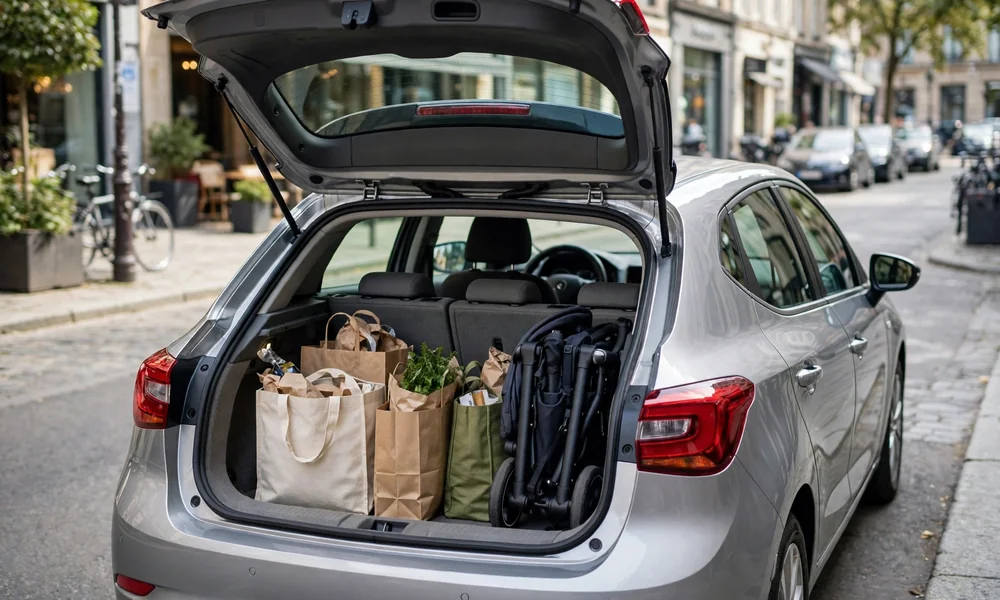
A hatchback looks small from the outside and feels big from the inside. The tailgate opens onto the whole cabin, the rear seats fold flat, and the load floor is low and wide. A pushchair, a flat-pack bookcase or a week’s shopping all fit without a struggle. A sedan’s boot may hold more litres on paper, but its narrow opening and fixed shape make it far less useful for the bulky, awkward loads that city life produces.
The best hatchbacks for city driving in 2026
Each car below was judged on the things that matter in town: length and turning circle, urban fuel economy, visibility, parking ease, boot flexibility and running costs. The ranking runs from excellent to best in class.
7. Kia Picanto
The Picanto is the smallest car here and the easiest to park, at under 3.6 metres long with a turning circle below 10 metres. It slips into gaps other cars cannot use and turns in spaces that defeat bigger cars entirely. The cabin is snug rather than spacious, and the boot is small, but for a solo driver or a couple doing city errands it is all the car you need.
6. Mazda2
The Mazda2 brings a premium feel to the small hatchback class, with a smart cabin, sharp handling and an engine that feels eager rather than strained. At just over 4 metres long it parks easily, and its light steering makes tight manoeuvres effortless. Fuel economy in town is strong, and the car’s small footprint means cheap insurance and low tax.
5. Suzuki Swift
The Swift is light, cheerful and genuinely fun at city speeds, with a tight turning circle and a chassis that makes narrow streets feel like a playground. The mild-hybrid engine returns excellent urban economy, and the car’s small size keeps every running cost low. The boot is modest and the cabin is simple, but the Swift never feels like a compromise in the environment it was built for.
4. Hyundai i20
The i20 is the sensible choice in this list: spacious for its size, well equipped, and easy to live with. Its cabin feels a class above its price, the rear seats take adults without complaint, and the boot is genuinely useful. At 4.04 metres long it still fits comfortably in standard bays, and its light controls make parking a non-event.
3. Volkswagen Polo
The Polo is the grown-up small hatchback: refined, solid and quiet, with a cabin that feels borrowed from a larger car. It is slightly longer than some rivals, but its excellent visibility and light steering keep it easy in town, and its fuel economy is among the best of any non-hybrid here. The boot is a useful size, the rear seats are comfortable, and the car holds its value better than almost any rival. For a driver who wants one car to do everything, the Polo is the safe pair of hands.
2. Toyota Yaris
The Yaris is the efficiency champion of this list. Its hybrid system returns more than 60 miles per gallon in urban driving, because it spends much of its city life running silently on electric power. It is compact, easy to park and cheap to insure, and Toyota’s reliability record means it will still be doing the same job in a decade.
1. Honda Jazz
The Honda Jazz is the best hatchback for city driving in 2026 because it does everything a city car should do, and nothing it should not. Its hybrid system returns outstanding urban economy, its turning circle is tight, and its visibility is the best in this class thanks to a tall, airy cabin. The magic seats fold in a dozen ways, turning the small car into a surprisingly capable load carrier. It is easy to park, cheap to run, comfortable over broken city roads and built to last. No rival combines efficiency, space and ease of use as completely as the Jazz.
Comparison table: the best hatchbacks for city driving
| Hatchback | Length | Turning circle | Urban economy | Standout strength |
|---|---|---|---|---|
| Kia Picanto | 3.6 m | 9.6 m | 45 mpg | Smallest, cheapest to run |
| Mazda2 | 4.1 m | 10.0 m | 48 mpg | Best driving feel |
| Suzuki Swift | 3.9 m | 9.8 m | 52 mpg | Light, fun, frugal |
| Hyundai i20 | 4.0 m | 10.0 m | 48 mpg | Roomiest cabin |
| Volkswagen Polo | 4.1 m | 10.2 m | 50 mpg | Most refined, holds value |
| Toyota Yaris | 3.9 m | 10.0 m | 60+ mpg | Best fuel economy |
| Honda Jazz | 4.1 m | 10.1 m | 58 mpg | Best all-round package |
The table shows how close the class is: every car here is under 4.1 metres long and turns in around 10 metres, and every one returns at least 45 miles per gallon in town. The figures are approximate real-world numbers rather than laboratory claims.
What to look for in a city hatchback
Length is the first number to check. Anything under 4.1 metres will fit a standard bay with room to spare, and under 4 metres is better still. Turning circle is the second: near 10 metres makes U-turns a single movement, while anything above 11 metres starts to feel clumsy. Visibility is the third, and it is best judged in person: sit in the car, look over your shoulder, and try reversing into a bay before you buy.
Fuel type matters more in the city than anywhere else. A hybrid earns its keep in stop-start traffic, where it runs on electric power at low speed, while a small petrol engine is the cheapest option to buy and still returns strong economy. Our guide to the best compact cars for city driving covers the wider class if you want to compare beyond hatchbacks.
City driving checklist: before you buy a hatchback
- Measure the car against your parking bay and garage, and check the length including mirrors.
- Test the turning circle on a real street: a U-turn should be one smooth movement, not a three-point shuffle.
- Check urban fuel figures, not combined claims, and favour a hybrid if most trips are under five miles.
- Fold the rear seats and try your bulkiest regular load: a pushchair, a bike or a flat-pack box.
- Sit in the back seats yourself: some small hatchbacks are far tighter than their rivals.
- Get an insurance quote before you commit: small hatchbacks sit in low groups, but city postcodes still push premiums up.
Frequently asked questions
What is the best hatchback for city driving in 2026?
The Honda Jazz tops this list. Its hybrid economy, tight turning circle, superb visibility and clever folding seats make it the most complete city car here, and it is cheap to run and built to last.
Are hatchbacks really better than sedans in the city?
For most urban drivers, yes. A hatchback is shorter, turns tighter and loads more flexibly than an equivalent sedan. A sedan’s separate boot is quieter on long journeys, but in town the hatchback’s advantages shape daily life far more.
How much fuel does a city hatchback save?
A lot. A hybrid hatchback can return more than 60 miles per gallon in town, against under 20 for a large petrol sedan. Over a year of city driving, the saving can run into hundreds of pounds.
Is a hybrid hatchback worth the extra cost?
If most of your trips are short and urban, yes. Hybrids earn their premium in stop-start traffic, where they run on electric power at low speed. If you drive mostly on motorways, a small petrol hatchback is the better buy.
Can a small hatchback carry a family?
Yes, for most families. The Jazz, i20 and Polo all take two adults in the back and a pushchair in the boot. Very tall teenagers or three child seats across the back are the cases where a larger car starts to make sense.
What is the cheapest hatchback to run in the city?
The Kia Picanto has the lowest purchase price, insurance and servicing costs in this list. The Toyota Yaris costs more to buy but returns the best fuel economy, so it can be cheaper over a full year of heavy city use.
The bottom line
The best hatchbacks for city driving in 2026 prove that small is not a compromise. They park anywhere, turn anywhere, sip fuel in traffic and swallow more luggage than their size suggests. The Honda Jazz leads the class, but every car in this list would make city driving easier, cheaper and less stressful. Choose the one that fits your parking space, your passengers and your budget, and the city will feel like it was built for you.