
The best helmet lights in 2026 put light exactly where you are looking, and that changes night riding in a way a handlebar light never can. A helmet light mounts on your helmet, so its beam follows your head: look into a side road and the beam goes with you, glance at a pothole and it lights up, turn to check traffic and drivers see a light moving at head height. A handlebar light only points where the bike points, which is fine on a straight road and useless at a junction.
A helmet light is a compact, rechargeable LED light that clips, straps or sticks to a bicycle helmet, usually on the front, top or rear. It is not a handlebar light moved higher up, and it is not a headlamp borrowed from a camping trip. Handlebar lights throw a wide beam from a fixed position but cannot follow your gaze. Headlamps point where you look, but their forehead strap is not designed to mount securely on a vented helmet shell or survive the vibration, rain and speed of a bike ride. A proper helmet light is built for the helmet: a secure mount, a beam shaped for riding, and a weight that does not pull your head forward.
Key takeaways
- A helmet light follows your gaze, so it lights up side roads, junctions and hazards a handlebar light cannot reach.
- For most riders, 400 to 800 lumens is the sweet spot: bright enough for dark lanes without blinding other road users.
- Mount security matters more than brightness: a light that slips, rattles or falls off is useless, however powerful it is.
- USB-C rechargeable lights with at least two hours of runtime on high are the easiest to live with for regular night riding.
- Pair a front helmet light with a rear helmet light or a bright rear light, because being seen from behind matters as much as seeing ahead.

How a helmet light actually helps
The first benefit is seeing around corners. When you approach a junction, your head turns before your bike does, and a helmet light sweeps the side road, the pavement and the waiting cars a fraction of a second earlier than any fixed light. That early warning is often the difference between a smooth turn and a nasty surprise. The second benefit is spotting hazards. Potholes, drain covers, glass and debris sit at the edge of a handlebar beam, but a quick glance puts a helmet beam straight onto them. The third benefit is being seen. A light at head height moves when you move, and drivers notice movement far more readily than a steady low light. A helmet light that bobs slightly as you scan the road is one of the most visible things on a bike after dark.
How we judged the best helmet lights
We judged every helmet light on the same six points. First, mount security: does it stay put over bumps, on rough trails and at speed, and does it fit different helmet vents without adapters? Second, brightness and beam shape: is the beam wide enough to be useful and focused enough to reach down the road, and does it have a low mode that does not blind other people? Third, runtime honesty: does the claimed runtime match what the light actually delivers on its main mode, and does it dim gradually or cut out suddenly? Fourth, weight and balance: does the light pull the helmet forward or make your neck ache after an hour? Fifth, charging and weatherproofing: is it USB-C rechargeable, and does it survive rain without fogging or failing? Sixth, controls: can you change modes with gloved hands, and can you tell which mode you are in without looking?
Front, rear or both: what do you need
Most riders start with a front helmet light, and for good reason: it is the one that helps you see. A front light with 400 to 800 lumens covers commuting and road riding, while trail riding and fast descents call for 800 lumens or more. Look for at least three modes, a steady high, a steady low and a flashing mode, so you can adapt to traffic and country lanes without stopping to fiddle.
The best helmet lights at a glance
| Light | Best for | Brightness | Standout strength |
|---|---|---|---|
| Best all-round front light | Commuting and road | 600 lumens | Secure mount and a clean, even beam |
| Best for dark country lanes | Fast night riding | 1,000 lumens | Long throw with a wide spill for corners |
| Best lightweight option | Long rides | 400 lumens | Barely noticeable on the helmet, two-hour runtime |
| Best rear helmet light | Being seen | 50 lumens red | Bright flash mode visible from a long way back |
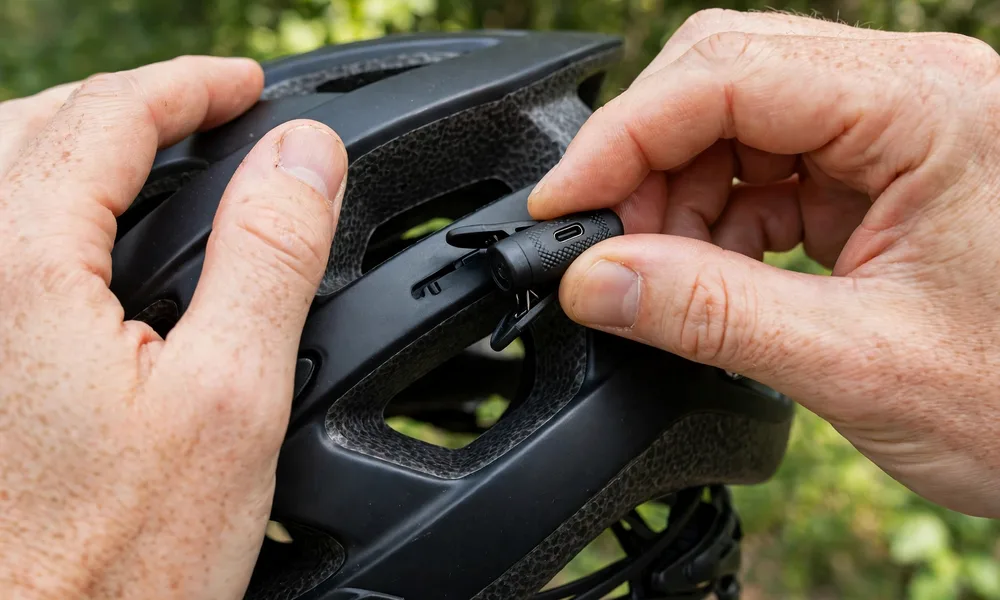
Best all-round front light
The best all-round front helmet light is the one most riders should buy first. Its 600-lumen beam is bright enough for unlit country lanes and restrained enough not to dazzle oncoming traffic, and the beam shape is the key: a bright centre for distance with a wide, even spill for the road edges. The mount uses a strap and a vent clip together, so it fits almost any helmet and stays put over potholes and cattle grids. Runtime is about two and a half hours on high and far longer on low, and it charges by USB-C in under two hours. It is not the brightest or the lightest here, but for a regular commute or evening club ride it is the hardest to fault.
Best for dark country lanes
Dark country lanes at speed need more light, and this 1,000-lumen light delivers it with a long, focused throw that reaches well down the road. The extra power matters most on descents, where you need to see the surface far ahead to brake in time, and on fast bends, where the beam has to reach around the corner as your head turns. The trade-off is weight and runtime: it is heavier than the all-round light and lasts about ninety minutes on full power, so it suits shorter, faster rides rather than all-night epics.
Best lightweight option
Weight is the hidden cost of a helmet light: a heavy light pulls the front of the helmet down and strains your neck on a long ride. The best lightweight helmet light weighs under 60 grams including its mount, yet still puts out 400 honest lumens with a two-hour runtime on high. That is enough for commuting and leisurely night rides, and you forget it is there within minutes. It is not the light for fast descents on unlit lanes, but for riders who value comfort over maximum brightness it is the right call.
Best rear helmet light
A rear helmet light does one job, and this one does it brilliantly. Its red LED is visible from a long distance, its flashing mode catches the eye without being distracting, and its mount clips securely to the rear vents of most helmets. Runtime is generous, often ten hours or more on flash. Use it alongside a seat-post rear light, so drivers see two red lights at different heights. Before you buy, read our guide to the best vs worst bike lights to see how rear lights fit into a complete night-riding setup.
Mounting a helmet light properly
Mounting matters more than most buyers expect, so take five minutes to get it right. Centre the light on the helmet, either on the top or the front, and angle it slightly downwards so the beam hits the road about ten metres ahead rather than pointing at the sky or at your front wheel. Tighten the mount until it does not move when you shake the helmet firmly, then ride a short test loop over bumps before trusting it on a long ride. Check that the light does not block any vents you rely on for cooling, and that the mount does not press on the helmet shell. If you are still choosing a helmet, our guide to the best cycling helmets covers vent layouts that take a light well.
Common mistakes to avoid
The most common mistake is buying the brightest light available: a very bright light with a poor beam shape dazzles oncoming traffic and drains its battery fast. The second is trusting claimed runtime, so carry a backup on longer rides. The third is mounting the light too high, which points the beam into other people’s eyes. The fourth is forgetting the rear: a front light helps you see, but it does nothing for the driver behind you. And the fifth is treating a helmet light as a replacement for a handlebar light: the two work best together. Do not substitute a camping headlamp either; compare with our guide to the best headlamps to see why a helmet-specific mount and beam matter.
Buyer checklist
- Choose 400 to 800 lumens for commuting and road riding, and 800 or more for fast dark lanes and trails.
- Check the mount fits your helmet vents and stays put when you shake the helmet firmly.
- Pick a light with at least two hours of honest runtime on its main mode.
- Make sure it charges by USB-C and has a weatherproof rating of IPX4 or better.
- Test the controls with gloves on, and check you can tell the modes apart without looking.
- Add a rear helmet light or a bright rear light, because being seen from behind matters too.
Frequently asked questions
Are helmet lights legal?
In most places, yes, as long as you also carry the lights the law requires, usually a white front light and a red rear light on the bike itself. A helmet light is an extra light, not a replacement for the legal minimum.
Do helmet lights replace handlebar lights?
No, they work best together. A handlebar light gives a steady, wide beam that shows the road ahead and makes you visible, while a helmet light adds a focused beam that follows your gaze into corners and onto hazards. Riders who use both see more and are seen more than riders who use either one alone.
How many lumens do I need for a helmet light?
For commuting and lit roads, 400 lumens is plenty. For unlit country lanes, look for 600 to 800 lumens. For fast descents and trail riding, 800 or more is worth having. More than 1,200 lumens is rarely useful on the road, because it dazzles other people and drains the battery fast.
Will a helmet light fit my helmet?
Most helmet lights fit most helmets, because they use straps, vent clips or adhesive mounts that adapt to different vent layouts. Check the mount type against your helmet before you buy, and be cautious with aero helmets, which have fewer vents and a smoother shell. A strap mount is usually the most versatile option.
Can I use a headlamp instead of a helmet light?
You can in an emergency, but a headlamp is not a good substitute. Its strap is designed for a bare head, not a vented helmet shell, so it slips and bounces on a bike, and its beam is shaped for walking rather than riding. A proper helmet light mounts securely, survives vibration and rain, and gives a beam shaped for the road.
How long does a helmet light battery last?
Most USB-C rechargeable helmet lights last between ninety minutes and three hours on their main mode, and far longer on low or flashing modes. Cold weather shortens runtime, so plan for less than the claimed figure in winter.
Bottom line
The best helmet lights stay put, last the ride and put the beam where you look. Choose 400 to 800 lumens for most riding, insist on a secure mount and honest runtime, and pair a front light with a rear light. Do that, and night riding becomes one of the best times to be on a bike.


