Choosing the best kids sunscreen in 2026 should be simple, yet any parent standing in front of a chemist shelf knows it is not. Lotions, sprays, sticks, mineral, chemical, SPF 30, SPF 50, water resistant, reef safe, sensitive skin, fragrance free: the labels pile up faster than the questions they answer. Meanwhile your child is already halfway out of the door, hat in one hand and a swimming costume in the other.
The short version is reassuring. For most children, a broad-spectrum SPF 50 mineral sunscreen, applied generously and reapplied often, is the safest starting point. Everything else, from sprays to sticks, is about making that habit easier. Read on for the detail behind that summary, and for the age-by-age guidance that matters most for babies, toddlers and school-age children.
Key Takeaways
- Choose broad-spectrum SPF 50 for children, and treat SPF 30 as the minimum for everyday use.
- Mineral formulas with zinc oxide or titanium dioxide suit sensitive skin best and start working as soon as they are applied.
- Apply sunscreen 15 to 20 minutes before going outside, and reapply every two hours and after swimming, sweating or towelling off.
- Use about a shot-glass amount for a whole child, and do not forget ears, the back of the neck, the tops of feet and the hairline.
- Keep babies under six months out of direct sun, and ask a paediatrician before using sunscreen on a baby.
Why Children Need Their Own Sunscreen
Children are not small adults when it comes to sun protection. Their skin is thinner, their surface area is larger relative to their body weight, and they spend far more time outdoors, often in the middle of the day when ultraviolet light is at its strongest. A sunburn in childhood is also more than a painful evening: repeated burning in the early years adds to the lifetime ultraviolet exposure that shapes skin health in later life.
Mineral vs Chemical Sunscreen: What Is the Difference?
Mineral formulas start working as soon as they are applied, which is a genuine advantage when a child is already running towards the garden. They are also the formulas most often recommended for sensitive skin, eczema-prone skin and very young children, because their active ingredients are less likely to irritate. Their main drawback is cosmetic: they can leave a white cast, particularly on deeper skin tones, and thicker mineral creams can feel heavy or hard to rub in. Newer formulas have improved a great deal, with smaller particles and tinted options that blend far better than the thick white pastes of a generation ago.
| Feature | Mineral sunscreen | Chemical sunscreen |
|---|---|---|
| Active ingredients | Zinc oxide, titanium dioxide | Chemical filters that absorb UV |
| Works | Immediately after applying | About 15 to 20 minutes after applying |
| Best for | Sensitive skin, eczema, younger children | Older children, sport, easy spreading |
| Feel on skin | Can be thick, may leave a white cast | Usually light, clear and easy to rub in |
| Watch for | White marks on clothes and deeper skin tones | Stinging eyes, reactions on sensitive skin |
SPF Guidance: What Number Do Children Actually Need?
SPF, or sun protection factor, measures how much longer skin protected by sunscreen takes to burn compared with unprotected skin. An SPF 30 product, properly applied, blocks about 97 percent of ultraviolet B rays, while SPF 50 blocks about 98 percent. The difference between the two is smaller than the numbers suggest, but it still matters, because nobody applies sunscreen as thickly in real life as testers do in a laboratory.
Sensitive Skin, Eczema and Allergies
Sensitive skin is one of the most common reasons parents struggle with sunscreen. A child who screams when sunscreen touches their face is not necessarily being difficult: many formulas sting, especially around the eyes, on cheeks chapped by wind, or on skin broken by eczema. The ingredients most often behind the stinging are fragrances, alcohol and certain chemical filters, so a fragrance-free mineral formula with a short ingredient list is the best first try for a reactive child.
Lotion, Spray or Stick: Which Format Works Best?
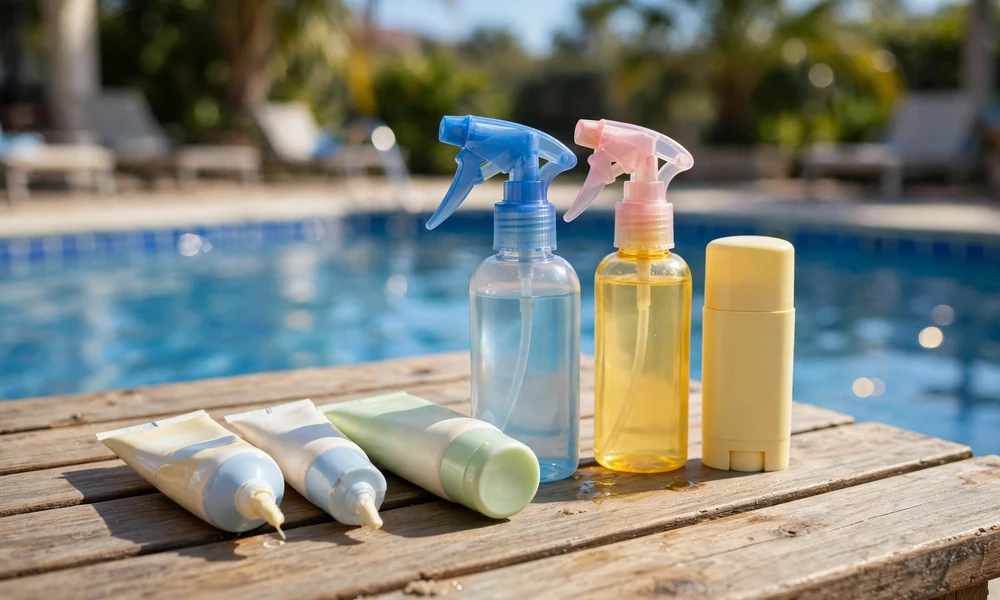
Lotion is the most reliable format for full coverage. You can see where it has been applied, you can rub it in properly, and it is the easiest way to be sure no patch of skin has been missed. For a full-body application before the beach or the park, lotion should be your first choice, even if it takes a few minutes longer. Keep one bottle at home and one in the beach bag so the habit never depends on remembering to pack it.
Sprays are the fastest way to reapply on a moving child, and that speed is genuinely useful. Their weakness is accuracy: a quick mist in a breeze may land mostly on the air rather than the skin, and it is easy to miss patches. If you use a spray, hold it close to the skin, spray until the skin looks wet, and then rub it in with your hand, exactly as you would a lotion. Never spray directly onto a child’s face, and never let a child spray it themselves. Spray into your own hand first, then apply it to their face with your fingers.

Water Resistance: What the Label Really Means
Water resistance is one of the most misunderstood claims on a sunscreen bottle. A product labelled water resistant for 40 minutes has been tested to keep its stated SPF after 40 minutes of water exposure under laboratory conditions. A product rated for 80 minutes has passed the same test for twice as long. Neither claim means the sunscreen is waterproof, and no sunscreen on sale is waterproof, whatever the packaging implies.
How to Apply Sunscreen Properly
Most sunscreen failures are application failures, not product failures. Studies of real families consistently find that parents use far too little product, miss the same spots every time, and reapply far less often than the label advises. Getting the routine right matters more than upgrading to a more expensive brand.
Start with the amount. A useful rule is about a shot glass full, roughly 30 millilitres, for a whole child’s body, and a teaspoon for the face and neck alone. For a small child that is roughly half that amount, but the principle is the same: if the bottle never seems to run out, you are probably using too little. Apply it in sections, working from the feet upwards so nothing is missed, and rub each section in fully before moving on.
Age Guidance: Babies, Toddlers and Older Children
Age changes the sun protection plan more than any product choice does. Babies under six months should be kept out of direct sunlight altogether, in the shade of a pram canopy, a sun tent or a tree, with a hat and light long sleeves as their main protection. Sunscreen is not recommended for babies this young, and if you are unsure whether any product is suitable for your baby, ask a paediatrician first. Their skin is far more sensitive than a toddler’s, and shade and clothing are safer than any cream.
Toddlers, from around six months to three years, need the gentlest approach of any age group. Use a fragrance-free mineral SPF 50, apply it to every exposed area, and lean heavily on the other layers of protection: a wide-brim hat that shades the face, ears and neck, a long-sleeved rash guard for swimming, and sunglasses made for small faces. Toddlers will not sit still for a long application, so make it quick, make it a game, and use a stick for the face to keep it out of their eyes. Our guide to the best sunglasses for kids covers the pairs that stay on small heads through a whole afternoon.
Shade, Hats and Clothing: The Other Half of Sun Safety
Clothing is the second line, and it is more reliable than any cream. A long-sleeved rash guard with an ultraviolet protection factor rating protects a child’s torso and arms without any reapplication, and a wide-brim hat shades the face, ears and neck that sunscreen so often misses. Sunglasses complete the kit: children’s eyes are more sensitive to ultraviolet light than adult eyes, and a proper pair with full UV protection is protective gear rather than a fashion item. Packing the full kit for a beach day takes a little planning, and our guide to the best packing lists for beach holidays helps make sure nothing on that list gets left behind.

Choosing and Buying: A Simple Checklist
- Broad-spectrum protection, covering both UVA and UVB rays.
- SPF 50 for children, or SPF 30 at the very minimum.
- Mineral active ingredients, zinc oxide or titanium dioxide, for sensitive or very young skin.
- Fragrance free and alcohol free where possible, especially for eczema-prone children.
- Water resistant for 40 or 80 minutes if the child will swim or sweat heavily.
- A format your child tolerates: lotion for full coverage, stick for faces, spray for top-ups.
- An expiry date comfortably in the future, and no bottle left baking in a hot car.
Price is a poor guide to quality here. Some of the best-performing children’s sunscreens are among the cheapest on the shelf, and a high price often pays for packaging or fragrance rather than protection. Judge a product by its label, its ingredient list and how your child’s skin reacts to it, not by the size of the price tag. And when you are choosing swimwear to go with it, our guide to the best swimwear covers the styles that work hardest alongside sunscreen.
Frequently Asked Questions
How much sunscreen should I use on my child?
About a shot glass full for a whole child’s body, and a teaspoon for the face and neck. For a toddler, roughly half that body amount is enough. If the bottle lasts all summer, you are almost certainly using too little, and the protection on the skin is lower than the SPF number promises.
What should I do if sunscreen gets in my child’s eyes?
Rinse the eyes gently with clean water and keep your child from rubbing them. A stick formula for the face reduces this problem, because it stays where it is put rather than running down with sweat. If redness or pain continues, or your child cannot open their eyes comfortably, seek medical advice.
Do children need sunscreen on cloudy days?
Yes. Up to 80 percent of ultraviolet light passes through cloud, and children burn on overcast days more often than on sunny ones, precisely because nobody thinks to apply sunscreen. Treat an overcast summer day like a sunny one, and keep the routine the same whatever the sky looks like.
When should I ask a doctor about sun protection?
Ask a paediatrician before using any sunscreen on a baby under six months, and ask again if your child has eczema, a rash that will not settle, or a reaction to a sunscreen that keeps coming back. A doctor can advise on which ingredients to avoid and whether a particular formula suits your child’s skin, and that advice is worth more than any review.
The Bottom Line
The best kids sunscreen in 2026 is not the most expensive bottle or the one with the biggest SPF number. It is a broad-spectrum SPF 50, ideally a gentle mineral formula, that your child tolerates, that you apply generously, and that you reapply every two hours and after every swim. Get those three habits right and the brand on the bottle matters far less than the routine around it.