A baby play gym is one of the first things many parents buy, and one of the few baby products that earns its place on the living room floor. It is a soft mat with an arch or two above it, and a handful of toys hanging down where a baby lying on their back can see them, reach for them and bat at them. It sounds simple, and it is, but the difference between a good one and a poor one shows up fast: a good gym keeps a baby happily occupied for ten or fifteen minutes at a time, while a poor one slides around, tips over, or holds toys so high that a small baby cannot reach them at all. The best baby play gyms of 2026 get the small details right, from a mat thick enough to cushion a hard floor to toys that are easy to grab and easy to wash.

What Is a Baby Play Gym?
Most babies start using a play gym in the first few weeks, once they are spending short periods awake on their backs, and most keep using one until they can roll over and crawl away, usually somewhere around six to nine months. After that the gym often becomes a tunnel to crawl through or a tent to sit under, which is fine too. A gym that folds flat and stores easily will last longer in your home than one that takes up a whole corner of the room when it is not in use.
The Main Types of Play Gym
Soft fabric gyms are the most common kind, and for most families they are the best place to start. The mat is quilted or padded, the arches are covered in soft fabric, and the toys are plush, crinkly or wooden rings. They are light, they fold up small, and most of them can go in the washing machine. Look for a mat that feels thick when you press it with your hand, because a thin mat on a hard floor is no more comfortable than the floor itself.
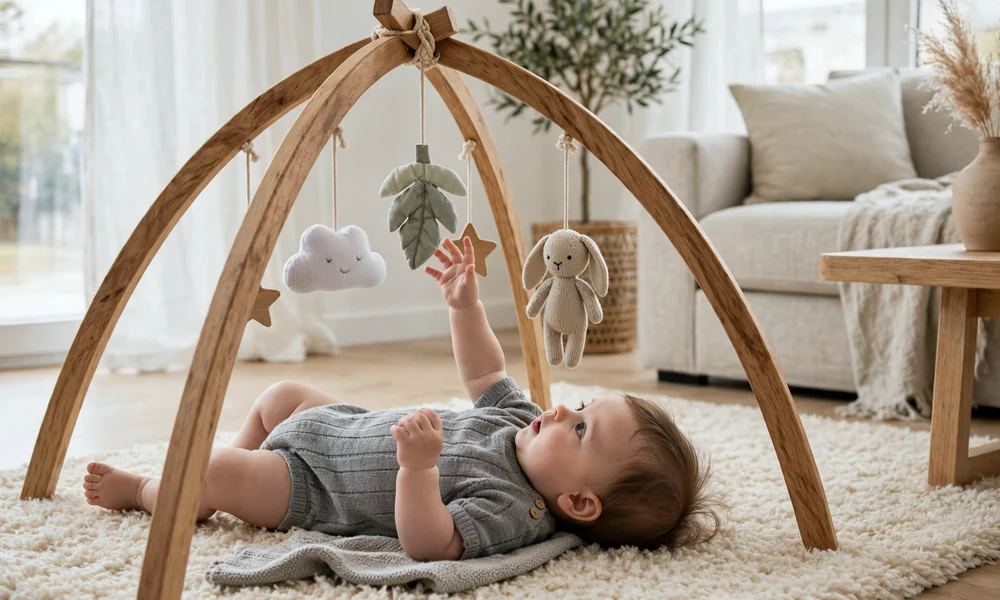
Wooden play gyms look better in a living room, and they are built to last. The frame is usually beech or birch, the mat is often sold separately, and the hanging toys are wooden rings, soft animals or rattles. They cost more than fabric gyms, and they do not fold flat, but they are sturdy, they do not tip over easily, and they suit parents who would rather buy one solid thing than replace a flimsy one twice. Check that the wooden joints are smooth and that no small screws or bolts are within reach.
Piano and kick gyms add a small keyboard or a set of soft keys at the baby’s feet, so kicking makes a sound. Babies love them, and they are a good choice for a baby who is already kicking strongly and getting bored of lying still. The trade-off is that they need batteries, they are heavier than a plain gym, and the music can wear thin for the adults in the room. Choose one with a volume control and an off switch you can reach without dismantling the whole thing.
How to Choose: The Five Things That Matter Most
Start with the mat. It should be thick enough to cushion the floor, wide enough that a baby can roll a little without sliding off the edge, and soft enough to lie on comfortably. A mat around ninety centimetres across suits most babies. Anything much smaller feels cramped by the time the baby is four or five months old, and anything much bigger takes over the room. If you already have a good play mat, our guide to the best baby play mats of 2026 covers flat mats in detail, but a gym mat needs to work with its arches, so buy them as a set when you can.
Next, look at the height of the toys. A baby’s arms are short, and a toy that hangs thirty centimetres above the mat might as well be on the ceiling. The best gyms hang their toys low enough for a small baby to touch, and let you move the toys along the arch or swap them for others. Detachable toys matter more than most parents expect, because the toy your baby ignores at two months may become the favourite at five months, and a gym with fixed toys cannot grow with them.
Then check the toys themselves. You want a mix of textures and sounds: something soft to hold, something crinkly to squeeze, something smooth to chew, and a mirror, because most babies are fascinated by their own reflection. Avoid toys with long cords, small buttons that can come off, or hard plastic edges. Everything that hangs over a baby’s face should be light, soft and firmly attached, and you should be able to take each toy off and wash it.
Washability is the fourth thing, and it is the one parents forget until the first sick-up or nappy leak. A gym that can be wiped clean is good, but a gym with a machine-washable mat and washable toys is better. Check the label before you buy, not after the first accident. If the mat is hand-wash only and the toys are spot-clean only, that gym will spend a lot of its life looking grubby, however pretty it was in the shop.
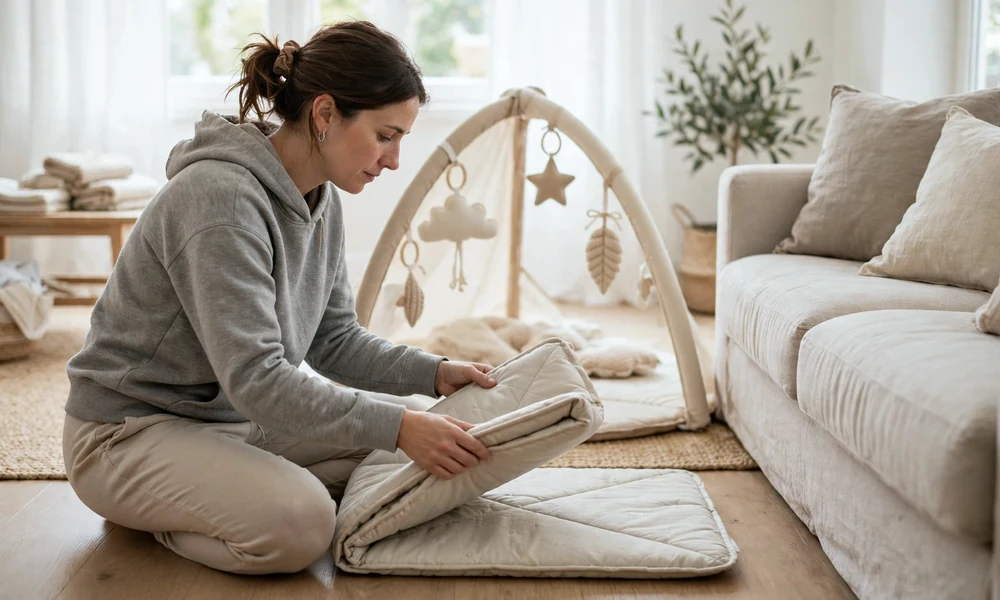
Finally, check stability and storage. Push the arches gently from the side and see whether the gym rocks or tips. A good gym stays put when a baby grabs an arch and pulls. Then fold it up, or take the arches off, and see how much space it takes. If you cannot fold it with one hand while holding a baby, it will live unfolded on your floor, and you will trip over it in the dark.
Play Gyms and Tummy Time
A play gym is also one of the easiest ways to make tummy time more interesting. Put the baby on their tummy on the mat, move a toy or two down low where they can see them, and let them lift their head to look. Short sessions are enough to start with, and a few minutes several times a day is a sensible pattern for a young baby. If your baby hates tummy time, try it after a feed and a nappy change, when they are fed and comfortable, rather than when they are tired or hungry.
Do not worry if your baby is not reaching for the toys yet. In the first weeks, looking is enough. Babies watch the toys move, follow them with their eyes, and slowly learn that their hands can touch what they see. That slow progress is normal. If you are ever worried about how your baby is moving, lifting their head or using their hands, ask your paediatrician rather than comparing your baby with the babies in online videos, who are often months older than they look.
Safety First
A play gym is a place for supervised play, not a place to leave a baby alone. Stay in the room, keep the baby where you can see them, and never use a play gym as a sleeping place. The mat is for play, and a baby who falls asleep on it should be moved to their cot or bassinet. Keep the gym on the floor, never on a bed, sofa or table, where a roll could turn into a fall.
Check the gym regularly for wear. Look for loose stitching, toys that are coming apart, arches that wobble, and any small parts that have worked loose. If a toy’s stuffing is showing, or a seam has split, take that toy off the gym and throw it away. It is also worth checking that the gym meets the safety standards sold in your country, and that any paint or finish on a wooden frame is marked as safe for babies who will chew it, because they will.
Cleaning and Care
Wash the mat and toys as often as they need it, which in practice means more often than you expect. Babies dribble, spit up and chew everything within reach, and a gym that is used every day picks up dust and crumbs too. Follow the washing label: most fabric mats can be machine washed on a gentle cycle and dried flat, while wooden parts should be wiped with a damp cloth and dried straight away so the wood does not swell.
Keep spare toys in rotation. A toy that has been in the wash can be swapped for a clean one, and a toy your baby has ignored for a week can come back later and feel new. A small basket by the gym, with two or three spare toys and a clean muslin, makes the daily routine much easier than hunting through the nursery every time something needs washing.
What to Skip
Skip gyms that are mostly noise and lights. A baby does not need a gym that plays a tune every time they move, and constant noise can make it harder for them to settle. A few gentle sounds are fine, but the best gyms are quiet most of the time, and let the baby make the entertainment by reaching, grabbing and kicking. If a gym needs batteries to be interesting, it is probably not interesting enough on its own.
Also skip gyms with toys you cannot remove, mats you cannot wash, and arches that feel flimsy when you pick the gym up. A cheap gym that tips over, sheds stuffing or falls apart in the wash is not a bargain, whatever the price. It is better to spend a little more on a solid, washable gym, or to buy a good one second-hand and wash it thoroughly, than to buy a new one that will not last the month. For the nursery as a whole, a soft blanket from our guide to the best baby blankets of 2026 pairs well with a gym mat on cold floors, and a monitor helps you keep an eye on the room, as covered in our guide to the best baby monitors of 2026.
Our Verdict
The best baby play gym for most families is a soft fabric gym with a thick, washable mat, low hanging toys that can be swapped around, and arches that stay steady when a baby pulls on them. It should fold flat, wash easily, and keep a baby interested without noise and flashing lights. A wooden gym is the better choice if you want something sturdy and long-lasting and you have the space to leave it up, while a piano gym suits a baby who is already kicking hard and wants a reward for it.
Whatever you choose, keep it simple. A play gym works because it gives a baby a safe, comfortable place to look, reach and practise moving, with you nearby. Buy the one with the best mat, the lowest toys and the easiest washing, put it on the floor, and let your baby get on with it. The right gym will not do the playing for them, but it will give them a good reason to try.