
A baby play mat is one of the first things a new parent buys for the floor, and one of the most used. It is the soft patch of ground where a baby spends tummy time, reaches for a toy, rolls over for the first time and later sits up to play with blocks. The best baby play mats of 2026 do a simple job well: they cushion a hard floor, stay put while a baby wriggles, wipe clean after a spill, and fold or roll away when the room needs to be a living room again.
What a Baby Play Mat Is For
A play mat is a soft, padded surface for supervised floor play. It is not a mattress, not a sleep surface and not a place to leave a baby alone. Its job is to make the floor kinder: a little softer under knees and elbows, a little warmer than bare wood or tile, and a little less slippery than a rug that slides about. Used that way, it becomes the centre of the baby’s day, the place where toys live and where a parent sits down on the floor too.
The Main Types of Baby Play Mat
Interlocking foam tiles are the most flexible option. Each tile is a square of thick foam with puzzle-style edges, so the mat can be as small as a single square or as large as a whole room. They suit families who want a big play area, and they are easy to replace one tile at a time if one gets damaged. The edges should fit snugly together, with no gaps where little fingers can catch, and the surface should feel soft rather than hard and shiny.
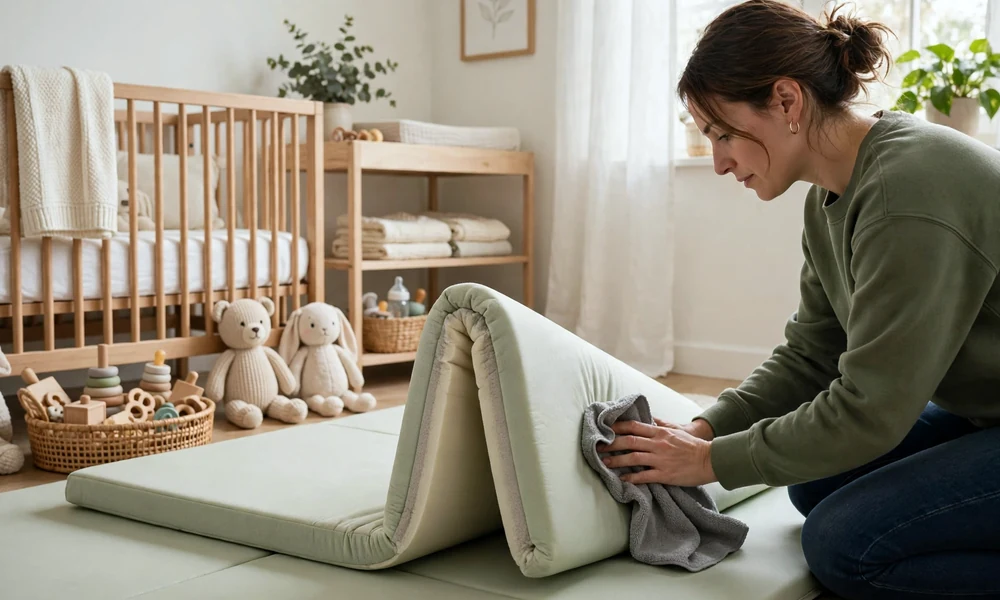
Foldable padded mats are the tidy option. They are one large mat, usually in two to four folding panels, with a wipe-clean surface on both sides. They fold flat for storage behind a sofa or under a bed, and they unfold in seconds. They suit smaller homes and families who want the living room back in the evening. Check the fold lines: they should lie flat when open, not spring up at the creases and make a ridge under a crawling baby.
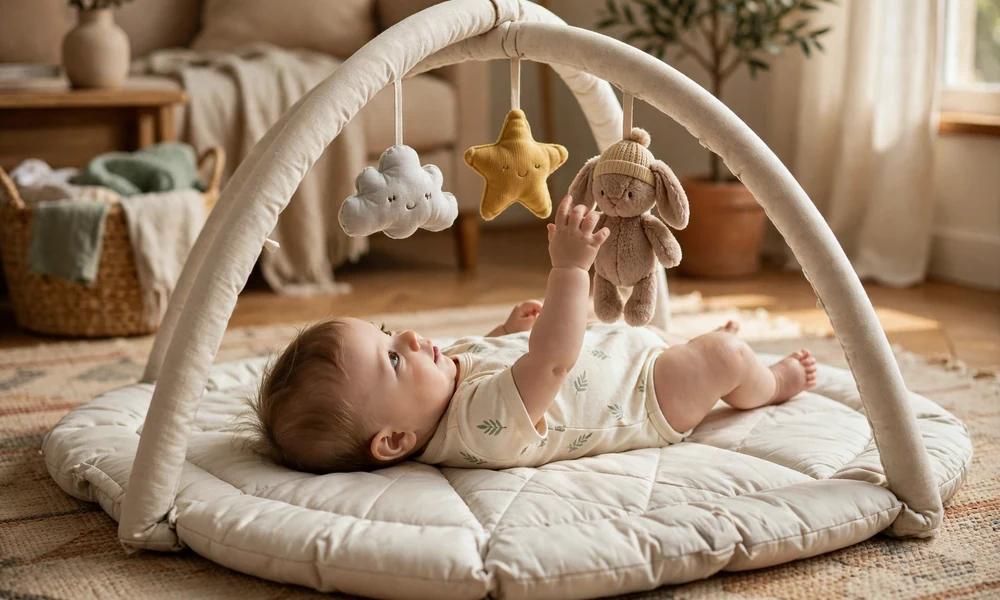
Activity gym mats are the smallest option, and the one most families buy first. A round or square padded mat comes with two soft arches overhead, and toys hang from the arches for a baby lying on their back to look at and bat at. They are made for the youngest babies, from the first weeks until the baby starts rolling and sitting, and they are outgrown sooner than the other types. If you buy one, choose arches that come off easily, so the mat can keep being used on its own once the arches are put away.
How to Choose: The Six Things That Matter Most
Start with size. Measure the space where the mat will live, then choose a mat that fills it without blocking a doorway or a cupboard. A mat that is too small leaves a baby half on the mat and half on the hard floor, which defeats the purpose. A mat that is too big becomes a trip hazard at its edges. For most living rooms, a mat of about one metre by one and a half metres is a good middle ground, big enough for a baby and a parent to sit on together.
Thickness comes next, and it matters more than it looks. A mat of about one to two centimetres of foam takes the hardness out of a wooden floor. Thinner mats feel little better than the floor itself, while very thick mats can be wobbly for a baby learning to sit. Press the mat with your hand before you buy if you can: it should give a little and spring back, not stay dented and not feel like a board.
Material is third. Most foam mats are made from EVA foam or a similar soft foam, often with a wipe-clean coating. Fabric mats are usually cotton with a padded filling. Either can be a good choice, but check the care label and the maker’s guidance before you buy. A mat that needs special cleaning will be cleaned less often than one that can be wiped down with a damp cloth, and a baby’s mat needs cleaning often.
Grip is fourth, and it is easy to overlook until the mat slides across the floor. The underside should grip the floor, or the mat should be heavy enough to stay put. A mat that slides when a baby pushes against it is frustrating for the baby and worrying for a parent. If your floor is very smooth, look for a mat with a textured or non-slip base, and test it on your own floor in the first week, when it can still be returned.
Cleaning is fifth. Babies spill milk, dribble and have nappy leaks on their mats, so cleaning should take a minute, not an afternoon. A wipe-clean foam surface is the easiest to live with: a damp cloth, a little mild soap, and it is dry in minutes. Fabric mats need washing and drying time, so they suit a home with a spare mat or a fast drying space. Whichever you choose, read the cleaning guidance first and follow it, because harsh cleaners can damage the surface and leave a smell a baby will not like.
Finally, think about storage and travel. A mat that folds flat or rolls up will be used far more than one that has to stay out all the time. If you visit grandparents often, a light foldable mat that fits in a car boot is worth its weight. If the mat lives in one room, a heavier mat that stays put is fine. Either way, choose a mat that fits your home as it really is, not as it looks in a photograph.
Safety and Age Guidance
Always use a play mat with a baby in sight, on the floor, and never as a sleep surface. A baby should sleep on a firm, flat surface made for sleep, with nothing soft around them, and a play mat is not that surface. Our guide to the best cribs of 2026 covers sleep spaces in detail, and it is worth reading before you set up the nursery, because the mat and the crib have different jobs and should never be mixed.
Follow the maker’s age guidance on the packaging, and check it again as the baby grows. Activity gyms suit the youngest babies, while bigger foam mats suit babies who are rolling, sitting and crawling. A mat that was perfect at three months may be too small or too soft at nine months, when a baby is pulling up to stand and needs a firmer surface under their feet. Move up a size when the baby starts to outgrow the mat, not when the mat starts to look worn.
Supervision is the part no mat can replace. A mat makes the floor softer, but it does not watch the baby. Stay in the room, keep the baby within reach, and treat the mat as a place to play together, not a place to leave a baby while you do something else. For times when you need to step away, our guide to the best baby monitors of 2026 explains how monitors can help you keep an ear on the nursery, but a monitor is not a substitute for being in the room during play.
Cleaning and Everyday Care
An adult yoga mat is not a good substitute for a baby play mat, even though the two look similar at a glance. Yoga mats are thinner, firmer and made for an adult’s grip, not for a baby’s knees, and they are often too small for a baby and a parent to share. Our guide to the best yoga mats of 2026 is useful if you want a mat for your own exercise, but keep the baby’s mat separate, softer and bigger, and clean the two in the way each maker recommends.
Setting Up a Play Corner
Choose one corner of the room and keep it for play. Put the mat down, add a basket of toys beside it, and keep the rest of the room clear. A defined corner helps a baby learn where play happens, and it helps a parent tidy up in a minute at the end of the day. Keep the mat away from radiators, open fires, trailing cords and anything that can be pulled down, and keep it out of direct sunlight, which can fade colours and warm foam uncomfortably.
What to Avoid When Buying a Baby Play Mat
Avoid mats that are too thin to cushion a hard floor. A mat that looks thick in a photograph but feels like a sheet of paper in real life will not protect knees and elbows, and it will not be used for long. If you cannot feel the mat before buying, read the thickness in the description and be wary of mats that do not state it at all.
Avoid mats with small detachable parts, loose strings or decorations that a baby can pull off and chew. Hanging toys on an activity gym should be firmly attached and short enough that they cannot wrap around a baby. Avoid mats with a strong chemical smell when first opened, and air a new mat out in a ventilated room before the baby uses it, following the maker’s guidance.
Frequently Asked Questions
When can a baby start using a play mat? Most families start in the first weeks, with a baby lying on their back on a soft mat for short, supervised periods. Follow the maker’s age guidance and your own judgement, and start with a few minutes at a time, building up as the baby gets used to the floor. If you are unsure, ask your health visitor or doctor.
How big should a baby play mat be? Big enough for the baby to roll and stretch without reaching the hard floor, and big enough for a parent to sit on it too. For most homes, a mat of about one metre by one and a half metres works well, but a smaller mat suits a small room and a larger mat suits a family that plays on the floor together every day.
Can a baby sleep on a play mat? No. A play mat is for supervised play on the floor, not for sleep. Babies should sleep on a firm, flat surface made for sleep, with nothing soft around them. If a baby falls asleep on the mat during play, move them to their proper sleep space.
How do you clean a baby play mat? Wipe a foam mat with a damp cloth and a little mild soap, then let it dry fully before use. Wash a fabric mat according to its label. Avoid harsh cleaners and strong smells, and clean up spills straight away rather than leaving them to dry on the surface.
The best baby play mat is the one that fits your floor, your routine and your baby’s age. Choose a mat that is thick enough to cushion, big enough to play on, easy to clean and safe to use with supervision, and it will be the most used thing in the room. Choose on looks alone, and you will be choosing again far sooner than you planned.


