
The best seed trays of 2026 are the ones that give every seedling the same fair start: damp soil that never waterlogs, roots with room to grow, and a tray stiff enough to lift without spilling a single plant. This guide judges seed trays on their own, as a single piece of equipment, not as part of a bundle.
Key Takeaways
- Buy the tray for the plants you actually grow: tomatoes and peppers need deep cells, while lettuce and herbs are happy in small shallow ones.
- A rigid tray beats a flimsy one every time, since a tray that flexes spills soil and snaps roots the first time you lift it full.
- Every cell needs a drainage hole and every tray needs a solid base tray, or roots will sit in water and the windowsill will flood.
- Standard 1020 sizing matters more than brand, because trays, inserts and base trays that share the same footprint stack and swap without fuss.
- Reusable trays cost more once and last for years, while thin disposable trays crack in their first spring and cost more per seedling in the end.
Seed Trays 2026 at a Glance
| Tray | Best For | Cells | Standout Strength |
|---|---|---|---|
| Standard cell tray | Most gardeners | 24 to 72 | Even germination, easy handling |
| Deep-cell tray | Tomatoes, peppers | 12 to 24 | Room for strong roots |
| Flat 1020 tray | Microgreens, soil blocks | None | One size fits every insert |
| Fibre tray | Plants that hate moving | 8 to 20 | Roots move outside undisturbed |
| Silicone tray | Small sowings, herbs | 6 to 12 | Seedlings pop out cleanly |
| Mesh-bottom tray | Bottom watering | 24 to 40 | Water soaks up evenly |
What a Seed Tray Is, and What It Is Not
A seed tray is a shallow container, divided into cells or left flat, in which seeds germinate and seedlings grow until they are strong enough to move on. A seed tray does not warm the soil, light the seedlings, or hold humidity on its own. Our guide to the best seed starting kits of 2026 covers the bundled systems that include those extras, for anyone starting from nothing. This guide is for the tray itself, the part you will still be using long after the first dome has yellowed and the first heat mat has given up.
The neighbours matter too. A raised bed is an outdoor frame filled with soil where plants grow to full size: the destination for your seedlings, not the place they start. A greenhouse stretches the season for plants already growing, while a seed tray is the indoor first step on a windowsill or a shelf. A plant pot houses one plant for months; a seed tray holds dozens for a few weeks.
The Main Types of Seed Tray
Seed trays fall into a handful of types, and each suits a different kind of gardener. The right choice depends less on taste than on how much space you have, how often you are home to water, and what you plan to grow.
The Standard Cell Tray: The Best Seed Tray Overall
The classic cell tray is the safest choice for most homes: a rigid tray divided into square cells, each with its own drainage hole, sitting inside a solid base tray. It is the best seed tray overall in 2026 because it does the ordinary job better than anything else. The 40-cell size is the sweet spot for most gardeners.

Deep-Cell Trays and Root Trainers
Some plants stay indoors for six to eight weeks and need room to build a root system that can support a fruiting plant. Tomatoes, peppers, chillies and squash are the obvious ones, and they are the reason deep-cell trays exist. A deep cell is six centimetres or more from top to bottom, twice the depth of a standard cell, and it lets the root run straight down instead of circling a shallow pot.
The Flat 1020 Tray
The flat 1020 tray has no cells at all, just a shallow rectangular base about ten inches by twenty, and it is the most useful tray a gardener can own. It is a base tray, a drip tray, a bottom-watering tray and a carrying tray all at once. The number matters: 1020 is the standard size, and almost every cell insert, dome and base tray on the market is made to fit it.
Biodegradable Fibre Trays
Biodegradable trays are made from pressed peat, coir or recycled paper fibre, and they solve the one problem rigid trays cannot: transplant shock. The seedling goes outside still in its cell, the fibre breaks down in the soil, and the roots never get handled at all. That makes them the best seed tray for plants that dislike being moved, like cucumbers, courgettes, sweet peas and poppies. The trade-off is real. Fibre trays dry out faster than plastic, soften when they stay wet, and fall apart if you handle them roughly when damp.
Silicone and Metal Trays
Silicone trays are the newcomer, and they earn their place on small sowings. The soft cells flex, so a seedling pops out with its soil block intact instead of needing to be prised free, and they wash clean in seconds. They suit herbs, chillies and a first try at seed sowing, where six or twelve plants are enough. They are not a tray for a full vegetable patch, because large silicone trays sag under wet soil and cost far more per cell than plastic. Metal trays last for decades but cost several times what plastic costs.
Cell Size and Tray Depth
Cell size is where most seed tray purchases go wrong. A cell that is too small forces the seedling to become rootbound before it has two sets of true leaves, and a cell that is too large holds wet soil around a tiny seed that rots before it sprouts. Lettuce, basil and most flowers suit standard three to four centimetre cells. Large seeds such as tomatoes, peppers and squash need deep cells of six centimetres or more, because they stay indoors for six to eight weeks.
Materials: Rigid Plastic, Fibre, Silicone and Metal
The material of a seed tray decides how long it lasts, how it handles water, and how it feels in the hand. Rigid plastic is the workhorse. A thick polypropylene tray holds its shape when lifted full and survives five seasons or more. Thin polystyrene trays are the opposite: cheap, light and brittle, they crack at the first lift and usually end up in the bin after one season.
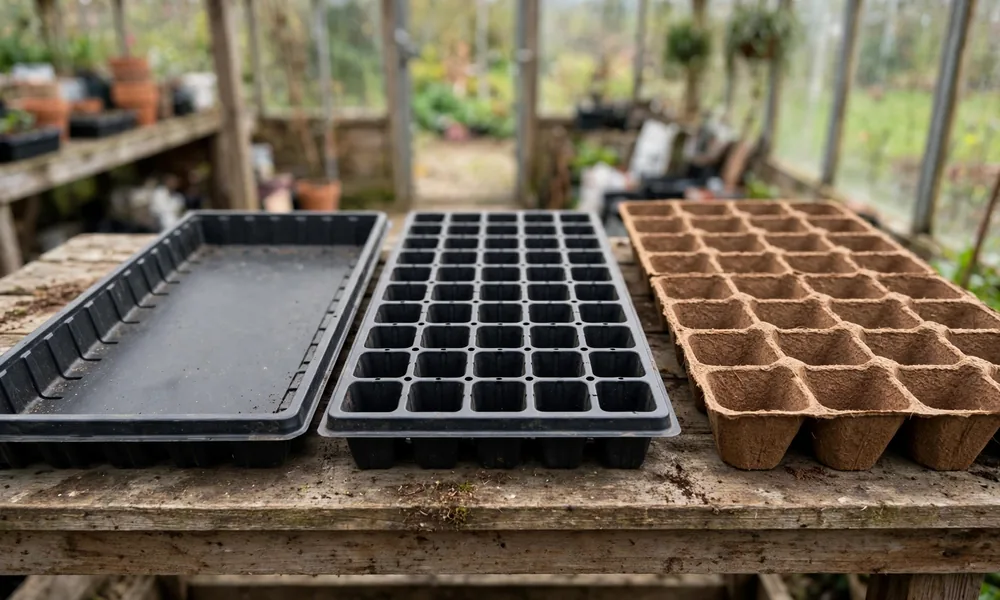
Fibre trays trade durability for kindness to roots, and they suit a gardener who values the plant over the equipment. Silicone trades capacity for ease, and it suits small sowings where every seedling counts. Metal trades price for permanence, and it suits a gardener who sows in the kitchen and wants equipment that looks as good as it works.
Drainage, Base Trays and Bottom Watering
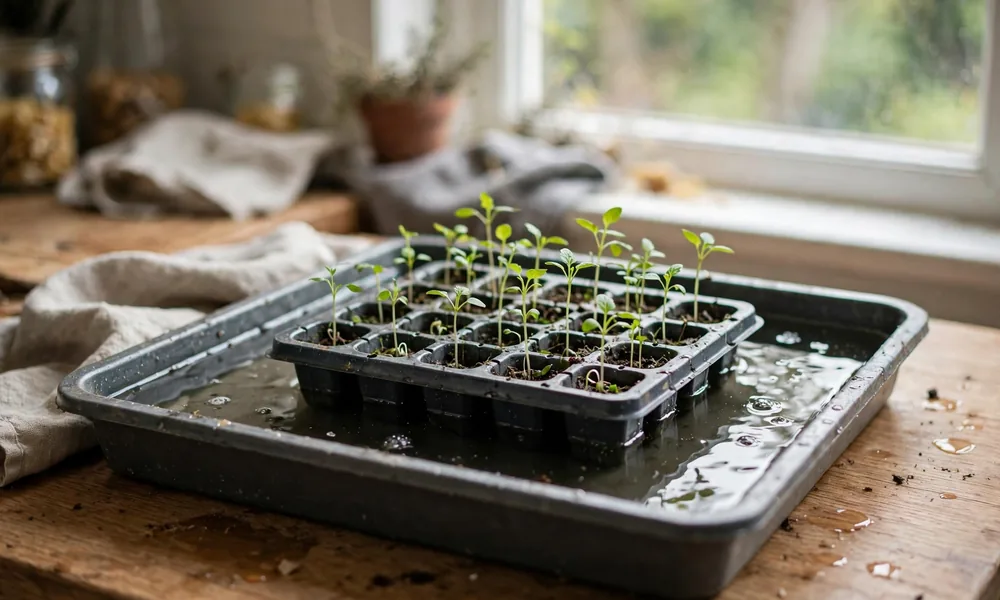
Drainage matters more than looks, and it is the first thing to check on any seed tray. Every cell needs a hole in the bottom, big enough to drain but small enough to hold the soil in. A tray with no holes leaves roots sitting in water, and a tray with holes but no base tray leaves a puddle on your windowsill. The pair is the product: a cell insert that drains, and a solid base tray that catches. Set the insert in a few centimetres of water for ten minutes, then drain the base tray. For the watering itself, a fine rose or a small can makes the job gentler, and our guide to the best watering cans of 2026 covers the ones that suit indoor seedlings.
Durability, Cleaning and Storage
A rigid tray that survives five seasons costs less per seedling than a thin tray that cracks in its first spring. Check the thickness of the plastic, the stiffness of the cells, and the strength of the base tray, because a base tray that flexes will spill water across the shelf the first time you lift it full. At the end of the season, clean every tray before you put it away: brush off the old soil, wash in warm soapy water, and rinse in a weak disinfectant if last year brought damping-off or green mould. Dry the trays fully before stacking them, because trays stored damp grow mould in the dark.
How to Use a Seed Tray Well
A good tray still needs a good routine, and the routine is simple. Fill the cells loosely with seed starting mix, never garden soil, which is too heavy for a small cell and often brings damping-off fungus with it. Sow at packet depth and water from below. Cover the tray only until the seeds germinate, then give the seedlings light and air, because warm damp still air is exactly what damping-off fungus needs. Move the tray outside for a few hours a day over a week before transplanting, so the seedlings harden off instead of stalling in the cold.
Before You Buy: A Short Checklist
- Choose the cell size for the plants you grow.
- Check that every cell has a drainage hole and that the base tray is solid and stiff enough to lift when full.
- Buy the standard 1020 size so inserts, domes and base trays all fit together.
- Flex the tray before you buy it, and skip any tray that creases or feels brittle.
- Count how many plants you actually need.
- Plan where the tray will live, because a sunny windowsill alone is rarely enough light in early spring.
Frequently Asked Questions
What size seed tray should I buy first?
A 40-cell tray in the standard 1020 size is the best first tray for most gardeners. The cells are big enough for tomatoes, peppers, lettuce and herbs alike.
Do seed trays need drainage holes?
Yes, every cell needs a hole, and the tray needs a solid base tray underneath to catch the water. A tray with no holes leaves roots sitting in water until they rot.
Are reusable plastic trays better than biodegradable ones?
For most plants, yes, because a rigid plastic tray lasts for years and costs less per seedling. Biodegradable fibre trays are better only for plants that hate transplanting, like cucumbers and sweet peas.
Can I reuse a seed tray next year?
Yes, if it is rigid plastic, silicone or metal. Clean it at the end of the season, wash it in warm soapy water, rinse it in a weak disinfectant, and dry it fully before stacking.
How do I stop seedlings going leggy in a tray?
Give them more light and cooler air. A sunny windowsill often gives only a few hours of direct light in early spring, so seedlings stretch toward it and grow pale and weak.
When should seedlings leave the tray?
Move them on when they have two sets of true leaves and the roots hold the soil block together when you lift the seedling out. If the roots are circling the bottom of the cell, you waited too long.
The Bottom Line
The best seed tray in 2026 is a rigid 40-cell tray in the standard 1020 size, with a drainage hole in every cell and a solid base tray underneath it. It is not the cheapest tray, and it is not the cleverest, but it is the one that will still be on your windowsill in five years, raising its fifth season of seedlings without a crack or a spill. Once your seedlings are ready, our guide to why raised garden beds grow better vegetables in 2026 is the natural next step.


