Knitting Needles That Make Every Stitch Even in 2026
Knitting needles that make every stitch even in 2026 are the tools that turn a ball of wool into a sweater you actually want to wear, because even stitches are what make hand-knitted fabric look smooth, drape well, and fit the way the pattern intended. The right needles let the yarn glide without sticking or slipping, hold the stitches at a steady size, and feel comfortable in your hands for an evening of knitting. The wrong needles snag the yarn, drop stitches, or tire your wrists, and the finished piece shows every struggle. This guide compares the needles that earn their place in a knitter’s basket and explains how to choose a pair that keeps your tension steady from the first row to the last.
Knitting is a two-needle craft: you form loops of yarn on one needle and pull new loops through them with the other, building fabric one row at a time. That simple action is what makes knitting needles different from their nearest neighbours. A crochet hook is a single hook that pulls loops through loops one stitch at a time, a different craft with a different rhythm and a different fabric. Yarn, meanwhile, is the fibre itself, the wool, cotton or blend you knit with, not the tool that shapes it. The needle is the shaping tool, and its material, size and shape decide how the yarn behaves in your hands.
Key Takeaways
- Knitting uses two needles to form loops, unlike crochet, which uses a single hook: the tools are not interchangeable, and each makes a different fabric.
- Match the needle size to the yarn weight first, because a needle too large makes loose, holey fabric and a needle too small makes stiff, tight fabric.
- Wood and bamboo grip the yarn and suit slippery fibres and beginners, while metal lets yarn glide fast and suits confident knitters.
- Circular needles handle flat knitting and knitting in the round, and they carry the weight of a large project better than straight needles.
- Check your gauge before you start a garment, because the needle size that gives the pattern’s gauge is the right size, whatever the ball band says.
How We Judged
We judged every needle the way a knitter actually uses one at home: casting on, knitting a swatch in stocking stitch, then trying garter stitch, ribbing and a simple lace repeat, in wool, cotton and a slippery acrylic blend. We noted how smoothly the yarn moved, whether stitches stayed put when the work was set down, whether the tips were sharp enough for fine work without splitting the yarn, and whether the joins on circular needles caught the yarn. A needle scored well when it kept stitches even, felt comfortable after an hour, and worked across more than one fibre.

What a Knitting Needle Actually Is
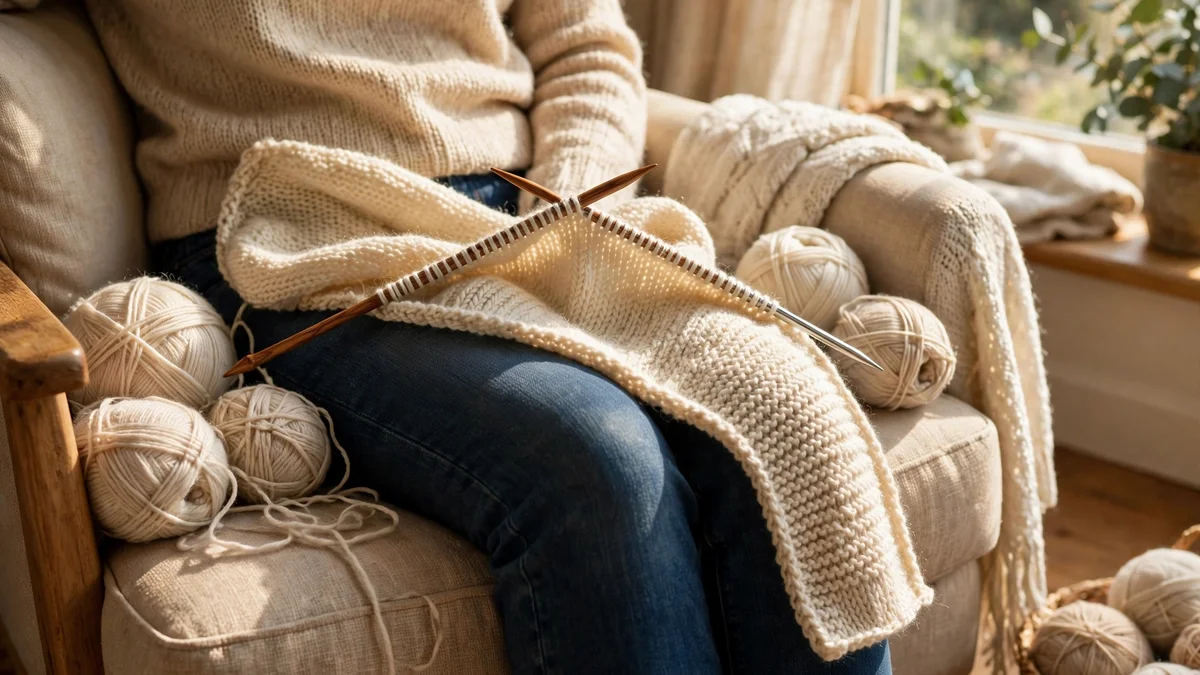
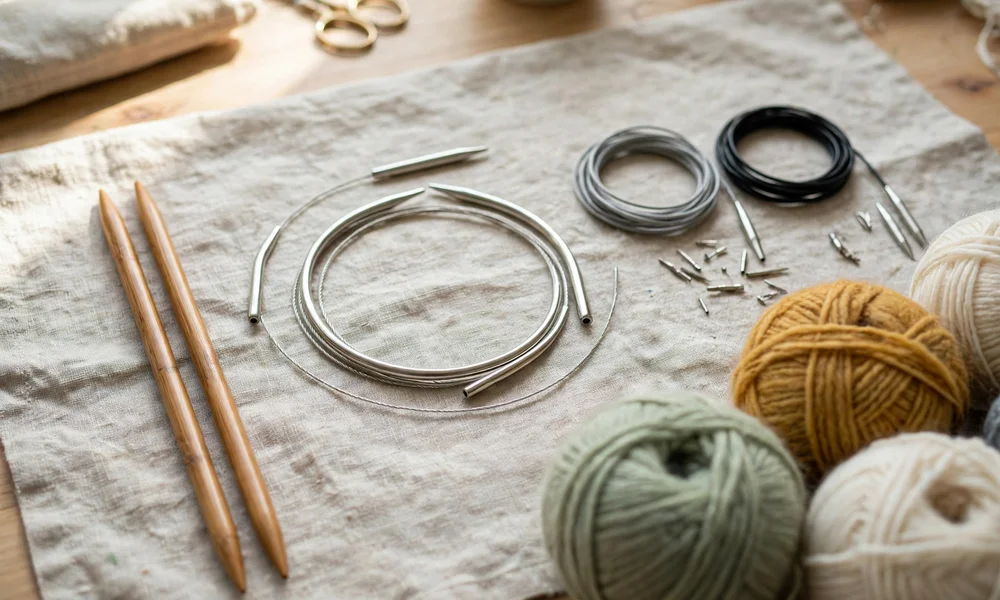
A knitting needle is a long, tapered rod with a point at one end, made to hold loops of yarn and form new ones. Straight needles come in pairs, with a stopper at the far end so stitches cannot slide off. Circular needles join two short tips with a flexible cable, so the stitches rest on the cable while you work. Double-pointed needles have points at both ends and come in sets of four or five, for knitting small tubes such as socks and sleeves. Interchangeable sets let you screw different tips onto different cable lengths, so one set covers many projects.
The size of a needle is its diameter, measured in millimetres, and it decides the size of each stitch. A four-millimetre needle makes a medium stitch suited to double-knitting yarn, while a six-millimetre needle makes a chunkier stitch for aran yarn, and a three-millimetre needle makes the fine fabric of a sock. The ball band on a yarn suggests a needle size, but that is only a starting point: your own tension, the fabric you want, and the pattern’s gauge all matter more.
Material changes the feel more than any other choice. Wood and bamboo are warm, light and slightly grippy, so stitches stay where you put them and slippery yarns behave. Metal is smooth, cool and fast, so stitches glide and knitting speeds up, but a slick yarn can slide off if you set the work down. Plastic is light and cheap, and suits chunky yarns, but can feel bendy in long lengths. There is no single best material, only the material that suits your yarn and your hands.
The Main Types Compared
Four types cover almost every project, and most knitters start with one and add the others as their ambitions grow. Straight needles are the classic first pair: simple, cheap, and ideal for scarves, blankets and flat pieces. Circular needles are the versatile workhorse: they knit flat pieces back and forth, knit tubes in the round, and hold the weight of a large blanket or sweater in your lap instead of on your wrists. Double-pointed needles are the small-tube specialists, for socks, mittens and sleeve cuffs. Interchangeable sets are the investment buy, replacing a drawer full of fixed needles with one organised case.
| Needle type | Best for | Typical sizes | Watch out for |
|---|---|---|---|
| Straight pair | Scarves, blankets, flat pieces | 3–8 mm | Heavy on large projects |
| Circular | Sweaters, hats, blankets | 3–8 mm, many cable lengths | Joins can snag yarn |
| Double-pointed set | Socks, mittens, sleeves | 2–5 mm | Fiddly for beginners |
| Interchangeable set | Many projects, one case | 3–10 mm tips | Costly upfront |
| Short straight | Small flat pieces, children | 3–5 mm | Too short for wide work |
Materials and How They Behave
Bamboo is the gentle teacher. It is light, warm, and grippy enough to hold stitches still, which makes it forgiving for beginners and for slippery yarns such as silk and bamboo blends. Its drawback is that it can feel slow, and a very fine bamboo needle can snap if it is bent. Hardwood needles, in birch, beech or rosewood, are smoother and stronger than bamboo, with a polished glide that suits most yarns, and they are the favourite of many experienced knitters.
Metal needles are the fast lane. Stainless steel and nickel-plated brass let yarn slide freely, so your hands move quicker and ribbing feels effortless. They suit confident knitters and tight knitters, whose firm tension benefits from the extra glide. Their drawback is slipperiness: a loose knitter may find stitches sliding off, and metal can feel cold and hard on the hands in winter. Aluminium is lighter and cheaper than steel, but can bend in thin sizes.
Getting Even Stitches
Even stitches come from steady tension, and the needle helps or hinders that. A needle that is too slippery lets stitches slide to different sizes, while a needle that is too grippy makes you tug the yarn and tighten some stitches more than others. The right needle lets each stitch form at the same size with the same gentle pull, so the fabric looks smooth and the rows line up.
Comfort matters on a long project. Hold the needles the way you naturally knit, and notice whether your wrists ache, your fingers cramp, or the needles feel too long or too short. Circular needles often help sore wrists, because the weight of the project rests in your lap on the cable instead of hanging from straight needles. Shorter tips suit small hands, and a lighter material suits anyone who knits for hours at a time.
Common Mistakes to Avoid
The most common mistake is knitting a garment without checking gauge, which is how a sweater meant for a medium ends up fitting a child or a tent. Another is using the wrong needle length: stitches stretched around a circular cable that is too long will be uneven, and stitches crowded onto a cable that is too short will be hard to move. A third is mixing needle sizes in one project, because even a half-millimetre difference shows as a band of tighter or looser fabric.
Choosing Your First Set
If you are buying your first knitting needles, start with a pair of straight bamboo needles in four millimetres, with a ball of double-knitting wool. That combination is forgiving, affordable, and suited to a scarf, which is the project most beginners start with. Learn to cast on, knit and purl on those needles, and only then branch out: a circular needle in the same size will let you knit a hat, and a set of double-pointed needles will let you finish it.
Price is a poor guide on its own. The cheapest needles often have rough tips and loose stoppers, while the most expensive ones sometimes charge for a brand name rather than better engineering. Hold the needles, run yarn over the tip, and check the join with your fingertip. A mid-priced needle with a smooth tip and a comfortable weight will out-knit a dear one that feels wrong in your hands. The finished pieces are the point, after all: a well-knitted sweater, like the ones in our guide to choosing a sweater that will not pill, shrink or itch, starts with needles that keep every stitch even. Warm feet matter too, and the yarn you choose for socks, as in our guide to wool socks that keep feet warm without the itch, behaves best on needles matched to its weight. And if you are building a wider craft kit at the same time, our guide to sewing kits that cover every quick fix shows what else belongs beside the needles in the basket.

Knitting Needle Checklist
- Start with straight bamboo needles in 4 mm and a ball of double-knitting wool.
- Match the needle size to the yarn weight, then adjust for your own tension.
- Knit, wash and measure a gauge swatch before starting any garment.
- Choose grippy wood for slippery yarn and smooth metal for sticky yarn.
- Check circular needle joins with your fingertip before you buy.
- Store needles in a case with tips protected, pairs kept together.
Frequently Asked Questions
What size knitting needles should a beginner buy?
Four millimetres, in straight bamboo, with double-knitting yarn. That size is easy to hold, easy to see, and forgiving while you learn to keep your tension steady.
Are knitting needles and crochet hooks the same thing?
No. Knitting uses two needles to form loops, while crochet uses a single hook to pull loops through loops. They are different crafts, make different fabrics, and their tools are not interchangeable.
Should I buy straight or circular needles?
Start with straight needles for flat pieces, then add a circular needle when you want to knit a hat or a sweater, or when a large project gets heavy on straight needles.
Why are my stitches uneven?
Usually because your tension varies, or because the needle is too slippery or too grippy for your yarn. Try a different material, knit more slowly, and check your gauge on a swatch.
Do I need an interchangeable needle set?
Not at first, but if you knit regularly an interchangeable set is good value, replacing many fixed needles with one case of tips and cables in the sizes you use most.
How do I know which needle size a pattern needs?
Follow the pattern’s gauge, not just the ball band. Knit a swatch with the suggested size, measure it, and go up or down a size until your gauge matches the pattern.
Bottom Line
The best knitting needles are the ones that suit your yarn, your tension and your hands: for most knitters that is a smooth, well-finished needle in the right size, grippy wood for slippery yarn and slick metal for sticky yarn, with circular needles for larger projects and double-pointed needles for socks. Start with a simple bamboo pair, check your gauge before every garment, and let the needles disappear into the rhythm of the knitting. Even stitches are not a gift; they are the result of the right tool and a little practice, and the right needles make the practice a pleasure.