Knitting patterns you’ll actually finish in 2026 are the ones that match your skill level, your yarn and the hours you honestly have. Most unfinished projects do not fail at the knitting — they fail at the choosing. A beautiful pattern means nothing if it asks for a yarn weight you do not own, a technique you have never tried, or forty evenings you will never find. This guide explains how to read a pattern the way an experienced knitter does, so the next project you start is one you will wear, gift or use.
Key Takeaways
- A knitting pattern is a set of instructions for a design, not the tools or the yarn — read it as a plan before you buy anything.
- Match the pattern to your real skill level, not the knitter you hope to be by Christmas.
- Check the yarn weight, gauge and finished measurements first: those three numbers decide whether the piece fits.
- Estimate the time honestly — a scarf takes a few evenings, a first jumper takes several weeks.
- Knitting builds fabric row by row on two needles, while crochet builds it stitch by stitch with a single hook, so the two kinds of pattern are never interchangeable.
What a Knitting Pattern Actually Is
A knitting pattern is the written design for a finished piece: the stitch sequence, the shaping, the sizes, the yarn it was made in and the order you work in. It is not the tools and it is not the material. The knitting needles hold the live stitches and form each new loop; the yarn is the fibre those loops are made from.
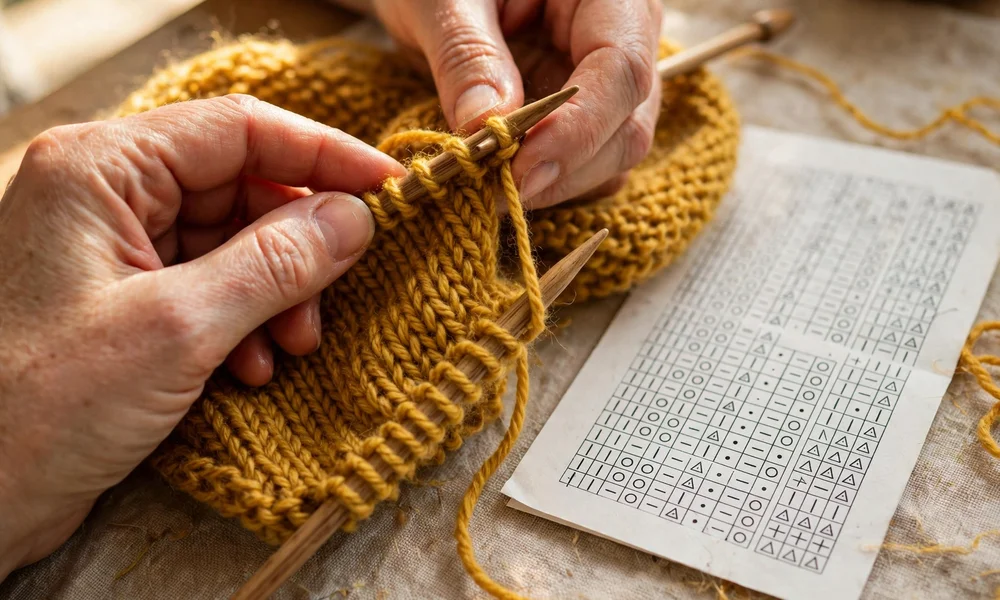
Knitting is a two-needle craft. You form loops on one needle and pull new loops through them with the other, building fabric one row at a time, with a whole row of live stitches held open at once. Crochet is different: a single hook pulls loops through loops one stitch at a time, so only one stitch is live. The two crafts share yarn and patience, but a knitting pattern cannot be crocheted and a crochet pattern cannot be knitted. Patterns come written out in words, drawn as symbol charts, or both; the best also add a schematic, a flat drawing of the finished piece with its measurements marked. A good pattern gives you the finished measurements, yarn weight and quantity, needle size, gauge and skill level before the first instruction.
How We Judged
We judged patterns the way a knitter actually uses one: reading the whole pattern before casting on, knitting a gauge swatch, then working the piece as written. We checked whether the instructions were clear at the shaping points, whether sizes were given as finished measurements, and whether yarn quantities were realistic. A pattern scored well when it was honest about its difficulty.
The Main Types Compared
Most patterns fall into a few families. Scarves and cowls are the classic first projects: no shaping, finished in days. Hats add shaping in the round and teach decreases. Blankets are simple stitches repeated over a long time. Baby knits are small, quick and forgiving, which makes them the best first garments. Jumpers are the real test: shaping, sizing and weeks of steady work. Socks are small but technically demanding, with heels and gussets that punish a careless reading.
| Pattern type | Best for | Typical time | Watch out for |
|---|---|---|---|
| Scarf or cowl | First projects, gifts | A few evenings | Boring stitch repeats |
| Hat | Learning decreases | One weekend | Sizing in the round |
| Blanket | Relaxed, long projects | Several weeks | Yarn cost adds up |
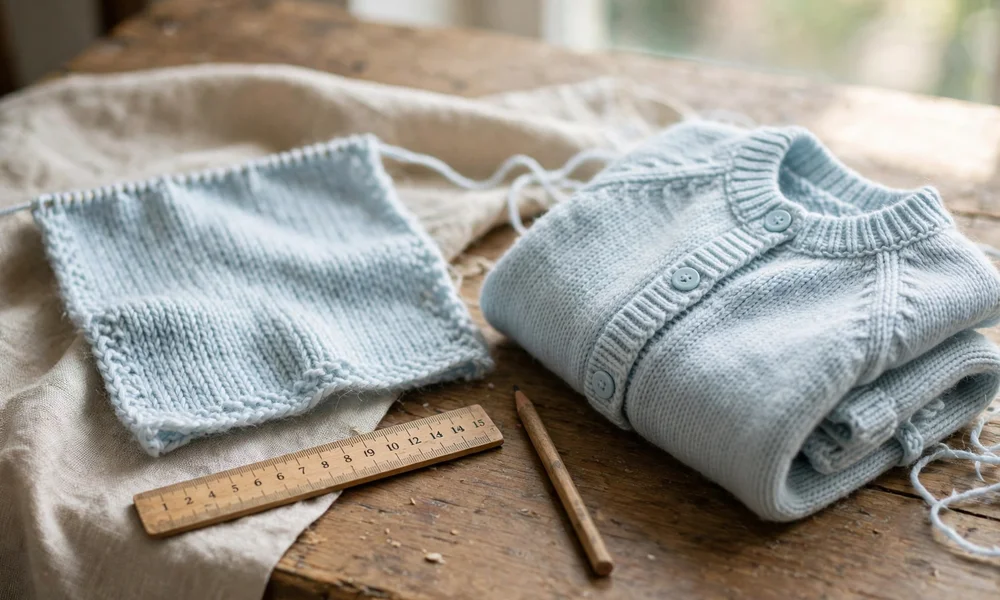
| Baby cardigan | First garment | A few evenings | Tiny buttons and seams |
| Jumper | A garment to wear | Four to eight weeks | Gauge and fit matter most |
| Socks | Portable knitting | One to two weeks | Heel and gusset shaping |
The table is a starting point, not a promise. What matters is the combination of stitch complexity, size and yarn weight: fine yarn means more stitches, and a complex stitch pattern means slower knitting on every one of them.
Reading a Pattern Before You Buy It
Read the whole pattern before you cast on, the way you would read a recipe before cooking. Check the skill level sceptically: one designer’s “easy” is another’s “intermediate”, because there is no standard scale. Look at the techniques listed instead. If the pattern needs short rows, provisional cast-ons or grafting, and you have never done those things, it is not an easy pattern for you, whatever the label says.
Next, check the finished measurements and the schematic. A jumper listed as size medium means nothing; a jumper with a finished chest of 104 centimetres and a body length of 58 centimetres tells you exactly what you will get. Compare those numbers with a jumper you already own and like — knitted fabric needs ease, the extra room that lets it drape instead of cling. Then look at the yarn requirements with a calculator, not a wish. Substituting a different yarn in the same weight usually works; substituting a different weight does not. Check the yardage for your size, add ten percent, and price it before you fall in love with the design.

Matching the Pattern to Your Skill Level
Pick a pattern one small step beyond what you have already finished, not three steps beyond it. If you have knitted scarves, a hat is the right next step: it adds knitting in the round and simple decreases, and a mistake costs an evening, not a month. If you have knitted hats, a baby cardigan is next: shaping and button bands, but small enough to finish while your enthusiasm lasts. If you have knitted a cardigan, try a jumper; if you have knitted a jumper, try lace or colourwork. Each step teaches one or two new skills.
Watch for the quiet signs of a well-written pattern for your level. Beginner patterns repeat the same row instructions rather than saying “continue in pattern”, and they explain the cast-on and the finishing. Intermediate patterns give you the stitch counts at the end of every shaping section, so you can check your work before the mistake travels ten rows. Whatever your level, a pattern that never tells you how many stitches you should have leaves you guessing at the exact moment guessing is most expensive.
Yarn Weight, Gauge and Sizing
Gauge is the number that decides whether the finished piece fits, and it is the step most knitters skip. Gauge means how many stitches and rows you get over ten centimetres in the pattern stitch, on the needles the pattern suggests. If your swatch gives fewer stitches than the pattern asks for, your stitches are bigger than the designer’s and the piece will come out bigger. Change the needle size until your swatch matches, and only then cast on.
Swatching is the cheapest insurance in knitting. A ten-centimetre square takes twenty minutes and tells you whether the yarn and needle combination makes a fabric you like and whether your gauge matches. Wash and dry the swatch as you will wash the finished piece, because wool and cotton change after washing. For sizing, pick by finished measurements, not by the size you buy in a shop: measure a jumper you love, compare it with the schematic, and choose the size that matches.
Time, Cost and the Finish Test
Before you start, run the finish test: can you see yourself knitting this, in this yarn, for this long, and wearing the result? First, the time. A jumper that needs forty hours is a month of knitting an hour and a half a night. Second, the cost. Price the yarn for your size, add the needles if you do not own them, and add the buttons or notions. A pattern is cheap; the yarn is the project. Third, the wearing. Picture the finished piece in your wardrobe, in the weather you actually live in. A heavy cabled jumper in a warm climate is a beautiful object you will never wear.
The finish test also catches patterns that look better in photographs than they feel in the hands. A stitch pattern that is beautiful in a close-up can be tedious over a hundred rows, and a garment with seams that need careful finishing can sit unfinished for months after the knitting is done. If a project does stall, put it down for a week, then decide: either set a small next step, or unravel it and free the yarn. Unravelling is not failure — it is the honest end of a pattern that did not pass the finish test.
Patterns Worth Starting in 2026
Start where the odds are best. A garter-stitch scarf in a yarn you love is the safest first project: no shaping, no sizing, finished in a week. A ribbed beanie is the best second project, teaching knitting in the round and decreases in a single weekend. A baby cardigan is the best first garment: quick, it teaches shaping and button bands, and someone small will wear it with pride. A simple raglan jumper in double-knitting yarn is the best first jumper, because the shaping is straightforward and the fit is forgiving.
For knitters with a few projects behind them, 2026 is a good year for texture: simple cable panels on an otherwise plain jumper, a slip-stitch colour pattern on a hat, or a feather-and-fan lace repeat on a shawl. One new technique carries the whole design, so the knitting stays relaxing and the result looks far more skilled than the work felt. Avoid patterns that combine a new construction, a new stitch and a new yarn all at once. Choose one experiment and keep the rest familiar.
Before You Cast On: A Six-Point Checklist
- Read the whole pattern, including the finishing instructions, before you buy the yarn.
- Check the finished measurements against a garment you already love, not your dress size.
- Knit, wash and measure a gauge swatch, and change needle size until it matches.
- Price the yarn for your size with ten percent extra, in one dye lot.
- List the techniques the pattern needs and confirm you know each one.
- Run the finish test — time, cost and wearing — before the first cast-on stitch.
Frequently Asked Questions
How do I know if a knitting pattern is too hard for me?
Read the techniques list, not the skill label. If the pattern needs three or more techniques you have never tried, it is too hard for now. Choose one that teaches a single new skill.
Can I use a different yarn from the one the pattern suggests?
Yes, if it is the same weight and a similar fibre, and you knit a gauge swatch to confirm. A different weight will change the size and drape of the finished piece.
Why does my finished jumper never match the pattern measurements?
Almost always the gauge. Knit a swatch, wash it, measure it, and change needle size until it matches before you cast on.
What is the easiest knitting pattern for a complete beginner?
A garter-stitch scarf in a medium-weight yarn. It uses one stitch, needs no shaping, and finishes in a few evenings.
How long does a first jumper take to knit?
Most first jumpers take four to eight weeks of regular evening knitting. Chunky yarn and a simple design can halve that; fine yarn can double it.
Can I knit a knitting pattern using crochet instead?
No. Knitting builds fabric row by row on two needles, while crochet builds it stitch by stitch with a single hook. A knitting pattern’s instructions describe knitting actions, and the crochet patterns of the other craft describe different ones entirely.
Bottom Line
The best knitting patterns of 2026 match your skill, your yarn, your gauge and your calendar, and you can picture yourself wearing them when the last end is woven in. Read the whole pattern first, swatch honestly, and choose one new skill at a time.