The best luggage carry-on bags of 2026 are not the biggest bags you can squeeze into an overhead bin, and they are not the cheapest ones on the shelf either. They fit the airlines you actually fly, roll smoothly through crowded terminals, and survive being lifted in and out of overhead bins dozens of times a year. A good carry-on means no baggage carousel waits, no lost luggage, and no checked-bag fees.
Choosing the right carry-on matters more in 2026 than it did a few years ago. Airlines have tightened size and weight rules, budget carriers charge more than ever for checked bags, and the market is crowded with options. With so much choice, it is easy to buy a bag that looks great in the shop and disappoints at the gate, an inch too deep for your airline or with wheels that give up mid-trip.
This guide explains what to look for, compares the main types side by side, and covers the sizes, features, and packing habits that separate a bag you love from one you regret.
Key takeaways
- Most airlines cap carry-on size at around 22 x 14 x 9 inches, including wheels and handles, so measure the full bag before you buy.
- Hard-shell bags protect fragile items and resist rain; soft-sided bags flex into tight bins and offer exterior pockets.
- Four-wheel spinner bags are easier to manoeuvre through airports than two-wheel bags, especially when fully packed.
- A bag under 7 pounds empty leaves far more weight allowance for what you pack inside.
- Packing cubes and rolling clothes can add an extra day of outfits to the same bag.
What Makes a Great Carry-On Bag
A great carry-on balances competing demands: large enough for several days of clothes, yet small enough for the strictest airline limits you are likely to face. It must be light enough to lift overhead easily, yet tough enough to survive baggage handlers and rain. The best share a few traits: strong, lightweight materials, large smooth wheels, a handle that locks firmly, and a sensible interior with a compression panel and a zippered divider.
Size and Airline Limits
Size is the first filter, and it is the one most buyers get wrong. Most full-service airlines in the United States allow a carry-on of up to 22 x 14 x 9 inches, including wheels and handle. Many international carriers are stricter, closer to 21.5 x 13.5 x 8 inches. A bag labelled as a 22-inch carry-on can measure 23 or 24 inches once you count the wheels, so the number on the tag is not enough on its own. Measure any bag, wheels and handle included, against the smallest limit among the airlines you fly most. Our guide to the best suitcases for couples looks at how two travellers can share packing space.
Hard-Shell vs Soft-Sided
Hard-shell carry-ons, usually made from polycarbonate, have become the default choice for most travellers. The rigid shell protects what is inside from knocks and rain and keeps its shape when half empty. Their main weakness is the lack of an exterior pocket, which means your book and boarding pass need another home during the flight. Soft-sided carry-ons, typically ballistic nylon or heavy polyester, trade some protection for flexibility. The fabric gives a little when you push the bag into a tight bin, the exterior pockets swallow a jacket and a water bottle, and the bag can expand by an inch when you need it to. Travellers who pack fragile items usually prefer hard shells; those who value quick access often prefer soft-sided bags.
Wheels and Handles
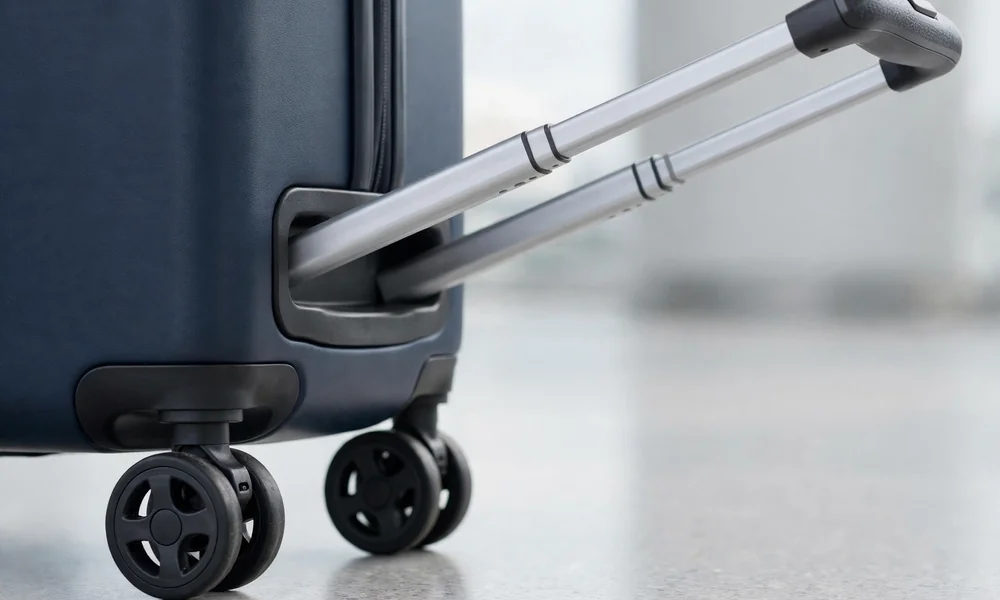
Wheels decide how a bag feels after an hour in an airport. Four-wheel spinner bags roll upright beside you, turn on the spot, and glide down the aisle without tipping. Two-wheel bags tilt and pull behind you, less convenient in a crowd but more stable over kerbs and cobbles. For most travellers, spinners are the better choice, because airports are smooth and crowded. Look for large, quiet wheels set wide apart: small narrow wheels wobble and wear out faster. The telescopic handle should lock firmly at two heights and feel solid, with no side-to-side wobble.
The Best Luggage Carry-On Bags of 2026
There is no single best carry-on for everyone. The comparison below groups the strongest types of 2026 by what they do best.
| Carry-on type | Best for | Typical weight | Key strength | Watch out for |
|---|---|---|---|---|
| Hard-shell spinner | Most travellers | 6 to 8 pounds | Tough, weatherproof shell | No exterior pocket |
| Soft-sided spinner | Flexible packing | 5 to 7 pounds | Exterior pockets, expands | Less protection, absorbs rain |
| Ultralight carry-on | Strict weight limits | Under 5 pounds | Maximum packing allowance | Thinner shell, fewer features |
| Expandable carry-on | Trips that grow | 6 to 8 pounds | Extra inch when needed | Expanded size may exceed limits |
| Business carry-on | Work trips | 6 to 8 pounds | Laptop sleeve, organisation | Smaller main compartment |
| Budget carry-on | Occasional trips | 7 to 9 pounds | Low price, decent durability | Heavier, weaker wheels |
Best Overall Hard-Shell Carry-On
The best overall hard-shell carry-on for 2026 is a mid-size polycarbonate spinner, roughly 21 to 22 inches tall, with double spinner wheels, a two-stage handle, and a TSA-approved lock. Polycarbonate flexes under impact instead of cracking. Inside, look for a zippered divider on one side and compression straps on the other. Weight is the hidden spec: on airlines with a 15-pound limit, the gap between a 6-pound and an 8-pound bag is the margin between carrying on and checking in.
Best Soft-Sided Carry-On
The best soft-sided carry-on suits travellers who pack uneven loads and want quick access on the move. A good one uses tightly woven ballistic nylon, which resists scuffs far better than loose polyester, with a water-repellent coating so rain does not soak your clothes. The front pocket should fit a 15-inch laptop, a jacket, and your travel documents. Soft bags also shine when the bin is nearly full: the fabric gives a fraction of an inch, often the difference between the door closing and the bag being gate-checked.
Best Lightweight Carry-On
Ultralight carry-ons matter most on airlines with strict weight limits, which are common on international and budget routes. Some carriers cap carry-on weight at 15 pounds, or even 11, and a heavy bag can eat a third of that before you pack a shirt. The lightest good carry-ons weigh under 5 pounds empty, thanks to thin shells, minimalist interiors, and smaller wheels. The trade-off is durability: ultralight bags have fewer pockets, thinner handles, and shells that scuff sooner. For family trips, our roundup of the best luggage sets for families covers matched sets in several sizes.
Best Budget Carry-On
You do not need to spend a fortune to get a decent carry-on. Budget bags in 2026 are far better than five years ago, many with spinner wheels, expandable zips, and polycarbonate shells at a fraction of premium prices. The compromises are usually weight, wheel quality, and warranty: a budget bag may weigh more, its wheels may be noisier, and its warranty may cover only a year or two. For an occasional traveller, those compromises are easy to live with. For a weekly flyer, a premium bag that survives five hundred trips costs less per trip than one replaced yearly.
Best Carry-On for Business Travel
Business travellers need a carry-on that works as a mobile office. The best business carry-ons have a padded laptop compartment that opens flat for security, a pocket for chargers and cables, and a sleeve that slides over a larger bag’s handle. Some also include a garment section that keeps a shirt or jacket presentable without a separate bag. The catch is capacity: all that organisation takes space, so a business carry-on holds less clothing than a plain bag of the same size, a fair trade for two- or three-day trips.
How to Pack a Carry-On Like a Pro
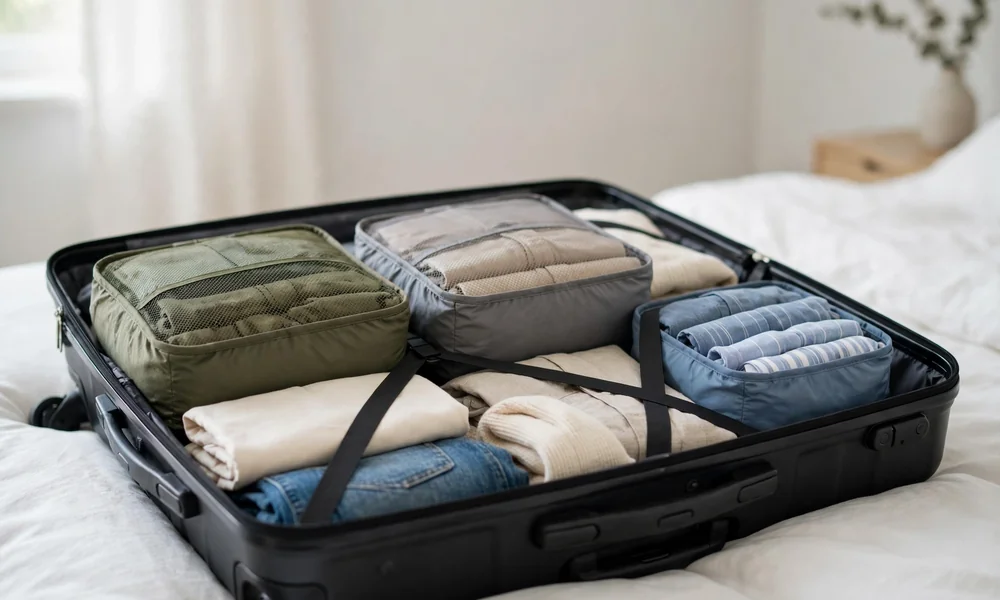
Start by laying out everything you think you need, then remove a third of it. Most travellers pack for the trip they imagine, and the extra shirt and just-in-case jacket are what push a bag over the limit. Roll soft clothes instead of folding them: rolling saves space, reduces creases, and fills gaps around shoes and toiletry bags. Place heavy items at the bottom near the wheels so the bag stays stable, fill shoes with socks and chargers, and keep essentials on top.
Packing cubes are the single most useful carry-on accessory. They compress clothes, keep categories separate, and let you lift one cube out without disturbing the rest. Our guide to the best travel pouches and organizers covers the cubes and toiletry bags that work best inside a carry-on. Pack the same way every time, and the job takes twenty minutes instead of an evening.
Carry-On Packing Checklist
Run through this checklist while the bag is still open: fixing a gap at home beats fixing it at the airport.
- Passport or ID, boarding pass, and payment cards in an accessible pocket.
- Phone charger, cable, and a small power bank, all in one pouch so they are easy to find.
- One full change of clothes and basic toiletries, in case a checked bag goes missing.
- Medication, glasses, and anything irreplaceable, always in the carry-on.
- Headphones, a book or a downloaded show, and a reusable water bottle for the flight.
- A light layer, such as a jumper or a scarf, because cabin temperatures vary widely.
Common Carry-On Mistakes to Avoid
The most common mistake is buying a bag without checking your airline’s exact limits, then discovering at the gate that it is too large or too heavy. The second is overpacking. a bag stuffed to bursting strains its zips and turns every security check into a repacking exercise. Leave a little space: a bag that closes easily lasts longer than one forced shut every time. Another mistake is ignoring the liquids rule: containers of 100 millilitres or less, inside a single clear resealable bag that comes out at security, so pack it at the top. Finally, use your personal item for what you need during the flight, so your carry-on stays closed overhead.
Frequently Asked Questions
What is the standard carry-on size for most airlines?
Most full-service airlines allow up to 22 x 14 x 9 inches, including wheels and handles, but international and budget carriers are often stricter, around 21.5 x 13.5 x 8 inches. Check your airline and measure the full bag before you travel.
Are hard-shell or soft-sided carry-ons better?
Hard-shell bags protect contents better and resist rain; soft-sided bags offer exterior pockets, flex into tight bins, and weigh less. Hard shells suit travellers who pack fragile items; soft-sided bags suit those who value quick access.
How much should a carry-on bag weigh?
A good carry-on weighs 5 to 8 pounds empty. Lighter bags leave more allowance for your belongings, which matters most where limits are 15 pounds or less.
Can I take a carry-on and a personal item?
Yes, most airlines allow one carry-on plus one smaller personal item, such as a handbag or small backpack that fits under the seat. Budget carriers sometimes charge extra, so check the fare rules before you book.
Do spinner wheels or two wheels last longer?
Spinner wheels are more convenient in airports, but their exposed design makes them more vulnerable than recessed two-wheel designs. Double spinner wheels tend to last longest, and some manufacturers sell replacements.
What should I pack in my carry-on instead of checked luggage?
Keep valuables, medication, documents, electronics, chargers, and one change of clothes in your carry-on. These are the items you cannot easily replace if a checked bag is delayed.
The Bottom Line
The best luggage carry-on bags of 2026 are the ones that fit your airline, your packing style, and your trips, not the ones with the most features. Measure before you buy, choose materials that match how you travel, insist on smooth wheels and a solid handle, and pack with a repeatable system. Get those four things right, and your carry-on will stop being something you worry about.