The best solar chargers for camping turn a sunny campsite into a reliable power source, keeping phones, headlamps, cameras and GPS devices charged for days without a wall socket in sight.
Choosing the right one still matters. A panel that is too small will trickle-charge all day and still leave your phone half empty, while a heavy, bulky panel is dead weight on a hiking trip. The difference comes down to wattage, panel quality, ports, weather resistance and weight.
This guide compares the best solar chargers for camping in 2026, from featherweight panels for backpackers to powerful foldable arrays for family base camps. You will find a comparison table, picks for every kind of trip, a buying checklist and answers to the questions campers ask most.
Key takeaways
- A 20 to 30 watt foldable panel suits most campers, charging a phone in two to three hours of direct sun.
- Monocrystalline panels charge faster and handle partial shade better.
- Pair a panel with a power bank to store sunshine by day and charge devices at night.
- Look for USB-C output, an IPX4 rating or better, and a panel that folds small enough for your pack.
- Angle the panel at the sun and avoid shade, since small shadows cut output sharply.
How Solar Chargers Work at a Campsite
A camping solar charger is a set of photovoltaic cells that convert sunlight into electricity, feeding it through USB ports to your devices or into a built-in battery. Most camping panels use monocrystalline silicon, the most efficient cell type widely available, at around 22 to 24 percent efficiency in the best models.
Output is measured in watts, and watts decide how fast your gear charges. A 10 watt panel slowly charges a phone, while a 28 watt panel can charge one in a couple of hours. Real output runs lower than the headline figure, so buy a little extra wattage.
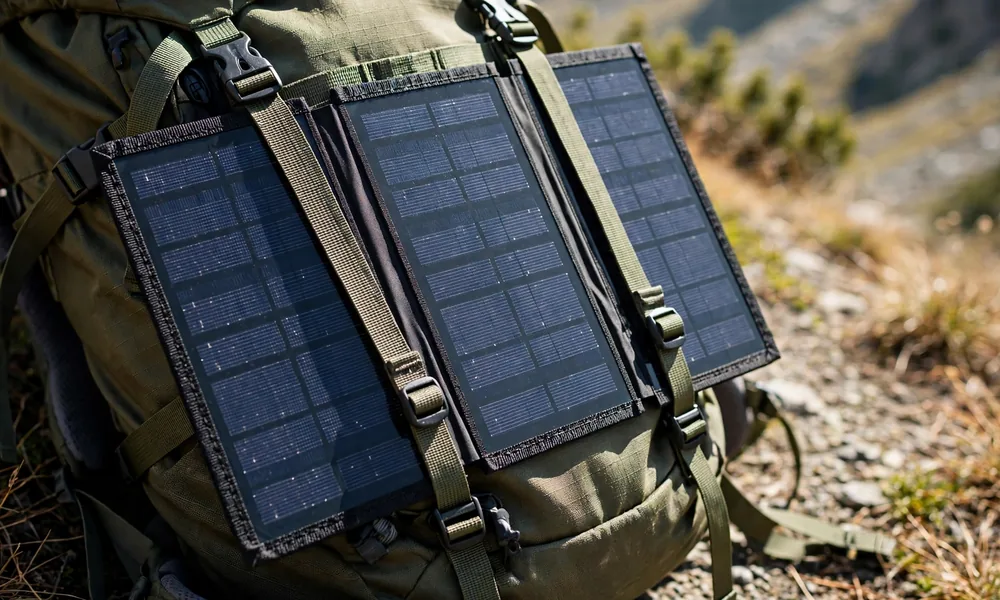
There are three main designs. Foldable panels unfold into sections and pack down flat, making them the most popular choice for camping. Solar power banks combine a small panel with a large battery, storing energy for later but charging slowly from the sun alone. Rigid panels are durable but heavy, suiting car camping.
The Best Solar Chargers for Camping in 2026
The picks below are organised by trip type, because a solo hiker and a family at a drive-up site need very different panels.
| Charger type | Power | Best for | Weight | Ports |
|---|---|---|---|---|
| 28W foldable panel | 28 watts | Most campers | About 600 g | USB-C, USB-A |
| Rugged solar power bank | 25,000 mAh battery | Overnight charging | About 500 g | USB-C, USB-A |
| 60W foldable panel | 60 watts | Groups and base camps | About 1.4 kg | USB-C PD, USB-A |
| 10W ultralight panel | 10 watts | Backpackers | About 250 g | USB-A |
| 21W budget foldable panel | 21 watts | Weekend campers | About 450 g | USB-A, USB-C |
Best Overall: 28W Foldable Solar Panel
The 28 watt foldable panel is the best solar charger for camping for most people. It unfolds to four sections of monocrystalline cells, folds down to roughly the size of a tablet, and weighs about 600 grams. In direct sun it charges a modern smartphone from empty to full in about two to three hours.
Look for both USB-C and USB-A outputs, so it can charge newer phones and older accessories at the same time, and a smart charging chip that restarts charging automatically when a cloud passes. The best 28 watt panels use ETFE-coated cells, which resist scratches, rain and dust far better than the glossy PET coating on cheaper panels.
Best Solar Power Bank: Rugged 25,000 mAh Bank
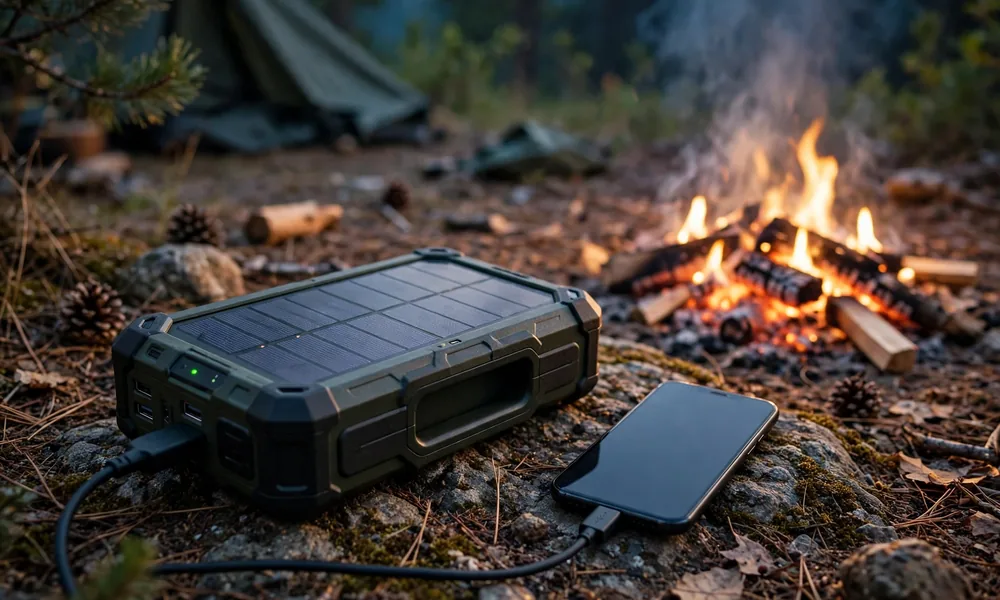
A rugged solar power bank is the best choice for campers who want power at night, because it stores energy in a large battery instead of only charging while the sun shines. A 25,000 mAh bank holds enough charge for roughly four to five full phone charges, or a mix of phone, headlamp and camera top-ups across a long weekend.
The small panel on its face, usually 5 to 6 watts, would take days of sun to fill the battery from empty, so treat it as an emergency top-up and charge the bank fully before you leave home. Pick a rugged case with an IP67 rating and a built-in flashlight. Pair the bank with a foldable panel and a good set of portable chargers for camping.
Best for Groups and Base Camps: 60W Foldable Panel
A 60 watt foldable panel is the best solar charger for camping when several people share one site, because it can charge multiple devices at once without slowing to a crawl. With USB-C Power Delivery of 45 watts or more, it can charge a laptop as well as phones, tablets and camera batteries.
These panels usually fold into six or more sections and weigh around 1.4 kilograms, so they are not a hiking option, but they pack flat and slide easily into a car boot. A kickstand and a cable pouch help. Set it up in the sunniest spot and rotate devices through it.
Best Ultralight: 10W Panel for Hikers
A 10 watt panel is the best solar charger for camping when every gram counts, because it weighs about 250 grams and folds to the size of a phone. It takes four to six hours of good sun for a full phone charge, but for a hiker who only needs to keep a phone alive for maps and emergency calls, that is enough.
Ultralight panels work best as part of a system. Pair the panel with a compact 10,000 mAh power bank, charge the bank while you hike, and charge your phone from the bank at night, so a passing cloud does not interrupt your charging. Look for an ETFE coating and attachment loops for pack straps.
Best Budget: 21W Foldable Panel
A 21 watt foldable panel is the best budget solar charger for camping, delivering most of the performance of the 28 watt pick for noticeably less money. It charges a phone in about three hours of direct sun and weighs around 450 grams, making it easy to carry on a weekend trip.
The savings come from simpler materials rather than worse cells. Budget panels often use a PET coating instead of ETFE, which scratches more easily, and they may have USB-A outputs only, without USB-C. Test it at home on a sunny day before you depend on it.
How to Choose the Right Solar Charger
Work through the decisions below before you buy.
Wattage and Charging Speed
Wattage is the single most important number on a solar charger. A 10 watt panel suits a single phone on a hiking trip, a 20 to 30 watt panel suits a phone plus a power bank on a general camping trip, and a 60 watt panel suits a group or anyone who needs to charge a laptop. Real output in the field is typically 70 to 80 percent of the headline figure, so buy a little more power than the minimum. USB-C Power Delivery charges modern devices much faster than USB-A.
Panel Type and Efficiency
Monocrystalline panels are the best choice for camping. Their cells are cut from a single silicon crystal, making them the most efficient type available at 22 to 24 percent, and they perform better in partial shade and low light than polycrystalline panels, which matters at a wooded campsite. Polycrystalline and thin-film panels are cheaper but less efficient. Look for monocrystalline cells with an ETFE coating, which protects against scratches, rain and dust.
Ports, Weatherproofing and Weight
Ports decide what you can charge. At least one USB-C port is now essential for modern phones, and a second USB-A port covers headlamps, cameras and older accessories. Weatherproofing is measured with an IP rating: IPX4 resists splashes, while IP67 survives dust and brief immersion. Ultralight panels suit hikers; panels over a kilogram belong in a car.
Solar Charger Checklist Before You Leave
Run through this list the evening before you go.
- Test the panel in full sun at home and confirm it charges your phone.
- Charge your power bank fully from the wall before the trip.
- Pack the right cables, including USB-C to USB-C and USB-C to Lightning.
- Check the forecast and plan charging around the sunniest hours.
- Clean the panel surface, because dust and fingerprints cut output.
- Pack a small dry bag for the panel and cables.
How to Get the Most Power from Your Panel
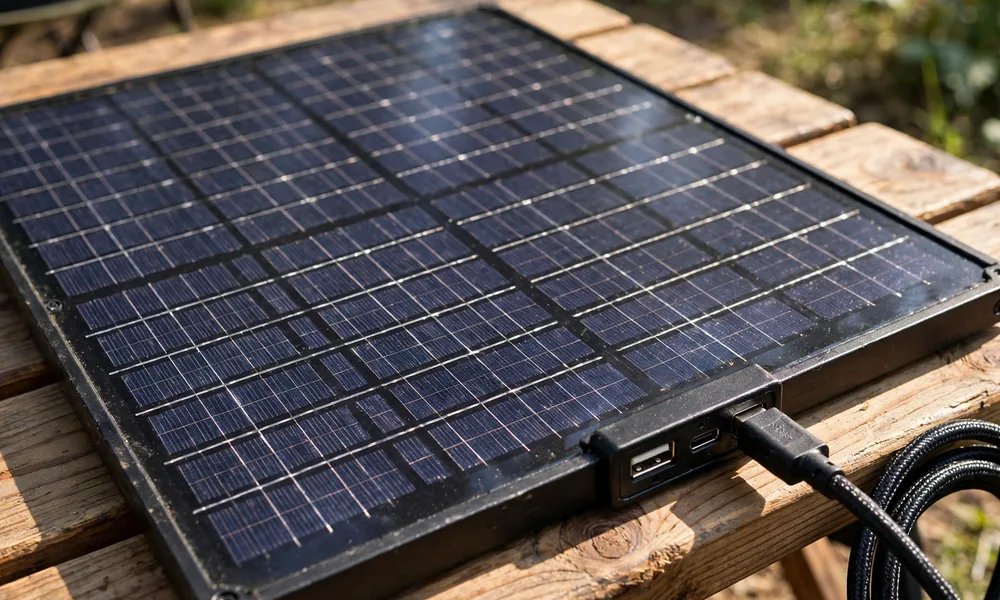
Getting full power from a solar charger is mostly about placement. Angle the panel so it faces the sun directly, and adjust it every hour or two as the sun moves. A tilted panel can produce 20 to 30 percent more over a day.
Shade is the biggest enemy of solar charging. Even a small shadow across one section can cut output sharply, because the cells are wired in series and the weakest cell limits the whole panel. Set the panel in open sun, away from tent poles and branches. Prop the panel up for airflow, and charge the bank by day and devices at night. The same habits work for solar chargers for travel on the road.
Frequently Asked Questions
How long does a solar charger take to charge a phone while camping?
A 20 to 30 watt panel charges a modern smartphone from empty to full in about two to three hours of direct sun. A 10 watt panel takes four to six hours, and a 60 watt panel can do it in around ninety minutes. Charging a bank by day and the phone from it at night works best.
Do solar chargers work on cloudy days?
Yes, but much more slowly. A good monocrystalline panel still produces 10 to 25 percent of its rated output under cloud, enough to trickle-charge a power bank over a full day. On a grey day, rely on your pre-charged power bank.
Can a solar charger charge a laptop while camping?
A 60 watt panel with USB-C Power Delivery can charge many laptops, especially smaller ultrabooks that accept 45 watt charging. Smaller panels do not produce enough power for a laptop. For working from camp, pair it with a large power bank.
Are solar chargers waterproof?
Most camping solar panels are water resistant rather than waterproof. An IPX4 rating handles rain splashes, and an IP67 rating handles dust and brief immersion, but the USB ports are the weak point and should be kept dry. Fold it away in heavy rain.
Should I buy a solar panel or a solar power bank for camping?
Buy a foldable panel for the fastest charging and the most power, and a solar power bank for power at night without extra gear. The best setup is both: a panel to harvest energy by day and a bank to store it for the night. A good set of camping lanterns rounds out the kit.
How do I store a solar charger between trips?
Store the panel folded, clean and dry, in its pouch, away from direct sunlight and sharp objects. Charge any built-in battery or companion power bank to around 50 to 80 percent before storage, and top it up every few months. Avoid leaving a panel in a hot car.
The Bottom Line
The best solar chargers for camping in 2026 make off-grid power simple: a 28 watt foldable panel covers most campers, a rugged power bank covers the nights, and a 60 watt panel covers groups and base camps. Pick the size that matches your trip and pair it with a power bank.