
A suitcase comes home from every trip a little worse than it left. The corners get scuffed on the baggage belt, the shell picks up black marks from other bags, and a pale case can look five years old after a single long-haul flight. A luggage cover is the simplest answer to all of that: a stretchy sleeve that pulls over the whole case, takes the abuse instead of the shell, and makes your bag easy to spot on a crowded carousel. The best luggage covers of 2026 do that without slipping, tearing, or hiding the handle and wheels, and the worst ones bunch up, rip at the first tug, or turn a smooth-rolling case into a wrestling match.
What a Luggage Cover Actually Does
A luggage cover is a fitted sleeve, usually made from a stretchy polyester and spandex blend, that wraps around a suitcase and fastens underneath with an elastic hem or a zip. It is not a bag in itself and it does not replace a good case. Its job is narrower and more useful: it absorbs scuffs, keeps rain and dust off the shell, stops zips from catching on conveyor belts, and gives your luggage a colour or pattern that stands out. On a carousel full of black cases, a bright cover can save five minutes of squinting and one wrong bag taken home by mistake.
How to Choose: The Three Things That Matter Most
Fit comes first, and it is the thing most buyers get wrong. Covers are sold by suitcase size, usually small, medium, and large, matched to height ranges such as 18 to 21 inches, 22 to 25 inches, and 26 to 30 inches. Measure your case, including the wheels, and compare it with the size chart rather than guessing from the word large, which means different things to different makers. A cover that is a touch snug is better than one that is a touch loose, because the fabric relaxes slightly with use, but a cover that needs brute force to pull on will tear at the seams.
Fabric is second. Look for a blend with a good share of spandex or elastane, usually around 10 to 20 percent, which gives the stretch that lets the cover hug the case without going baggy. Thicker fabric resists scuffs and tears better, but it is heavier and slower to dry. A water-resistant finish helps in rain, though no fabric cover is fully waterproof, and a cover that soaks through will stay damp inside your luggage rack. Washability matters too: the best covers go through a cold wash and come out looking new, while cheap printed ones fade after two washes.
Access is third. A good cover leaves the telescopic handle free, either through a top opening or a zip, and does not cover the wheels. Some covers have a side opening so you can reach the case handle on the side as well, which is handy if you carry the case by that handle. Check the openings before you buy, because a cover with no handle opening forces you to peel it back every time you roll the case, which defeats the purpose.
The Best Luggage Covers of 2026
Best Overall: The Everyday Stretch Cover
The best all-rounder is a mid-weight stretch cover in a bold pattern, with a top opening for the telescopic handle and an elastic hem that grips the base. It fits the most common case sizes, pulls on in under a minute, and survives the belt and the carousel without riding up. The fabric is thick enough to stop scuffs reaching the shell but light enough to fold flat into a packing cube when you are not using it. For most travellers this is the only cover they will ever need, and it is the one to buy if you are choosing just one.
Best for Spotting Your Bag: The Bright Pattern Cover
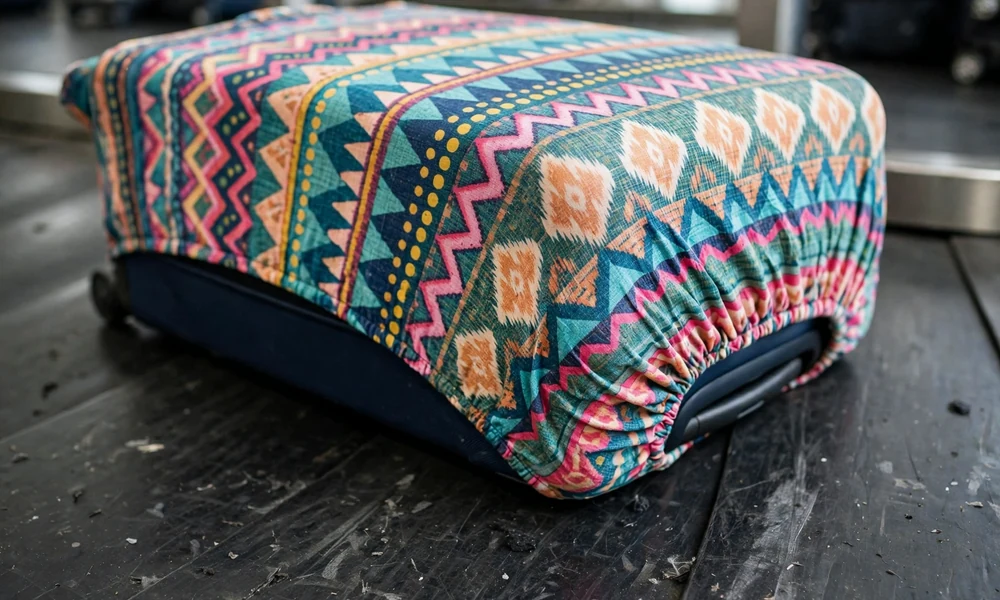
Some covers are bought purely to be seen, and this is the best of them. Loud geometric prints, bright florals, and high-contrast designs make a case visible from across the baggage hall, and the pattern also hides the marks the cover itself picks up. The fabric is the usual stretch blend, so fitting is no harder than a plain cover, and the print is dyed into the fabric rather than printed on the surface, which means it fades far more slowly in the wash. Families often buy one pattern per person so each case is instantly recognisable.
Best Budget Pick: The Lightweight Travel Cover
A good budget cover does not try to do everything. It is a light stretch sleeve that protects against scuffs and dirt, folds down to almost nothing, and costs little enough that replacing it every year or two is painless. The trade-offs are a thinner fabric and simpler stitching, so it will not last as long as a heavy-duty cover, but for a holiday or two a year it is more than enough. It is also the best choice for a case you only want covered on the way home, when a bag is at its most battered.
Best for Hard-Shell Cases: The Snug-Fit Shell Cover
Hard-shell cases have sharp corners and smooth surfaces that make loose covers slide around, so they need a cover cut close to the shape of the case. This style is sized tightly, with the stretch concentrated at the corners, and it stays put on a glossy shell where a generic cover would bunch. The top opening lines up with the handle, the wheels stay clear, and the smooth fit means the case still rolls and stands exactly as it should. Measure carefully before ordering, because the snug fit leaves little room for error.

Stretch Fabric vs Hard Plastic vs Clear Covers
Most covers today are stretch fabric, and for most travellers they are the right choice. They fit well, fold small, wash easily, and come in patterns that make a bag easy to find. Their weakness is that they offer no real protection against impacts, and a sharp edge can snag or tear the weave. Hard plastic covers, usually clear PVC or a thicker transparent shell cover, protect better against scratches and rain, and they let the design of the case show through, but they are heavier, bulkier, and can crack in cold weather or split at the corners. They are also harder to fit and impossible to fold into a pocket.
Getting the Right Size
Sizing is where most cover purchases go wrong, and it is easy to get right with a tape measure. Stand the case upright, measure from the floor to the top of the shell, not including the extended handle, and then measure the width and depth at the widest points, including the wheels. Compare all three numbers with the size chart, and if your case falls between two sizes, choose the smaller one when the fabric has plenty of stretch, and the larger one when it is a thicker, less stretchy cover. A cover that is an inch too small will not go on at all; one that is an inch too big will slip and bunch.
How to Fit a Luggage Cover Without a Fight
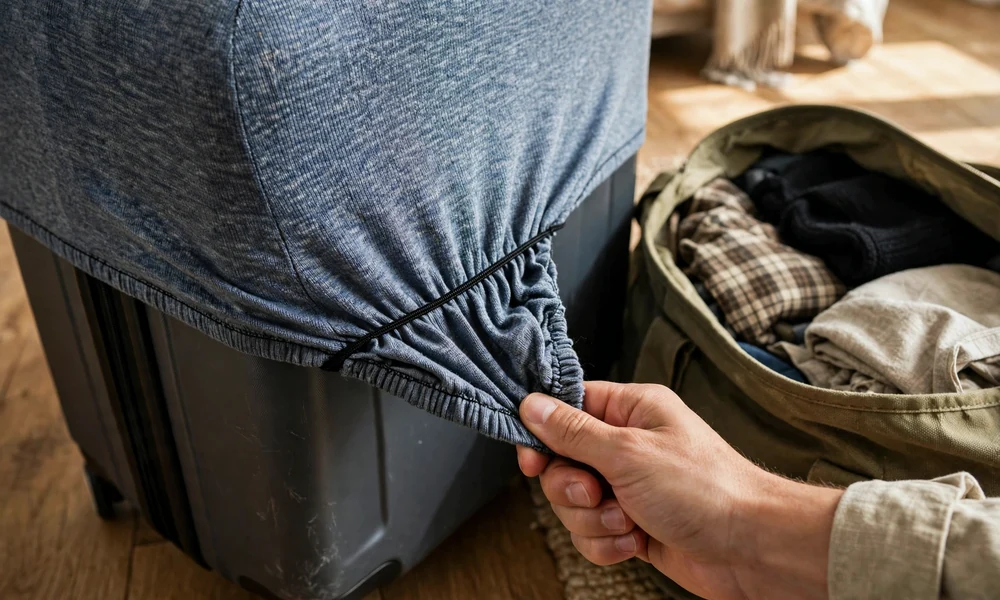
Fitting a cover is a two-minute job once you know the order. Lay the case on its side, open the cover wide, and slide it over the top end of the case first, working it down over the corners. Then stand the case upright, pull the elastic hem down around the base, and line up the top opening with the telescopic handle. Pull the handle up through the opening and check that the wheels are clear and the cover is smooth on the front and back. If the cover has a side opening, line that up with the side carry handle before you finish.
What to Avoid When Buying a Luggage Cover
The cheapest covers on the market usually fail in the same ways. The fabric is thin enough to see through, the stitching is a single row that unravels at the first snag, and the print is a surface layer that flakes off in the wash. A cover that costs very little is fine as a one-trip disposable, but it is not a bargain if you have to replace it every journey. Spend a little more for double-stitched hems and a fabric you cannot see through when you hold it up to the light.
Looking After Your Cover
A luggage cover lasts longer if it is treated like clothing rather than packaging. Shake it out after each trip, wash it in cold water when it is dirty, and let it air-dry rather than putting it in a hot dryer, which weakens the elastic. Do not store it damp inside a closed case, because mildew will set into the fabric and the smell is hard to remove. Fold it loosely and keep it with your travel gear so it is there when you need it, not buried in a drawer you forget about until the morning of a flight.
Frequently Asked Questions
Do luggage covers fit all suitcases? No, and that is the most common mistake. Covers are sold by size, and a cover made for a 28-inch case will not fit a 20-inch cabin case. Measure your case and match it to the size chart, and check whether the cover is designed for hard-shell or soft-sided cases, because the fit is different.
Will a luggage cover protect my case from damage? It protects against scuffs, scratches, dust, and light rain, which is most of the wear a case suffers. It will not protect against a hard drop, a crushing load, or a determined thief. Think of it as a screen protector for your suitcase: it takes the everyday damage so the case does not have to.
Can I leave the cover on during check-in? Yes, and that is the point. Airlines accept covered cases, and the cover does not interfere with weighing or tagging. The one exception is if staff need to inspect the case, in which case you can peel the cover back in seconds and put it on again afterwards.
Do covers make it harder to find my bag? The opposite, if you choose a bright colour or pattern. A covered case stands out on a carousel full of bare black cases, and a distinctive pattern is easier to describe to lost-luggage staff than a plain black shell. A dark cover gives up that advantage, so choose colour with purpose.
A good luggage cover is a small purchase that pays for itself the first time your case comes off the belt looking the way it did when you left home. The best ones fit snugly, survive the wash, and make your bag the one you can spot from across the hall. If you are still choosing the case itself, our guide to the best and worst suitcases of 2026 is the place to start, and once the case is sorted, a good luggage tag and a set of packing cubes finish the kit. Buy the cover before your next trip, not after it, because the scuffs it prevents are the ones you cannot undo.


