
A travel makeup bag does a harder job than the bag on your dressing table. It gets squeezed into a suitcase, lifted into an overhead bin, dropped on a hotel bed and opened in a bathroom with almost no counter space. It has to keep glass bottles from breaking, powders from cracking, brushes clean and liquids away from everything else you packed. The best makeup bags for travel in 2026 are the ones that do all of that without taking up half your luggage, and they look ordinary until the moment you actually need them to work.
Most travel makeup bags fail for small, predictable reasons. One is too big for a weekend bag but too small for a full routine, so half your kit ends up loose in a side pocket. Another has a single open compartment, so everything sinks to the bottom and you spend five minutes digging for one lipstick. Choosing well means thinking about the trip you actually take, not the trip in the advert, and buying the bag that fits that trip.
Key Takeaways
Buy for the trip you take most often: a weekend carry-on bag and a two-week checked bag need different sizes and layouts. Compartments beat capacity, because a medium bag with a brush sleeve, a mesh pocket and a zipped section keeps things findable, while a big open sack just hides the mess. Look for a wipe-clean lining and a smooth, sturdy zip, since makeup leaks happen and a bag you cannot clean is a bag you will throw away. Keep liquids upright and sealed, and keep powders flat and padded, because those two habits prevent most travel damage. Measure your longest palette and tallest bottle first, since a bag one centimetre too short is useless, however nice it looks.
What Makes a Travel Makeup Bag Good
The first thing to judge is protection. A travel bag is only useful if what is inside arrives in the same condition it left in, and the best bags have a little padding, a firm base and pockets that stop bottles rolling into each other. A bag that lets a glass bottle knock against a powder compact is a bag that will cost you a broken palette sooner or later. Protection does not need to mean heavy and rigid, but it does need to mean that things stay where you put them when the bag is turned sideways or upside down.
The second thing is the layout. A travel bag is opened in awkward places, often standing up in a small hotel bathroom, so the best bags open wide and stay open, with everything visible at a glance. A bag that only opens halfway, or flops shut the moment you let go, slows you down every single morning of the trip. Look for a bag that lies flat when open, with the pockets you reach for most often on top, and a zipped section for the things you want kept separate, like cotton pads, hair grips and spare sponges.
The Main Types of Travel Makeup Bag
Compact pouches are the simplest choice. They are soft, light and flat, they squash into the gaps in a suitcase, and they are the best choice for a short trip or a minimal routine. They suit a traveller who carries ten products or fewer, and they are the easiest to slip into a handbag for the day. The trade-off is organisation: most pouches have one main compartment and perhaps a small inner pocket, so you need to be disciplined about what goes in, or everything ends up in a jumble. For a weekend away with a short routine, a compact pouch is the one to buy.
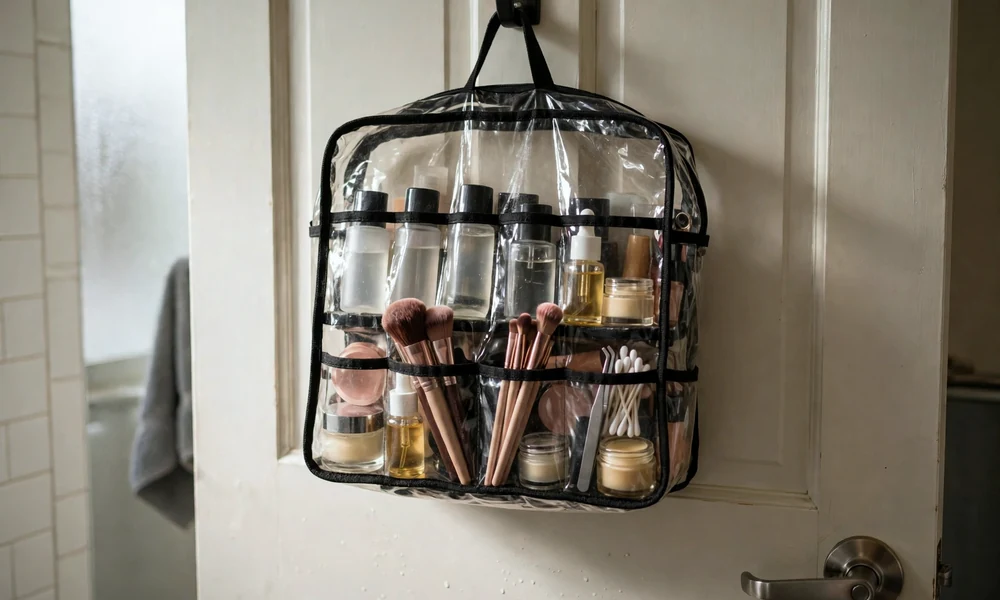
Hanging bags are the organised option. They unfold into a panel of clear or mesh pockets, hang from a hook on a bathroom door, and turn any hotel bathroom into a dressing table. They are the best choice for a longer trip, or for anyone who likes to see everything at once without unpacking. They suit a traveller who carries a full routine, and they are the most practical option when counter space is scarce. The downside is the size when folded: a hanging bag is bigger and heavier than a pouch, and it needs a door hook or a towel rail to work properly. For a week away with a full kit, a hanging bag is the one that works.
Hard-shell bags are the protective option. They have a rigid outer case, often with a padded interior, and they protect powders and glass far better than any soft bag. They are the best choice when you carry expensive palettes, glass bottles or anything fragile, and they are the one to pick for a checked bag, where luggage gets thrown around. They suit a traveller who would rather carry a slightly heavier bag than replace a cracked palette. The downside is that they do not squash, so they take up a fixed amount of space, and they are usually the heaviest option. For fragile products and checked luggage, a hard-shell bag is the safest choice, and it sits in the same family as the rigid cases covered in our guide to the best vanity case, which explains when a structured case beats a soft bag.
Roll-up brush bags are the specialist option. They are a flat roll with individual slots for brushes, which keeps bristles straight, clean and separate from everything else. They are the best choice when brushes are the most valuable part of your kit, and they pair well with a pouch or a hanging bag rather than replacing one. They suit a traveller who owns good brushes and wants them to last, and they are the lightest way to protect them. Our guide to the best makeup brushes explains which brush shapes are worth carrying, and a roll keeps exactly those brushes safe. The downside is that a roll holds brushes and little else, so it is an extra piece, not a complete bag.
How Big Should a Travel Makeup Bag Be
For a weekend trip, a bag about the size of a paperback book is usually enough. It holds a foundation, a powder, a blush, a mascara, a few lip products and two or three brushes, which is a complete routine for most people. Anything bigger is carrying products you will not use, and anything smaller means leaving something you need behind. Pack it once at home, a few days before you travel, and see what is left out. The products left on the dressing table are the ones you do not need on the trip.

Liquids, Leaks and Airport Security
Liquids cause more travel makeup disasters than anything else, and most of them are preventable. The rule is simple: keep every liquid upright, keep every cap tight, and keep every bottle in its own sealed section or a small resealable pouch inside the main bag. A bottle that leaks inside a sealed pouch is an annoyance, while the same bottle leaking loose in a bag is a ruined suitcase. Check every cap before you close the bag, and give each bottle a gentle squeeze to make sure the seal holds.
How to Pack a Travel Makeup Bag
Pack in the order you will use things, with the products you reach for first on top. That usually means foundation and powder first, then blush and eye products, then lips and brushes last, or the other way round if you start with your eyes. Either way, the point is the same: the bag should open onto your routine, not onto a random pile. If you have to move three things to reach the one you want, the packing order is wrong, and it will annoy you every morning of the trip.
Protect the fragile things first. Wrap a powder compact in a soft cloth or a spare sponge, lay palettes flat rather than on their edge, and keep glass bottles away from hard corners. Brushes should go in a sleeve or a roll, with the bristles pointing the same way, so they do not bend against each other. A brush with bent bristles is a brush that will never blend properly again, and it is one of the easiest travel losses to prevent. The general guide to the best makeup bag covers the same packing principles for everyday bags, and they matter even more when the bag is travelling.

Materials, Zips and Cleaning
The material decides how the bag survives the trip. Soft nylon and canvas travel well, because they are light, they squash into gaps, and they forgive being folded. Leather looks lovely and lasts for years, but it is heavier and it needs more care, so it suits a bag that travels by car or by hand rather than one that is thrown into a hold. Clear PVC is the easiest to clean and the best for security checks, but it can feel stiff and it shows every mark. The best travel bags use a wipe-clean lining whatever the outside is made of, because the inside is where the mess happens.
The zip is the part most people never check, and it is the part that fails most often. A good travel zip is smooth, sturdy and long enough to open the bag wide, and it should run freely even when the bag is full. A zip that catches, sticks or feels gritty will only get worse on the trip, and a zip that bursts open in a suitcase is a disaster. Before you buy, open and close the zip a dozen times, and pull it firmly from both ends. If it feels weak in the shop, it will feel weaker after a week of travel.
Mistakes to Avoid
The most common mistake is packing your whole collection. A travel bag is not a dressing table, and carrying every shade you own means carrying weight you do not need and risking products you would miss if they broke. Pick one foundation, one powder, one blush, one eye look and two lip options, and leave the rest at home. You will use the same few products every day, and you will enjoy the trip more without the extra weight.
Choosing the Right Bag for Your Trip
Start with the trip, not the bag. A weekend city break needs a compact pouch and a clear liquids bag. A week in a hotel needs a hanging bag that turns a small bathroom into a workspace. A long trip with checked luggage needs a hard-shell bag that protects fragile products. A flight-heavy trip needs clear sections and easy access at security. Match the bag to the journey, and the bag will do its job without you thinking about it.
The best travel makeup bag is the one you stop noticing. It opens wide, it holds everything you need, it keeps liquids away from powders, and it closes easily at the end of the day. It does not need to be expensive, and it does not need to be beautiful, though it is nice when it is both. It needs to be the right size, the right layout and the right material for the trip you actually take, and once you have found that bag, you will pack it the same way every time, and you will wonder why you ever travelled with anything else.


