How to Choose Grill Tongs That Survive Real Heat in 2026
Grill tongs are the tool you reach for a dozen times every time you barbecue, and they are also the tool most likely to let you down at the worst moment. A good pair of grill tongs grips a slippery steak, holds it steady while it sears, and lifts a heavy roast off the grate without bending. A bad pair flexes under the weight, lets the tips meet at an angle, or leaves your knuckles hovering over the flames because it is too short.
The short answer is to buy long, thick stainless steel tongs with scalloped tips, a firm spring, and a lock, and to test the grip before you trust them with a heavy piece of meat. Length keeps your hands safe, thickness keeps the tongs from bending, and scalloped tips are the difference between a steak that stays put and a steak that slides back onto the coals.
Key Takeaways
- Buy sixteen-inch grill tongs as your main pair: long enough to keep your hands away from high heat, short enough to control precisely.
- Thick stainless steel is the best material for grill tongs, because it will not melt, bend, or absorb smells at open-flame temperatures.
- Scalloped tips grip slippery food far better than flat tips, and they double as a spoon for serving vegetables.
- A firm, even spring matters more than it sounds: weak springs drop food, and stiff springs tire your hand.
- Test the tongs before you buy if you can: the tips should meet evenly, the lock should work one-handed, and the balance should feel level.
Why Grill Tongs Are Not Kitchen Tongs
It is tempting to use the kitchen tongs you already own at the grill, and for a quick turn of a sausage it works. But grill tongs face three problems kitchen tongs never meet. The first is heat: a grill runs far hotter than a frying pan, and handles, springs and tips that are fine over a stove can soften or burn over open flame. The second is distance: your hands are further from the food on a grill, so the tongs must be longer, and longer tongs need to be stronger, or they flex and wobble.
The third is weight: a whole chicken, a thick steak or a heavy roast is far heavier than anything you turn in a pan, and a pair of tongs that bends under that weight is a pair that drops dinner. That is why a dedicated pair earns its place. Our guide to tongs covers the whole family, from nine-inch kitchen pairs to serving tongs, and it is worth reading if you are building a set.
Length: How Long Is Long Enough
Twelve-inch tongs are the best all-round length for the stove, but at the grill they leave your knuckles too close to the heat, especially over a charcoal fire that flares. Sixteen-inch tongs are the sweet spot for most grills: long enough to keep your hands clear of high heat, short enough that you can still turn food precisely and lift it without the tips wandering.
Eighteen-inch tongs and longer suit very large grills, kamado cookers and open fires, where the heat is fiercest and the grate is furthest from the edge, but they are clumsy on a small kettle grill, . If you can only own one pair, buy sixteen inches. If you grill often on a large grill, add an eighteen-inch pair as your second.
Materials That Survive Open Flame
Stainless steel is the best material for grill tongs, and it is not close. Good stainless steel is strong, heat-resistant, easy to clean, and it does not melt, stain or absorb smells. The best tongs are made from a single piece of thick steel with a strong spring, and they feel solid rather than flimsy. Check the thickness before you buy: press the arms together and feel for flex.
Handles matter almost as much as the steel. Bare stainless handles get hot if you leave the tongs resting on the grill, and they get slippery with grease, so look for a heat-resistant grip, usually silicone or textured rubber, that stays cool and stays put in a greasy hand. Avoid wooden handles on grill tongs: wood chars and dries out over open flame.
Tips: The Part That Actually Grips
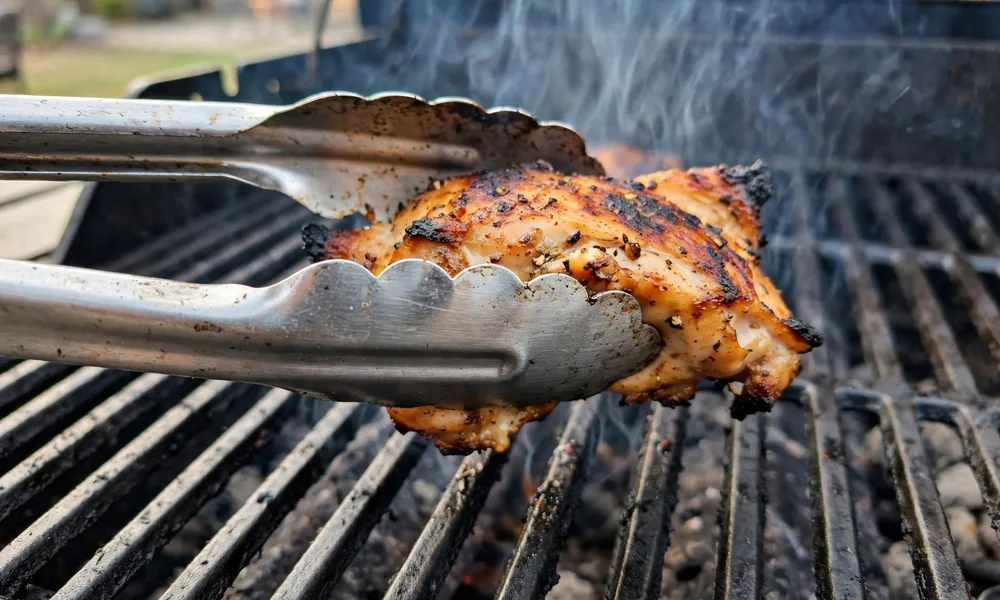
The tips are where grill tongs succeed or fail, and scalloped tips are the best choice for most grilling. Scalloped tips have a wavy edge that bites into slippery food, a steak, a piece of fish, a chicken thigh, and holds it without crushing it. Flat tips look neat and are fine for lifting flat food, but they slide on anything round or greasy, and they are the reason so many steaks end up back on the coals.
Serrated tips grip even harder than scalloped ones, and they suit heavy, fatty meat, but they can tear delicate fish and tear the skin off chicken if you squeeze too hard. Spatula-style tips, wide and flat with a slight curve, are the best choice for fish and burgers, because they support the food from underneath rather than pinching it.

Spring Tension and Locking
The spring is the part nobody thinks about until it fails, and it decides how the tongs feel in your hand over a long cook. A good spring opens smoothly and closes with a firm, even pressure, not a stiff snap. Too weak, and the tongs will not grip a heavy steak firmly enough to lift it.
A locking mechanism matters more on grill tongs than on kitchen tongs, because long tongs are awkward in a drawer and usually live hanging by the grill. A good lock keeps the tongs closed for storage and opens one-handed, so you are not fumbling with a catch while a steak burns. Whichever type you choose, test it with one hand, because the other hand will be holding a plate or a lid.
Grill Tongs Compared
The right pair depends on your grill and what you cook on it. Here is how the main choices stack up.
| Type | Best Length | Tips | Best For |
|---|---|---|---|
| Stainless steel, scalloped | 16 inches | Scalloped | Most grilling: steaks, chicken, vegetables |
| Extra-long steel | 18 inches or more | Scalloped or serrated | Large grills, kamado cookers, open fires |
| Spatula-tip | 16 inches | Wide, flat | Fish, burgers, delicate food |
| Heavy-duty serrated | 16 to 18 inches | Serrated | Large roasts, whole chickens, fatty meat |
| Silicone-grip steel | 16 inches | Scalloped | Anyone who grills with greasy hands |
For most people, the first row is the answer: sixteen-inch stainless steel tongs with scalloped tips and a heat-resistant grip. The other rows are second pairs for people who grill a lot, or for specific jobs like fish. A sixteen-inch pair used on a small kettle grill is already the right tool, and an eighteen-inch pair bought for the same grill is money spent on length you will never use.
How to Test Tongs Before You Buy
If you can handle the tongs before buying, run through five quick checks. First, close the tips and look at them: they should meet evenly along their whole length, with no gap and no angle. Second, squeeze a dozen times and feel for a smooth, even spring with no grinding. Third, check the balance: hold the tongs by the middle and they should sit level.
Fourth, work the lock one-handed: it should click shut and open again without a struggle. Fifth, grip something heavy if the shop allows it and lift it: the tongs should hold firm without flexing at the hinge. If you are buying online, read the specifications instead of the marketing: the steel thickness, the stated length, and whether the handles are heat-resistant to barbecue temperatures. Skewers are the other tool that lives beside tongs at the grill, and our guide to skewers covers the lengths and materials that suit different grills.
Using and Caring for Grill Tongs
Good grill tongs last for years if you treat them decently, and the care is simple. Do not leave them resting on the hot grill between turns, because the handles will heat up and the spring will weaken over time; rest them on the side table instead. After cooking, wash them in hot soapy water and dry them properly, because stainless steel can still spot and, on cheap pairs, rust at the hinge if it is left wet.
Storage matters too. Hang them by the grill using the hanging loop most good pairs have, or keep them in a tall utensil holder with the lock engaged. If your grill is a portable one that travels with you, our guide to portable grills covers the compact setups where a sixteen-inch pair may be too long to pack, and a shorter pair earns its place.

Checklist: Before You Buy Grill Tongs
- Sixteen inches long for most grills, eighteen only for large grills, kamado cookers or open fires.
- Thick stainless steel that does not flex when you press the arms together, with a solid hinge.
- Scalloped tips that meet evenly along their whole length, with no gap and no angle.
- Heat-resistant, non-slip handles that stay cool and stay put in a greasy hand.
- A firm, even spring that feels the same on the twelfth squeeze as on the first.
- A lock that works one-handed, and a hanging loop so the tongs store neatly by the grill.
Frequently Asked Questions
What length grill tongs should I buy?
Sixteen inches suits most grills: long enough to keep your hands clear of high heat, short enough to control precisely. Twelve inches is too short for a charcoal grill, and eighteen inches suits only large grills, kamado cookers and open fires.
Are stainless steel grill tongs the best?
Yes, for the grill. Thick stainless steel is strong, heat-resistant, easy to clean, and it does not melt, stain or absorb smells at open-flame temperatures. Look for a solid hinge and a heat-resistant grip, and avoid wooden handles, which char and crack over open flame.
Are scalloped tips better than flat tips?
For most grilling, yes. Scalloped tips bite into slippery food like steaks and chicken thighs and hold it without crushing it, and they double as a spoon for serving vegetables. Flat tips slide on round or greasy food, though spatula-style flat tips are better for fish and burgers.
Do I need locking grill tongs?
A lock is well worth having, because long tongs are awkward in a drawer and usually hang by the grill. A good lock keeps them closed for storage and opens one-handed, so you are not fumbling with a catch while food cooks. Test the lock with one hand before you buy.
Can I use kitchen tongs on the grill?
You can for a quick job, but kitchen tongs are usually too short and too light for the grill. They leave your knuckles close to the heat, and they can bend under a heavy steak or roast. A dedicated sixteen-inch pair is safer and will last far longer at barbecue temperatures.
How do I stop grill tongs from rusting?
Wash them in hot soapy water after every cook, dry them properly, and never leave them wet at the hinge. Cheap steel can rust where the hinge traps moisture, so a quick wipe with cooking oil on the hinge helps. Do not leave tongs resting on the hot grill, which weakens the spring over time.
Bottom Line
Choosing grill tongs comes down to three things: length, steel and tips. Buy sixteen-inch tongs in thick stainless steel with scalloped tips, a firm even spring, a one-handed lock and a heat-resistant grip, and test them before you trust them with a heavy piece of meat. That one pair will handle steaks, chicken, vegetables and roasts for years, and it will keep your hands clear of the fire while it does.