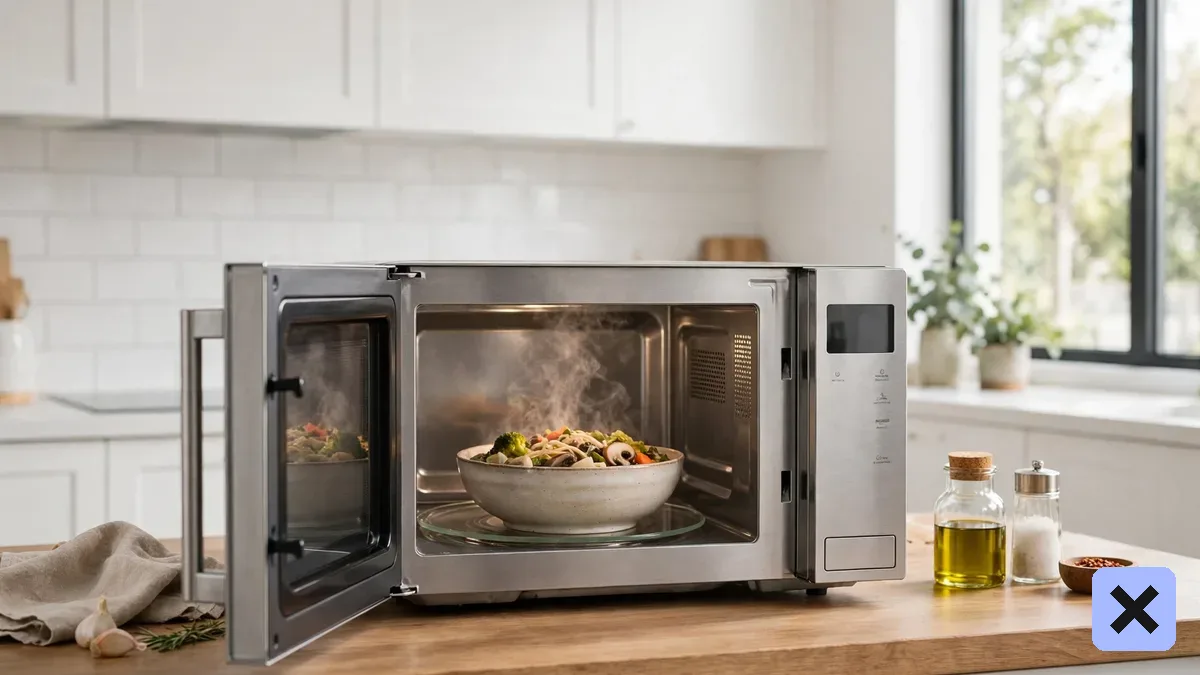
The best microwaves of 2026 do one unglamorous job brilliantly: they heat food evenly, quickly and quietly, day after day, without demanding attention. A great microwave reheats last night's dinner so the middle is as hot as the edges, defrosts chicken without cooking the outside, and pops popcorn without filling the kitchen with smoke. A bad one leaves cold spots in soup, rattles like a washing machine and turns a two-minute job into a guessing game.
Choosing well matters more than it used to, because microwaves have quietly split into very different machines. A compact 700-watt model for a studio flat, a family-sized 1,200-watt countertop workhorse and an over-the-range unit that doubles as a cooker hood are barely the same appliance. They differ in power, cavity size, sensor cooking and noise, so the right choice depends on how you actually cook, not on the longest feature list on the box.
This guide compares the microwave types that earn their place in a modern kitchen, explains what wattage and capacity really mean in practice, and flags the design flaws that turn a bargain into a regret. Every recommendation below is judged on the same things that matter at 7pm on a Tuesday: even heating, honest power, a turntable that fits a real dinner plate, and controls you can use without reading a manual.
Key Takeaways
- For most households, a 1,000 to 1,200-watt countertop microwave with a 30 to 34-centimetre turntable is the sweet spot: fast, even and big enough for a dinner plate.
- Measure your space before you buy: leave at least 5 centimetres of clearance on the sides and back, and check the door swing against nearby cupboards.
- Sensor cooking is the one premium feature worth paying for: it adjusts time and power to the steam coming off your food instead of guessing.
- Over-the-range models save counter space but need proper venting and a safe mounting height.
- Cheap microwaves fail in predictable ways: cold spots, noisy fans, flimsy doors and turntables too small for a standard plate.
The Best Microwaves of 2026 Compared
The table below summarises the five microwave types most buyers should consider. These are categories, not individual models: the same strengths and weaknesses appear across brands at each price level.
| Microwave Type | Power | Capacity | Best For | Price |
|---|---|---|---|---|
| Compact countertop | 700–900 W | 17–23 litres | Singles, dorms, small flats | Budget |
| Family countertop | 1,000–1,200 W | 25–32 litres | Households of three or more | Mid-range |
| Over-the-range | 900–1,100 W | 40–55 litres | Kitchens short on counter space | Mid to premium |
| Built-in / integrated | 900–1,200 W | 25–40 litres | Fitted kitchens, keen cooks | Premium |
| Microwave-convection combo | 900–1,000 W | 25–32 litres | Small kitchens without an oven | Premium |
Countertop, Over-the-Range or Built-In?
Most buyers should start with a countertop microwave, because it is the simplest, cheapest and easiest to replace. It sits on the worktop, plugs into a standard socket and can move with you when you move house. The trade-off is counter space: a family-sized model needs roughly 55 centimetres of width and 45 of depth, plus ventilation clearance, so in a small kitchen it can dominate the worktop. If your kitchen is tight, our guide to the best air fryers for small kitchens shows how other appliances handle the same space problem.
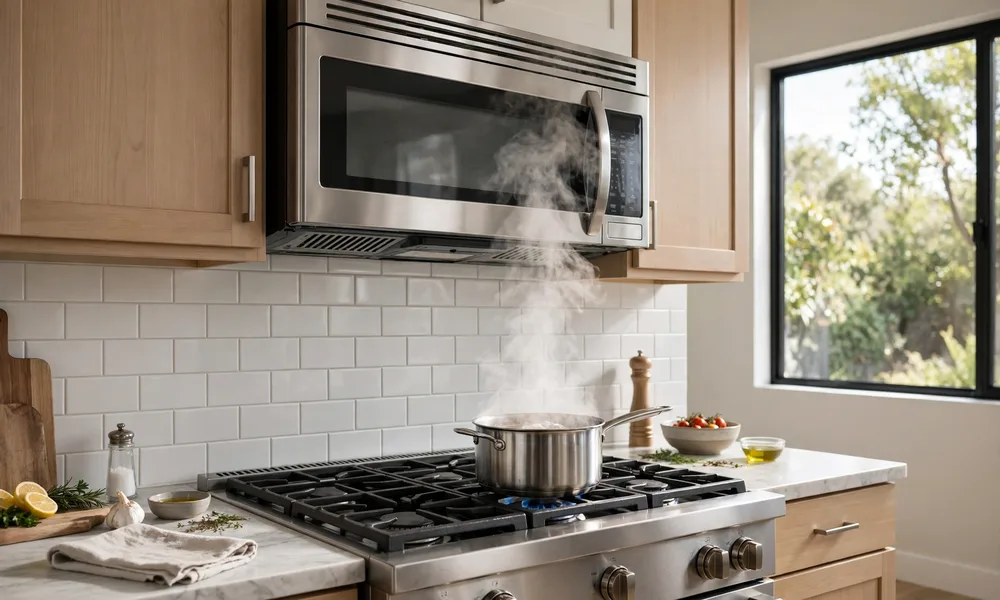
Over-the-range microwaves mount above the hob and double as an extractor hood, which frees the counter entirely. They suit kitchens where worktop space is precious, but they come with conditions: the unit must be mounted at a safe height, the venting must actually move air outside or through a proper filter, and reaching up to lift a hot bowl is harder than it looks. A weak fan is the most common complaint, so check the extraction rate before you fall for the space saving.
Built-in microwaves sit in a tall unit or under the counter and look superb in a fitted kitchen, but they cost the most and commit you to a fixed position. They make sense during a renovation, when the cabinetry is being planned around them, and much less sense as a standalone purchase.
Wattage: Why 1,000 Watts Is the Sweet Spot
Wattage is the single most honest number on a microwave box, and it is also the most misunderstood. It measures how much microwave energy reaches the food, not how much electricity the machine draws from the wall. A 1,000-watt microwave heats roughly 40 percent faster than a 700-watt one, which is the difference between a mug of soup in two minutes and the same soup in three and a half.
Below 900 watts, reheating becomes a chore: frozen meals take noticeably longer, and the lower power makes uneven heating worse because the food spends more time in the cavity while the magnetron cycles on and off. Above 1,200 watts the gains flatten out for most households, so the extra cost buys little in daily use.
For most kitchens, 1,000 to 1,200 watts is the right band: it handles a family dinner, a frozen lasagne and a mug of cocoa without fuss, and pairs well with a sensor that throttles power down when food is nearly done. If you mostly reheat single portions and live alone, a 900-watt compact model is perfectly adequate and cheaper to run.
Capacity and Turntable Size
Manufacturers quote capacity in litres, but the number that matters in daily use is the turntable diameter. A dinner plate is about 27 centimetres across, and it needs a turntable of at least 30 centimetres to rotate freely without catching the walls. Many compact microwaves quote a respectable capacity yet ship with a 25-centimetre turntable, which means your plate wedges, the food heats on one side only, and you end up stopping the machine to turn the dish by hand.
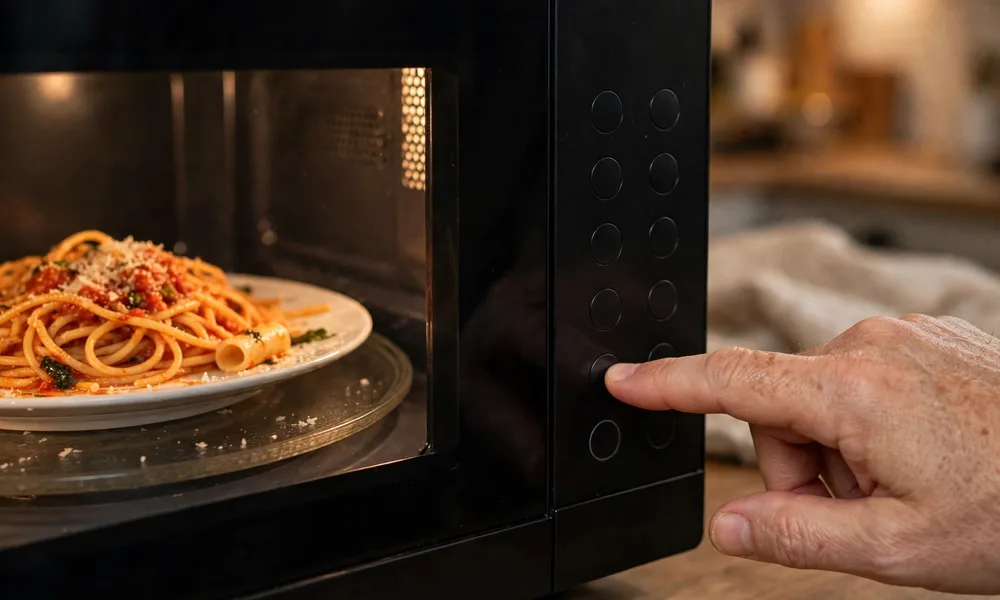
For a single person or a couple, 20 to 25 litres with a 28 to 30-centimetre turntable is comfortable. For a family, look for 28 litres or more and a turntable of 32 to 34 centimetres, which fits a large plate or a standard casserole dish. Flatbed microwaves replace the turntable with a rotating antenna underneath, so the whole cavity floor is usable and a lasagne tray sits flat instead of spinning into the walls.
Height matters too: a cavity under 20 centimetres tall will not fit a large mug. Measure your tallest mug before you shop.
Sensor Cooking and the Features Worth Paying For
Sensor cooking is the one premium feature that genuinely earns its price. A humidity sensor watches the steam rising from your food and adjusts the time and power automatically, so reheated rice comes out steaming rather than dried out, and vegetables stop cooking before they turn to mush.
Inverter technology is the second feature worth seeking out. A conventional microwave delivers power in bursts, full on, then off, which is why butter melts in patches and chocolate seizes. An inverter delivers steady, lower power, so defrosting is gentler and delicate food heats evenly. If you defrost meat or melt chocolate regularly, an inverter is a real upgrade.
Beyond those two, be sceptical of long preset lists. Thirty cooking programmes sound impressive, but most people use three: reheat, defrost and popcorn. A clear display, simple controls and a mute button for the beep matter far more in daily life than a preset for softening ice cream, plus a child lock for family homes.
What the Worst Microwaves Get Wrong
Bad microwaves fail in the same few ways, and spotting the pattern before you buy saves you the return trip. The most common flaw is uneven heating: a weak magnetron and a poorly designed waveguide leave cold spots in the middle of the plate while the edges boil. With meat and leftovers, cold spots are also a food safety problem, because bacteria survive where the microwaves never reached.
Noise is the second giveaway: a good microwave hums quietly, while a cheap one rattles, buzzes and vibrates the worktop every time it runs. In an open-plan home that noise becomes part of every meal. Flimsy doors are the third warning sign: a door that needs a slam to latch, or a handle that flexes under your hand, will not last the year, and a door that does not seal properly is a machine to return immediately.
The same quality traps show up across kitchen appliances, and the worst air fryers of 2026 fail for strikingly similar reasons: weak airflow, dishonest capacity claims and coatings that peel within weeks. The lesson transfers directly: trust measured dimensions over headline numbers and be wary of any model whose main selling point is its price.
How to Choose: Your Microwave Checklist
- Measure the space: width, depth, height and door swing, with 5 centimetres of ventilation clearance on the sides and back.
- Check the turntable: at least 30 centimetres for a standard dinner plate, 32 to 34 centimetres for family cooking.
- Pick the right power: 1,000 to 1,200 watts for most households, 900 watts at minimum for a compact single-person model.
- Look for sensor cooking and, if you defrost often, inverter technology for gentler, steadier power.
- Test the door and controls in a shop if you can: a solid latch, a clear display and a mute button for the beep.
- Confirm the warranty and the service network: two years as a minimum, and a brand with parts available locally.
Frequently Asked Questions
What size microwave do I need for a family of four?
For a family of four, choose a countertop model of 28 litres or more with a turntable of at least 32 centimetres and power of 1,000 watts or above. That combination fits a large dinner plate or a standard casserole dish and reheats a family meal without cold spots.
Is a 1,000-watt microwave much better than a 700-watt one?
Yes, noticeably. A 1,000-watt microwave heats food roughly 40 percent faster than a 700-watt model, and the higher power also reduces uneven heating because food spends less time in the cavity. For daily family use the difference is worth the small extra cost.
Are over-the-range microwaves worth it?
They are worth it when counter space is genuinely scarce and the venting is done properly. Check the extraction rate and the mounting height, and remember that lifting a heavy hot bowl down from above the hob is awkward. If you have the counter space, a countertop model is simpler and cheaper.
Do I need sensor cooking?
Not strictly, but it is the most useful premium feature on a modern microwave. Sensor cooking adjusts time and power based on the steam from your food, so reheated rice, vegetables and leftovers come out far more consistently than with a fixed timer.
Can I put metal containers in a microwave?
No. Metal reflects microwaves, which can cause sparking and damage the machine, and it shields the food so it heats unevenly or not at all. Use glass, ceramic or microwave-safe plastic instead. For storage that goes straight from fridge to microwave, see our guide to the best meal prep containers for freezing.
How long should a microwave last?
A well-made microwave should last eight to ten years with normal household use. Cheap models with flimsy doors, weak fans and peeling interiors often fail within two to three years, so a solid door latch and a quiet fan are good signs of a machine built to last.
The Bottom Line
The bottom line is simple: buy the microwave that fits your kitchen, your household and the way you actually eat. For most homes that means a 1,000 to 1,200-watt countertop model with a turntable of at least 30 centimetres, sensor cooking and a door that closes with a solid click. Spend a little more on power and build quality now, and the machine will repay you every evening for the next decade.