Mugs multiply. One for tea, one for coffee, and three more that arrived as gifts. They end up stacked in twos inside the cupboard, chipped at the rims, with the one you want always at the bottom of the pile. A mug rack ends that small daily hunt. It hangs every mug by its handle, in the open air, where you can see the whole collection and grab the one you want without moving any other.
This guide explains what a mug rack actually is, which types suit which kitchens, and how to choose one that holds your mugs safely without eating the counter.
Key Takeaways
- A mug rack stores dry mugs by their handles, in the open air: wall rails, under-cabinet hooks, over-door racks and freestanding stands.
- Wall-mounted rails suit most kitchens: they free the cupboard and the counter, and they hold four to eight mugs at eye level.
- Measure your tallest mug and the gap under your wall cabinets before you buy: a hanging mug needs clearance below it.
- Hooks should be at least 8 centimetres long and spaced so chunky mugs do not knock each other.
- Fix wall racks into a stud or solid wall with proper plugs: six stoneware mugs are heavier than they look.

What a Mug Rack Actually Is
A mug rack is a rail, hook strip or stand designed to store dry mugs by hanging them from their handles, so air circulates around them and they dry properly, inside and out, within an hour or two. A mug left upside down on a draining board traps moisture inside, and a damp mug grows a musty smell. A hanging mug does not.
The pieces it holds are everyday drinking mugs: ceramic, stoneware, porcelain and enamel, usually 250 to 400 millilitres, with a handle strong enough to hang from. It does not hold wet dishes. That is the job of a dish rack, which holds wet plates flat while they drain, and our guide to the best dish racks of 2026 covers those in full. A dish rack dries; a mug rack stores.
A mug rack also differs from a mug tree, a freestanding countertop stand with a central pole and a round base that holds six to eight mugs on one small footprint. Our guide to the best mug trees of 2026 covers those in full. A tree is one kind of mug rack, and it suits a kitchen with counter space to spare and no wall to fix into. A rack in the wider sense covers far more: wall rails, under-cabinet hooks, over-door racks and tiered stands. The tree guide itself notes that a wall-mounted rack is strictly not a tree, because it has no pole and no base, and that it is the best answer when there is no counter space to spare.
The Main Types of Mug Rack Compared
Almost every mug rack on sale falls into one of five types. Once you know the five, you can match the tool to your kitchen.
| Type | Holds | Best For | Watch Out For |
|---|---|---|---|
| Wall rail with hooks | 4 to 8 mugs | Most kitchens; frees counter | Needs a solid wall fixing |
| Under-cabinet hook strip | 4 to 6 mugs | Tiny kitchens; hidden storage | Tall mugs may hit the counter |
| Over-door rack | 4 to 6 mugs | Renters; no screws needed | Door must still close fully |
| Freestanding tiered stand | 8 to 12 mugs | Big collections; coffee corners | Eats counter space |
| Mug tree | 6 to 8 mugs | One small countertop spot | Needs clearance under cabinets |
Wall Rails: The Default Choice
A wall rail is a wooden or metal bar fixed to the wall, with hooks or pegs that hold mugs by their handles at eye level. It uses no counter and no cupboard, keeps daily mugs within reach, and turns a plain tiled wall into a display.
Fixing is everything. Six stoneware mugs weigh about two and a half kilos, and that weight hangs off two small screws. A rail held by two screws in bare plasterboard will not stay up. Use proper wall plugs, and fix into a stud or solid wall where you can. If the wall is tiled, drill through the tile with a masonry bit at a slow speed, or use adhesive pads rated for the weight, and test it with one mug before you load it fully.
Spacing decides whether the rack works. Hooks should sit at least 10 centimetres apart, so chunky mugs do not knock each other when you lift one off. Pegs should be at least 8 centimetres long, so a mug hangs clear of the wall and its handle does not scrape the tiles. Measure your widest mug, not your narrowest, and count the mugs you actually use every day, plus one spare hook for the mug in the dishwasher.
Under-Cabinet Hooks and Over-Door Racks
An under-cabinet hook strip screws or sticks to the underside of a wall cabinet, and mugs hang below it, hidden from view, using space that is otherwise wasted. It suits a tiny kitchen with no free wall and no spare counter. The limit is height. Most mugs are 9 to 11 centimetres tall, but tall latte mugs can reach 14 centimetres, and a hanging mug must not rest on the counter below. Measure from the underside of the cabinet to the counter, and leave at least 5 centimetres of clearance.
An over-door rack hooks over the top of a cupboard or pantry door and holds four to six mugs in slots or on hooks. It needs no screws, which makes it the best choice for renters. The limit is the door: the rack must be thin enough for the door to close fully, and the door must be strong enough to carry the weight. Test the door with the rack loaded, and keep it for lighter porcelain mugs rather than heavy stoneware.
Freestanding Stands and Mug Trees
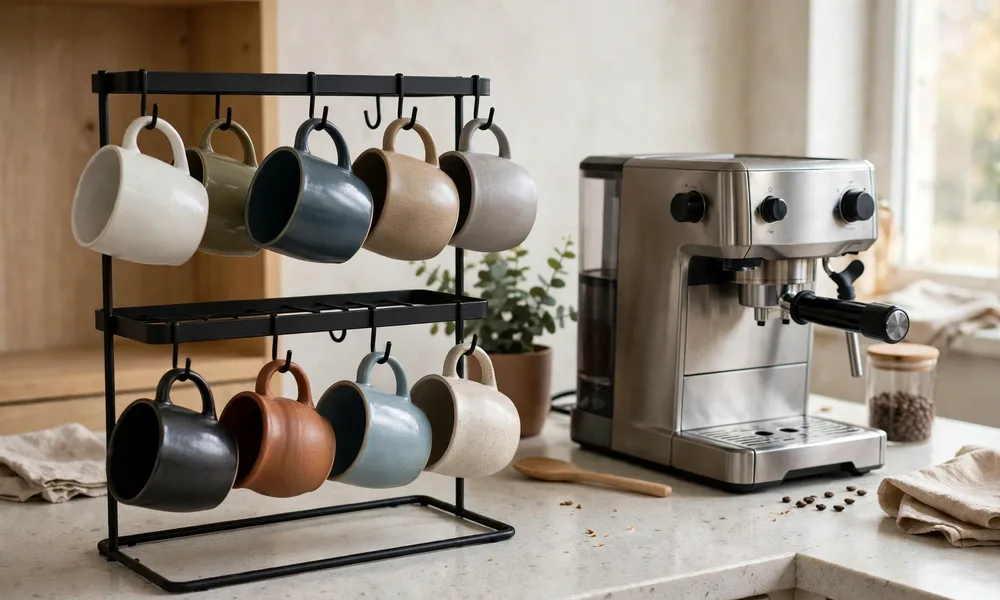
A freestanding tiered stand is a metal frame that sits on the counter, with two levels of hooks holding eight to twelve mugs. It suits a big collection and a dedicated coffee corner, where the stand lives next to the machine. The trade-off is counter space: a two-tier stand takes about the same footprint as a chopping board.
A mug tree is a smaller freestanding stand, usually 30 to 45 centimetres tall, with a round base and a central pole. Short pegs stick out from the pole, and each mug hangs from a peg by its handle. Wooden trees suit warm, traditional kitchens and are quiet; metal trees are stronger and suit heavy stoneware. A tree needs clearance under the wall cabinets above it, so measure first.
Materials: Wood, Metal and Plastic
Wooden rails, usually oak, beech or bamboo, suit warm kitchens and look like furniture rather than hardware. Wood is quiet and does not chip a mug that swings against it. It needs to stay dry, so it suits a wall away from the sink, and unsealed wood can stain.
Metal rails and hooks, usually chrome, stainless steel or powder-coated black steel, are the strongest option. A metal rail holds heavy stoneware without flexing and wipes clean. Chrome shows water spots, and the cheapest chrome can bubble and rust at the joints. Powder-coated black steel hides spots, but a chip in the coating can rust if it stays damp. Plastic hooks are the cheapest and lightest, but they flex under a heavy mug and can snap without warning.
Choosing for Your Mugs: Size, Weight and Handles
Measure your tallest mug first. Most are 9 to 11 centimetres tall, but tall latte mugs can reach 14, and a hanging mug must not rest on the counter, the shelf or the mug below. Measure your widest mug too: chunky stoneware needs wider hook spacing than slim porcelain.
Weight decides the fixing. A thick stoneware mug can weigh 450 grams empty, and six of them will test any stand or rail. A metal rail with a solid wall fixing stays put when you pull a mug off one-handed; a light adhesive strip does not. Handles decide the hook: a wide loop handle fits most hooks, while a small ear handle needs a narrow hook. Our guide to the best coffee mugs of 2026 explains which mug shapes suit which drinks, and the same shapes decide which rack holds them best.
Mistakes to Avoid
The most common mistake is buying the rack before measuring the space. People measure the mugs and forget the wall, or measure the wall and forget the clearance below. Measure your tallest mug, the gap under your cabinets, and the free wall width, and write all three numbers down before you shop.
The second mistake is overloading. A rail rated for six mugs holding ten is a rail waiting to fall, and the mugs will chip each other when they knock together. Count the mugs you use every day and buy hooks for that number plus one spare, not for the whole collection.
The third mistake is hanging wet mugs. A mug hung up dripping will spot, and the water will run down the wall. Dry every mug before it goes on the rack. The fourth mistake is fixing a rail with the wrong plugs. Two small screws in bare plasterboard will not hold six stoneware mugs.

Buying Checklist
- Measure your tallest mug, the gap under your wall cabinets, and the free wall width before you order anything.
- Count the mugs you actually use every day, not the ones you own, and buy hooks for that number plus one spare.
- Choose a wall rail for most kitchens, under-cabinet hooks for tiny kitchens, and an over-door rack if you rent.
- Check hook spacing against your widest mug: chunky stoneware needs at least 10 centimetres between hooks.
- Fix wall rails into a stud or solid wall with proper plugs, and test with one mug before you load it fully.
- Pick wood for warm kitchens, metal for heavy stoneware, and never hang wet mugs.
Frequently Asked Questions
What is the difference between a mug rack and a mug tree?
A mug tree is one kind of mug rack: a freestanding countertop stand with a pole and a base. A mug rack is the wider category, covering wall rails, under-cabinet hooks, over-door racks, tiered stands and trees.
How many mugs can a mug rack hold?
A wall rail holds four to eight mugs, an under-cabinet strip holds four to six, an over-door rack holds four to six, and a freestanding tiered stand holds eight to twelve. Count the mugs you use daily and buy hooks for that number plus one spare.
Will hanging mugs by their handles damage them?
It should not, if the hooks are smooth and the mugs hang clear of the wall and each other. Damage happens when mugs knock together on hooks spaced too closely.
Can I use a mug rack for cups without handles?
Not easily. A rack holds mugs by their handles, so handle-free cups need a different solution, such as a shelf or a cupboard with dividers.
Do I need to screw a mug rack to the wall?
Wall rails and under-cabinet strips usually need screws for a safe fixing, though some use adhesive pads rated for the weight. Over-door racks and freestanding stands need no screws at all.
Where should a mug rack go?
Within reach of the kettle or coffee machine, at eye level, where the mugs dry in the open air. Keep it away from the sink splash zone.
The Bottom Line
Buy the rack for the kitchen you have, not the collection you wish you had. Measure your tallest mug, the gap under your cabinets and the free wall width, count the mugs you use every day, and choose a wall rail for most kitchens, under-cabinet hooks for tiny kitchens, and an over-door rack if you rent. Fix it properly, space the hooks wide enough, and dry every mug before it goes up.