Nail Guns That Drive True Every Time in 2026
Nail guns that drive true every time in 2026 are the tools that turn framing, fencing and trim work from a slow hammering marathon into fast, straight, satisfying progress. A good nail gun drives each nail to exactly the same depth, in exactly the right place, with one pull of the trigger, so a wall frame that would take an hour of hammering goes together in minutes, with every nail flush.
Choosing the right nail gun is not about buying the most powerful tool on the shelf. It is about matching the gun to the work, because framing a wall, fixing decking, fitting skirting and building furniture all need different nail sizes and different levels of precision. This guide compares the strongest nail guns of 2026 and helps you pick one that drives true.
Key Takeaways
- The nail size decides the gun: framing guns take large nails for structure, finish guns take small nails for trim, and brad guns take fine pins for delicate work.
- Depth adjustment is the feature that matters most, because a nail driven too deep leaves a hole and one left proud needs finishing by hand.
- Cordless battery guns are the easiest to use around a house, while pneumatic guns are lighter and cheaper to run if you already own a compressor.
- A nail gun is only as accurate as the wood it is held against, so mark, measure and clamp the work before you pull the trigger.
- Clear jams safely and keep the gun clean, because a dirty magazine and a dull driver blade cause the misfires that spoil a finish.
What a Nail Gun Actually Does
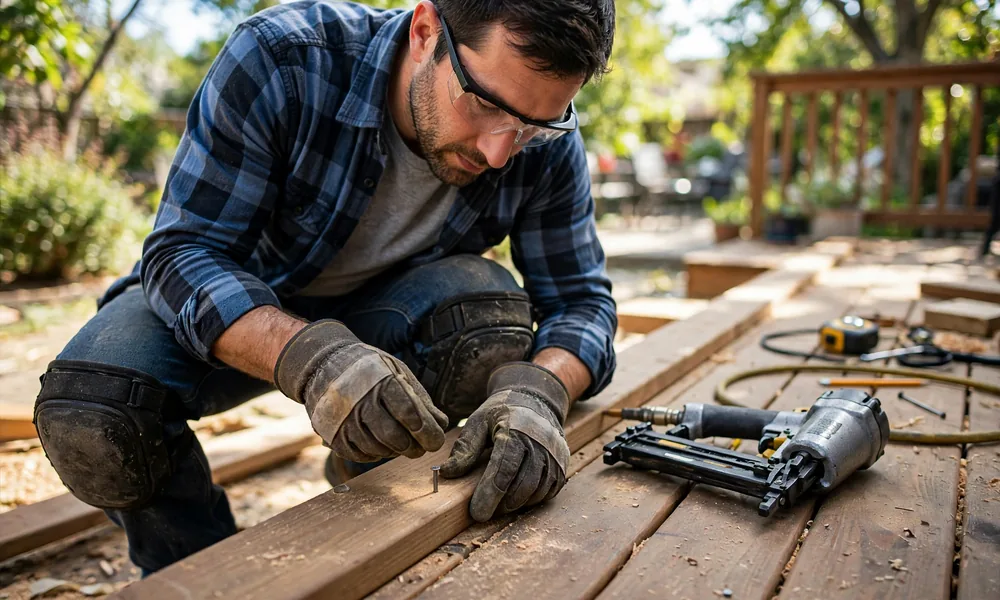
A nail gun, also called a nailer, drives nails into wood using stored energy instead of a hammer swing. You load a strip or coil of nails into the magazine, press the nose against the wood, and pull the trigger. In that instant the gun drives a single nail home with far more force and consistency than a hand swing can manage, and it does it again and again at the same depth. The result is faster work, tighter joints and far less chance of a nail bending or splitting the timber.
The accuracy comes from the design. A hammer depends on your arm, your aim and your energy on the fiftieth swing, and all three fade as the day goes on. A nail gun removes that variation: the same force, the same angle and the same depth on every shot, as long as you hold the nose flat against the work. That is why the supporting tools matter too. A frame measured carefully goes together square, which is why a good tape measure that matters more than you think is the first thing to reach for, and a frame that is level stays true, which is why our guide to why a good level is the tool you reach for most belongs in the same toolbox.
The Main Types of Nail Gun
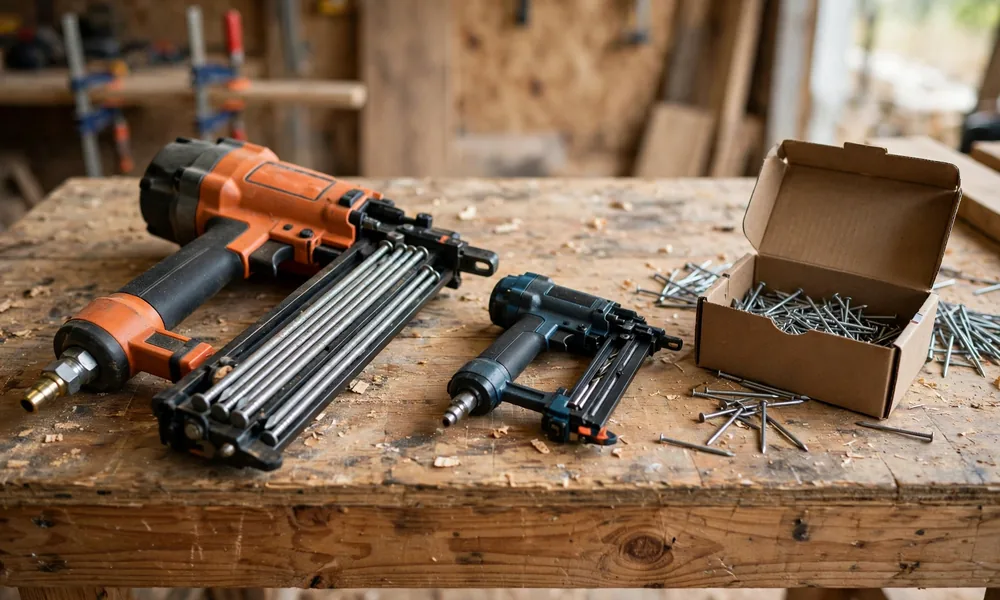
Framing nailers are the biggest and strongest. They take large nails, usually 50 to 90 millimetres long, and they are made for structural work: wall frames, floor joists, roof trusses and decking. They drive nails deep into thick timber all day. The trade-off is size and weight: a framing nailer is heavy, leaves a large hole on visible work, and is far too much tool for trim.
Finish nailers, also called second-fix nailers, are the middle ground. They take smaller nails, usually 30 to 65 millimetres, with a small head that can be sunk just below the surface and filled. They are made for skirting boards, architraves, door frames and panelling, where the joint must be strong but the nail should almost disappear. Brad nailers are the lightest of all. They fire very fine pins, usually 15 to 50 millimetres, with almost no head, for delicate work like beading and thin trim. They hold wood while glue dries rather than providing strength themselves.
Roofing nailers and flooring nailers are specialists for shingles, felt and hardwood floors. Most homeowners will never need either. For everyone else, the choice is between a framing gun, a finish gun and a brad gun.
Power Sources Compared
Pneumatic guns run on compressed air from a separate compressor. They are the lightest guns to hold and usually the cheapest and most reliable over years of hard use. The trade-off is the compressor: it is noisy, it needs a hose trailing behind you, and it is one more machine to maintain.
Cordless battery guns are the most convenient option for work around a house. They run on the same rechargeable batteries as many other power tools, with no hose to drag around. The trade-off is weight and price: the battery and motor make the gun heavier, and a good cordless gun costs more. For most homeowners the convenience is worth it.
Gas-powered guns use a small fuel cell and a battery to fire. They are powerful and fast, but the fuel cells are an ongoing cost and they need warmth in cold weather. They are less common in 2026, as cordless battery guns have caught up in power.
What Actually Decides a True Drive
A nail that drives true depends on four things, and the gun itself is only one of them. The first is nail choice. The nail should go about two-thirds of its length into the piece you are fixing to, so a 50-millimetre board needs a nail of roughly 75 millimetres. Too short and the joint is weak; too long and the nail pokes through. Match the gauge too, because a thick nail splits thin trim while a fine pin will not hold a heavy frame.
The second is depth adjustment, the feature to test before you buy. A good gun lets you set how deep the nail is driven with a dial or lever, so you can sink finish nails just below the surface for filling, or drive framing nails fully flush. Set the depth on scrap wood first and adjust in small steps. Expect to adjust again when you move from soft pine to hard oak.
The third is how you hold the gun. Press the nose flat against the wood, keep the gun square, and do not lift it until the nail is fully driven. The fourth is the condition of the gun: a clean magazine and a sharp driver blade fire the same on the hundredth nail as on the first.
Nail Guns Compared
| Type | Best for | Nail length | Visible hole | Power |
|---|---|---|---|---|
| Framing nailer | Wall frames, joists, decking | 50–90 mm | Large | Strongest |
| Finish nailer | Skirting, architraves, doors | 30–65 mm | Small | Medium |
| Brad nailer | Beading, thin trim, crafts | 15–50 mm | Tiny | Light |
| Roofing nailer | Shingles and felt | 20–45 mm | Hidden | Strong |
The Best Nail Guns of 2026
Best Overall: A Cordless Framing Nailer
The best overall nail gun for most homes is a cordless framing nailer that runs on a standard tool battery. It has the power for wall frames, decking and fencing, it has no hose to drag around, and it can be carried anywhere on the property. Look for tool-free depth adjustment, a large magazine, and a dry-fire lockout.
Best for Trim: A Cordless Finish Nailer
The best nail gun for trim work is a cordless finish nailer with fine depth control and a small, clean nose that lets you see exactly where the nail will go. It drives small-headed nails that sit just below the surface of skirting, architraves and door frames, ready for filler and paint. Look for a one-hand depth dial and a tool-free jam-clearing latch.
Best for Delicate Work: A Brad Nailer
The best nail gun for delicate work is a lightweight brad nailer that fires fine pins with almost no visible hole. It is the right tool for beading, thin trim, small boxes and craft projects, where a finish nail would split the wood. Look for a range of pin lengths and a clear nose for precise placement. Use it with glue on anything that needs to stay together.
Safety and Clearing Jams
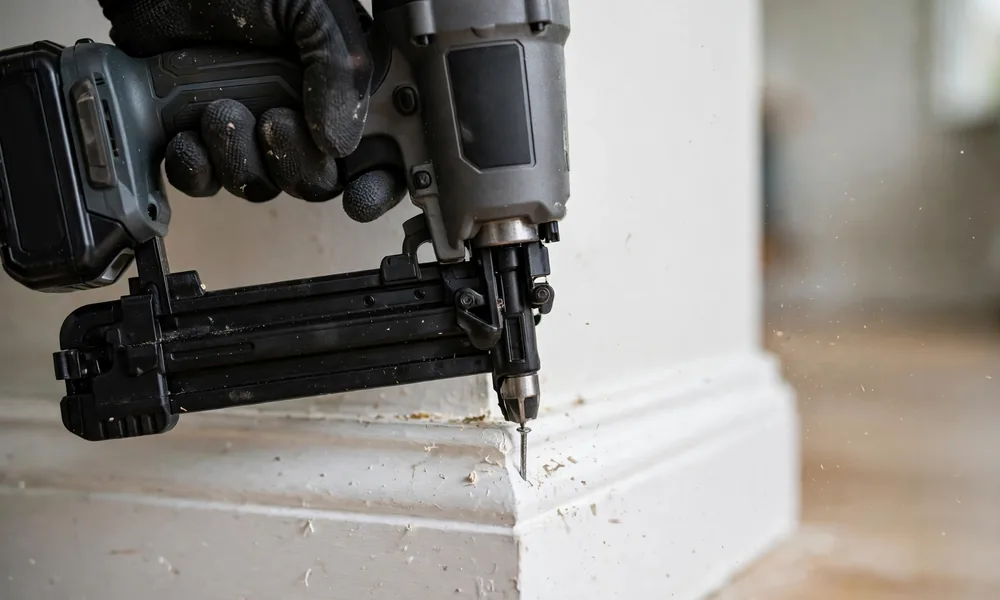
A nail gun deserves respect, because it drives a nail with enough force to go through wood, and it will do the same to anything else in its path. Treat it as if it could fire, keep your hands clear of the nose, and never point it at anyone, even when you believe it is empty. Disconnect the battery or air hose before clearing a jam or loading nails, and wear safety glasses and hearing protection.
Jams happen to every nail gun, usually because a nail was bent in the magazine or the wrong nails were loaded. Stop, disconnect the power, and open the jam-clearing latch. Pull the bent nail out with pliers, check the driver blade, and reload with the correct nails. Never clear a jam with the gun connected. When a job goes wrong and something needs taking apart, a good pry bar that will not bend is the right tool for the rescue.
Looking After Your Nail Gun
A nail gun that is looked after will drive true for years; one that is neglected will misfire within months. Blow dust out of the magazine and nose after each use, wipe the gun down, and oil the moving parts if it is pneumatic. Store it in its case with the magazine empty and keep it dry.
Before You Nail Checklist
- Choose the gun for the job: framing for structure, finish for trim, brad for delicate work.
- Pick the right nail length and gauge, and check that the nails fit your gun’s magazine.
- Mark and measure the work, check it is square and level, and clamp it before you start nailing.
- Set the depth on a piece of scrap wood and fire a few test nails before you start on the real work.
- Hold the nose flat and square against the wood, and keep your hands clear of the firing line.
- Clear jams only with the power disconnected, and clean the magazine and nose after every use.
Frequently Asked Questions
Do I need a compressor for a nail gun?
No, cordless battery nail guns need no compressor and are the easiest choice for work around a house, while pneumatic guns are lighter and cheaper but need a compressor and a hose.
What size nail gun do I need?
For framing use a framing nailer taking 50 to 90 millimetre nails, for skirting and doors a finish nailer taking 30 to 65 millimetre nails, and for thin trim a brad nailer.
Can a nail gun split wood?
Yes, a nail gun can split thin or dry wood, especially near the end of a board, so use a finer gauge nail, keep nails away from the very end, and test on scrap first.
How do I stop nails sticking out?
Set the depth adjustment on scrap wood until each nail sits flush or just below the surface, and adjust it again when you change wood species or nail length.
Are nail guns safe for beginners?
Yes, a nail gun is safe for a beginner who follows the rules: keep hands clear of the nose, disconnect power before clearing a jam, wear safety glasses, and practise on scrap wood first.
Why does my nail gun keep jamming?
Repeated jams are usually caused by the wrong nails, bent nails, or a dirty magazine, so check the nails, clean the magazine and nose, and inspect the driver blade.
The Bottom Line
The nail guns that drive true every time in 2026 are the ones matched to the work: a cordless framing nailer for structure, a finish nailer for trim, and a brad nailer for delicate pieces. Pick the right gun and nail, set the depth on scrap wood, measure and clamp the work first, and keep the gun clean, with power disconnected when you clear a jam. Do that, and every nail will sit flush and every joint will hold tight.