
The Best Outdoor Lights for Porches, Paths and Patios in 2026
The best outdoor lights for porches, paths and patios in 2026 do three jobs at once: they make the front door easy to find, the walk to it safe to use, and the back of the house worth sitting in after dark. Most homes get one of those right and leave the other two to chance, which is why so many porches are either blinding or pitch black, and so many patios sit unused once the sun goes down. A good outdoor lighting plan is not about buying more lights.
This guide works zone by zone. The porch needs welcoming, glare-free light at the door. The path needs low, even light that shows every step without blinding anyone walking it. The patio needs warm, layered light that flatters people and food rather than flooding the garden like a car park.
Key takeaways
- Plan outdoor lighting by zone: porch, path, and patio each need a different kind of light, and one fitting cannot do all three well.
- Warm white light between 2700K and 3000K suits porches and patios; cool white is better reserved for security areas and driveways.
- Look for IP44 as the minimum outdoors, and IP65 for any fitting left fully exposed to rain all winter.
- Mains-wired lights are brightest and most reliable, solar lights are easiest to install, and battery lights suit spots no cable can reach.
- Layer the light: a little light in several places always looks better than one very bright fitting.
How to plan outdoor lighting by zone
Start by walking your home at dusk, not by shopping. Stand at the front gate and look at the door: can you see the lock, the step, and the house number? Walk the path to the back door and note every step, turn, and dark corner. Then sit where you sit on the patio and look at what is around you. The three walks tell you how many lights you need and where they belong, and they stop you buying a dozen identical fittings and hoping for the best.
Think in layers as you walk. The porch needs light at face height so visitors can see you and you can see them. The path needs light at ankle height, close to the ground, marking the edges of the walk. The patio needs light at table height and above, warm and low enough to sit under comfortably.
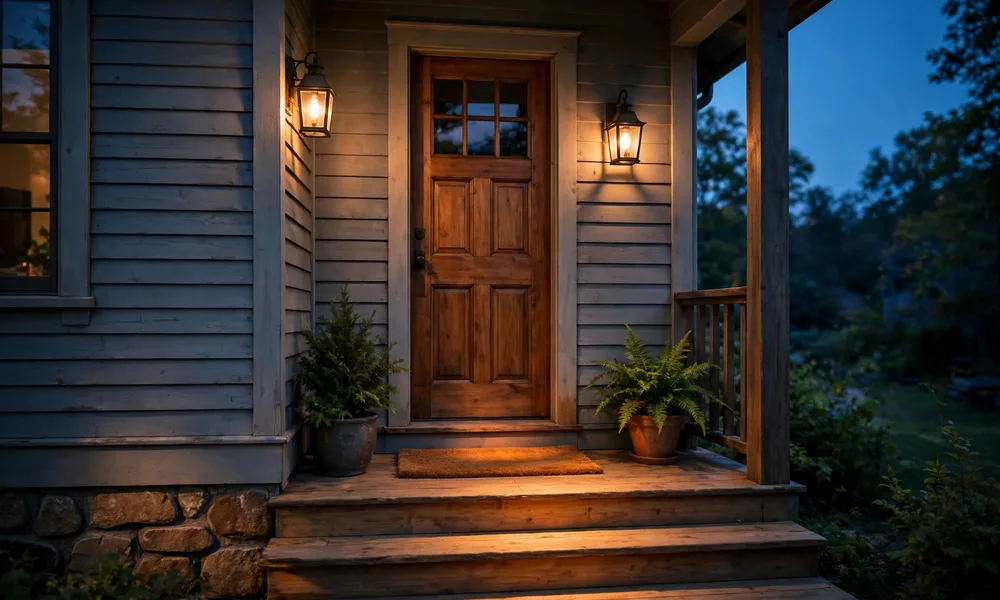
Porch lights: welcoming light at the front door
The porch is the first light visitors meet, and it sets the tone for the whole house. Two wall lanterns, one on each side of the door, is the classic arrangement for a reason: the light falls on faces from both sides, there is no hard shadow across the step, and the door itself reads clearly from the street.
Choose warm white bulbs, around 2700K, in a fitting with a shade that hides the bulb from eye level. A bare bulb at face height is the most common porch mistake: it dazzles visitors and makes the rest of the porch look darker by comparison. A lantern with glass panels and a solid top throws light down onto the step and outwards, which is exactly where it is needed.
Controls matter as much as the fitting. A dusk-to-dawn sensor means the porch is always lit when someone arrives after dark, and a motion sensor adds a brighter welcome when someone approaches the step. The best setups combine both: a low warm glow all evening, rising to full brightness when the sensor trips.
Path lights: safe steps from gate to door
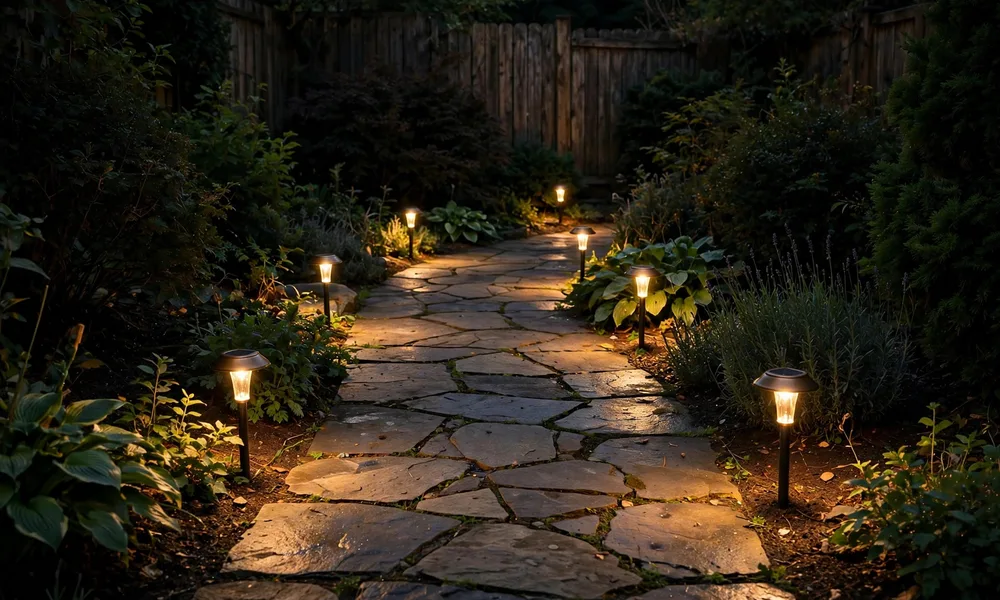
Path lights have one job: show people where to put their feet. The best ones are low bollards or stake lights, about knee height or lower, spaced two to three metres apart and staggered slightly from side to side rather than lined up in a rigid row. Aim for gentle pools of warm light on the stones, not a continuous bright strip.
Solar path lights are the easiest way to light a path, because there is no cable to bury and no electrician to call. The trade-off is brightness: a solar stake gives 10 to 25 lumens, which is plenty for a familiar path but not enough for a long, uneven walk. Our guide to the best solar lights for the garden covers the panel and battery details that decide whether a solar path light lasts the night or fades by ten o’clock.
Steps deserve special attention. A single step in the dark is a trip waiting to happen, so put a light at the top and the bottom of any step, or fit small recessed step lights into the riser itself. Avoid pointing path lights up into people’s eyes: the fitting should throw light downwards onto the path, and you should not be able to see the bare bulb when you walk towards it. If you can see the bulb, the light is aimed wrong.
Patio lights: warm light for evenings outside
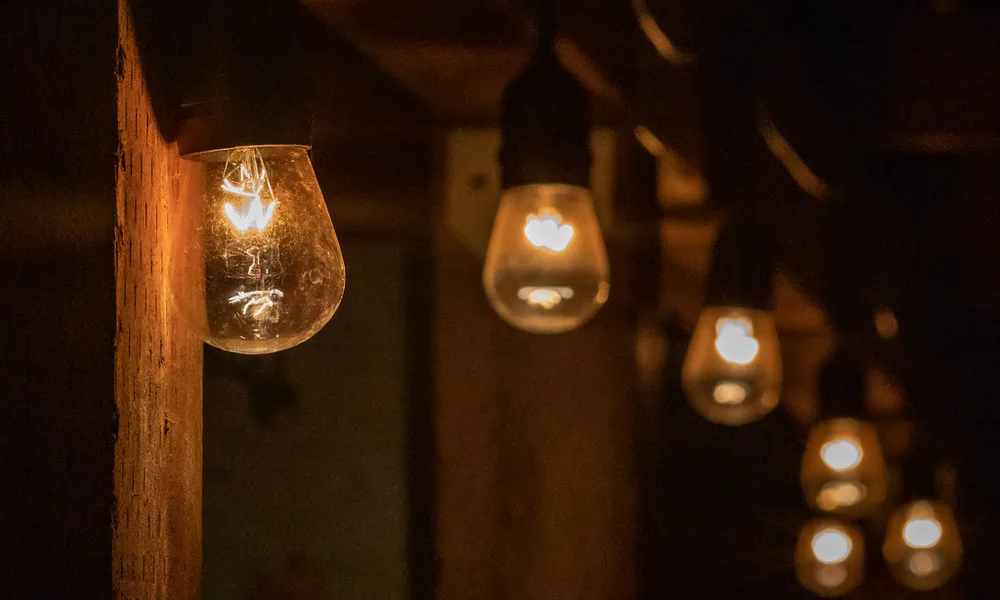
Patio lighting is about atmosphere first and safety second. The goal is a warm glow that lets people see each other and their food, without the harsh brightness that makes a garden feel like a car park. Festoon string lights are the fastest way to get there: strung across the patio with a gentle sag, they give an even golden light that suits evening meals and late conversations.
Wall lights and table lanterns fill in the rest. A pair of warm wall lights on the house wall gives a steady base layer, and a couple of battery lanterns on the table add light exactly where people are eating. If you want the full detail on strings, our guide to picking string lights that last all year covers IP ratings, cables, and hanging, and our patio furniture guide covers the seating and layout the lights are meant to show off.
Outdoor lights comparison
| Zone | Best fitting | Light level | Power | Weatherproof |
|---|---|---|---|---|
| Porch | Pair of wall lanterns | Warm, face height | Mains, sensor | IP44 to IP65 |
| Path | Low bollards or stakes | 10 to 25 lumens each | Solar or low voltage | IP44 minimum |
| Patio | Festoon string lights | Warm, overhead | Mains or solar | IP44 to IP65 |
| Steps | Recessed step lights | Low, downward | Low voltage | IP65 |
| Security | Motion floodlight | Cool white, bright | Mains | IP65 |
| Features | Spotlights, uplights | Focused beams | Solar or mains | IP65 |
Choosing between wired, solar, and battery power
Power is the decision that shapes everything else. Mains-wired lights are the brightest and most reliable: they work in winter, they stay on as long as you want, and they suit porches, patios, and any fitting that stays in one place for years.
Solar lights need no wiring at all, which makes them the easiest to install and move. Their limits are real, though: a solar panel needs several hours of direct sun to charge, and in winter many solar lights glow for only a few hours after dark. Check the panel size and battery capacity before you buy: a larger panel and a bigger battery are worth more than a fancy design.
Battery lights fill the gaps the other two cannot reach: inside a lantern on the table, under a pergola with no socket nearby, or on a fence far from the house. They are the weakest option for permanent lighting, because batteries need replacing and brightness drops as they drain, but for movable, seasonal light they are hard to beat. Rechargeable batteries and a timer keep the running cost and the faff down.
Weatherproofing, installation, and upkeep
The IP rating is the number that matters most outdoors. The first digit covers dust and the second covers water: IP44 means protection against splashing water from any direction, enough for a sheltered porch or patio, while IP65 means the fitting can handle jets of water, which is what you want for anything left out in open rain all winter.
Installation is mostly about keeping water out of the connections. The plug and transformer are the weak points of any outdoor set, so keep them under cover and off the ground. Run cables where nobody will trip on them or catch them with a mower, and use proper outdoor connectors rather than indoor extension leads.
Upkeep is light but regular. Wipe solar panels once a month, because dust and bird droppings cut charging more than most people expect. Clear leaves from around path lights in autumn, and check fittings after the first hard frost of the year.
Outdoor lighting checklist
- Walk the porch, path, and patio at dusk before buying anything, and note the dark steps and corners.
- Choose warm white 2700K to 3000K for porches and patios, and keep cool white for security areas.
- Check the IP rating: IP44 minimum outdoors, IP65 for exposed fittings and step lights.
- Space path lights two to three metres apart, staggered, with the light aimed down at the stones.
- Put porch lanterns on both sides of the door, with the bulb hidden from eye level.
- Keep plugs, transformers, and connections under cover and off the ground.
Frequently asked questions
How many outdoor lights do I need?
Fewer than you think. Two lanterns at the porch, a stake light every two to three metres along the path, and one string of festoon lights over the patio covers most homes. Start with that, live with it for a week, and add light only where the garden still feels dark. Over-lighting is the most common outdoor mistake, and it is harder to fix than under-lighting.
Are solar outdoor lights bright enough?
For paths and decoration on a summer evening, yes. For a long walk, a flight of steps, or all-night use in winter, mains-wired lights are brighter and more reliable.
What IP rating do outdoor lights need?
IP44 is the minimum for any fitting used outdoors, and it suits sheltered porches and patios. IP65 handles heavy rain and exposed positions, and it is the rating to choose for step lights, ground lights, and anything left out all winter without cover.
Should porch lights be warm or cool white?
Warm white, around 2700K, suits porches and patios because it flatters faces, wood, and stone, and it feels welcoming. Cool white looks harsh at a front door and suits security lighting better, where the priority is seeing clearly rather than feeling welcome.
Can I leave outdoor lights on all night?
Yes, if they are rated for it and on a proper outdoor circuit. A dusk-to-dawn sensor keeps the porch lit only when it is dark, and a timer switches patio lights off at bedtime. Leaving lights on all night costs little with LEDs, but a sensor or timer is cheaper still and kinder to the neighbours.
Do outdoor lights need an electrician?
Mains-wired lights fixed to the house do, and outdoor mains work should always be done by a qualified electrician. Solar, battery, and plug-in low-voltage lights do not: you can install them yourself in an afternoon, as long as the plug and transformer stay dry and under cover.
The bottom line
The best outdoor lights for porches, paths, and patios in 2026 are the ones planned by zone: warm lanterns at the door, low even light along the path, and soft festoon light over the patio. Choose IP44 as a minimum and IP65 where the rain hits hardest, pick mains power where reliability matters and solar where the sun does the work, and layer a little light in several places instead of one bright flood.


