Why the Best Pasta Servers Make Spaghetti Night Easier in 2026
A pasta server is the long-handled tool that lifts spaghetti from the pot, twirls it into a neat nest, and serves it without a trail of sauce across the table. The best pasta servers in 2026 grip long strands without dropping them, drain just enough water, and portion evenly. The difference between one that twirls a clean nest and one that drops half the spaghetti back into the pot comes down to the head, the teeth, and the handle.
Serving spaghetti with a fork and a spoon is fiddly: the strands slip, the sauce drips, and the portion lands in a tangled heap. A pasta server does the job in one tool, twirling the strands into a compact nest.
Key Takeaways
- A pasta server lifts, twirls, and portions long pasta in one tool: the head grips the strands while the teeth stop them sliding off.
- A slotted spoon server suits most kitchens; a fork server twirls the neatest nests, and a claw server grips the biggest portions.
- Stainless steel is the safest all-round choice: it will not melt, it survives the dishwasher, and it stays rigid under a heavy portion.
- A handle of at least 30 centimetres keeps your hand clear of steam and reaches the bottom of a deep stockpot.
- Own one pasta server for the stove and use a serving spoon for short pasta such as penne and fusilli.
What a Pasta Server Actually Is
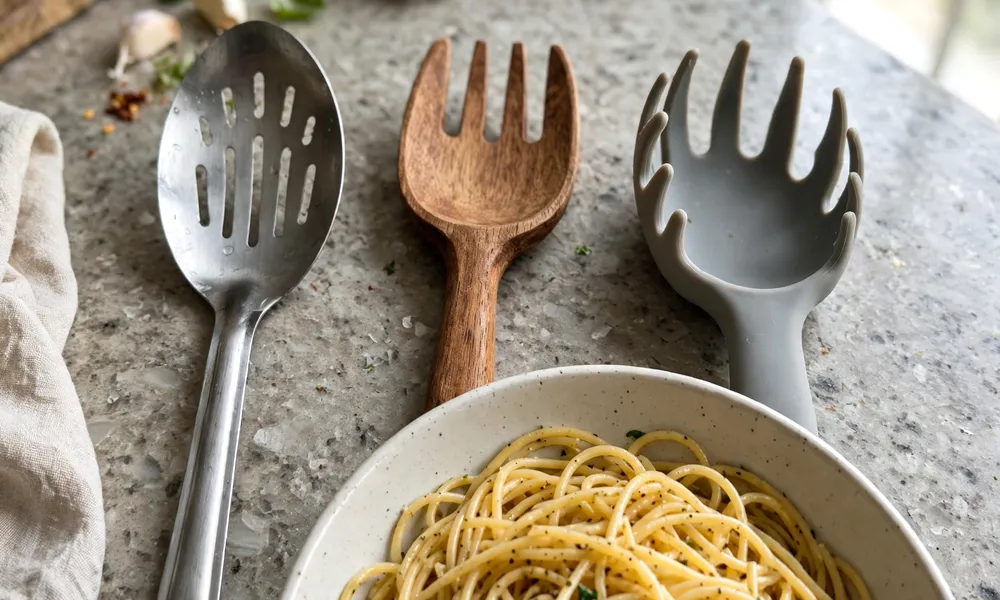
A pasta server is a long-handled serving tool with a head designed for long pasta. The most common design is a slotted spoon with teeth around the rim: the slots drain water, and the teeth grip the strands so they can be twirled into a nest. Other designs use a fork head with long tines, or a claw head that scoops a portion.
A serving spoon can lift spaghetti, but it cannot wind it into a nest, and the strands slide off the bowl in a heap. A pasta server works by grip and rotation: the teeth catch the strands, a twist of the wrist winds them into a compact coil, and the nest holds its shape as it moves from pot to plate. Short pasta needs no twirling, which is why a serving spoon still wins for penne and fusilli.
The Main Types of Pasta Server
Four designs cover nearly every pasta server on sale: the slotted spoon server, the fork server, the claw server, and the ladle server.
The Slotted Spoon Server: The One to Buy First
A slotted spoon server is a long-handled spoon with a slotted bowl and teeth around the rim. It lifts spaghetti from the pot, drains the water through the slots, and twirls a neat nest with a twist of the wrist. It is cheap, light, and easy to store, and it serves every long pasta from spaghetti to linguine.
The Fork Server: Neatest Nests
A fork server is a long-handled fork with wide, curved tines that wind spaghetti into the tightest, neatest nests. It suits cooks who plate carefully, because the nest holds its shape on the plate. The trade-off is draining: a fork server carries more water than a slotted server, so lift it over the pot for a second before plating.
The Claw Server: Biggest Portions
A claw server has a wide, scooping head with prongs that grip a large portion of pasta at once. It suits family cooking, where four bowls need filling fast, and buffet serving, where speed matters more than neatness. The portions are generous but less tidy.
The Ladle Server: For Saucy Pasta
A ladle server is a deep, slotted ladle that lifts pasta and sauce together, so the strands arrive coated and ready to eat. It suits saucy pasta such as spaghetti Bolognese, where the sauce belongs on the pasta rather than left in the pot.
Pasta Servers Compared
| Type | Head | Best for | Weakness |
|---|---|---|---|
| Slotted spoon server | Slotted bowl, teeth | Everyday spaghetti, linguine | Less neat than a fork |
| Fork server | Wide curved tines | Neat nests, guests | Carries more water |
| Claw server | Wide prongs | Family portions, buffets | Less tidy portions |
| Ladle server | Deep slotted ladle | Saucy pasta, Bolognese | Least precise |
| Wooden fork server | Wooden tines | Non-stick pots | Needs hand washing |
| Silicone server | Silicone head | Non-stick pans | Can flex under heavy loads |
Head, Teeth, and Materials: What to Check
Choosing a pasta server comes down to three checks. The first is the head: wide enough to hold a proper portion in one lift, around eight to nine centimetres across, with a gentle curve that cradles the strands. The teeth should be evenly spaced and smooth, with no burr that catches and tears the pasta. A head that is too small means three trips per bowl; a head that is too flat drops the nest before it reaches the plate.
The second check is the handle: at least 30 centimetres long, so your hand stays clear of steam and reaches the bottom of a deep stockpot, and balanced when held by the middle, with the head sitting level. A hanging loop is useful, since long servers are awkward in a drawer.
The third check is the material. Stainless steel wins for most kitchens: it does not stain, it survives the dishwasher, and it will not melt if left against a hot pot. Wood is gentler on non-stick and enamel pots and stays cool in the hand, but it needs hand washing and oiling. Silicone suits non-stick pans, but a thin silicone head flexes under a heavy portion.

How to Serve Pasta Cleanly, Step by Step
Start with pasta cooked until just firm: overcooked strands break when twirled and slip off the teeth. Lift the server into the pot and gather a portion with a gentle scoop, then hold it over the pot for a second so the water drains through the slots.
Twirl the server in the pot or against the side of the bowl, winding the strands into a compact nest. Keep the twirl slow and steady: a fast spin throws sauce off the strands, while a hesitant one lets the nest unravel. Lift the nest onto the plate in one movement, and use a second spoon to guide any stray strands.
Pasta Servers Against Spoons, Tongs, and Ladles
A serving spoon is the closest neighbour, and the difference is the twirl: a serving spoon lifts food, while a pasta server winds long strands into a nest. The best serving spoons of 2026 cover the general serving job, including short pasta such as penne, which a server cannot grip. A kitchen that serves both long and short pasta needs both tools.
Tongs are the second neighbour. They grip a slippery piece of chicken, hold a steak steady, and lift pasta from boiling water without dropping a strand. The tongs that grip without slipping are the tool for lifting and turning, and twisting tongs as you lift winds the strands into a nest. But tongs need more attention to portion evenly, while a pasta server portions and twirls in one movement. A ladle is the third neighbour: built to carry liquid, it serves soup and sauce, while a pasta server leaves the water behind and carries only the strands.
Which Pasta Suits a Server?
Long pasta is where a server earns its keep. Spaghetti, linguine, fettuccine, and tagliatelle all twirl into neat nests. Short pasta such as penne, fusilli, and rigatoni cannot be twirled, so a serving spoon or a slotted spoon is the better tool. Filled pasta such as ravioli and tortellini needs a slotted spoon, which cradles the parcels without tearing them.
The bowl matters too. A wide, shallow bowl lets the nest sit proudly, while a deep bowl hides it. The best pasta bowls of 2026 show which shapes suit a twirled nest.
Care and Storage
Rinse a steel server straight after use, before starch dries into the slots and teeth, and wash it in hot soapy water or the dishwasher. A soft brush reaches into the slots and around the teeth. Wooden servers need hand washing in warm soapy water, drying straight away, and a monthly rub of food-safe mineral oil. Never leave one soaking overnight, and never put it in the dishwasher.
For storage, hang a pasta server from a hook or stand it in a tall crock by the stove: left loose in a drawer it will snag and bend. Keep the head away from heavy utensils that could bend the teeth.
What to Avoid When Buying
The cheapest pasta servers fail in predictable ways. Avoid teeth with rough or burred edges, which tear pasta instead of gripping it. Avoid a head that is too small for a proper portion, and a handle too short for your deepest pot. Avoid a handle joined with glue or a single small spot weld, which will wobble and then snap. Avoid very thin steel, which flexes under a heavy portion, and avoid plastic handles for pot work, which soften in hot water.
Checklist: Before You Buy a Pasta Server
- Pick the head: slotted spoon for everyday spaghetti, fork for the neatest nests, claw for family portions.
- Check the head holds a proper portion in one lift, around eight to nine centimetres across.
- Choose a handle of at least 30 centimetres, with a hanging loop for storage.
- Hold the server by its middle: the head should sit level, not tip forward.
- Buy stainless steel for the stove, or wood or silicone if your pots are non-stick.
- Check the teeth are smooth, evenly spaced, and firmly fixed, with no burr or rough edge.
Frequently Asked Questions
What is a pasta server used for?
A pasta server lifts long pasta from the pot, twirls it into a neat nest, and portions it onto the plate: spaghetti, linguine, fettuccine, and tagliatelle, draining water as it lifts and gripping the strands so they hold their shape.
What is the difference between a pasta server and a serving spoon?
A serving spoon lifts food, while a pasta server winds long strands into a nest. A serving spoon suits short pasta such as penne, which a server cannot grip, while a pasta server suits long pasta such as spaghetti.
Can I use tongs instead of a pasta server?
Yes, tongs lift pasta from boiling water and twist into a nest as you lift. But tongs need more attention to portion evenly, while a pasta server portions and twirls in one movement.
Are pasta servers dishwasher safe?
Stainless steel and silicone pasta servers are dishwasher safe, though hand washing keeps steel looking its best. Wooden servers should never go in the dishwasher: hand wash, dry straight away, and oil once a month.
Which pasta server is best for spaghetti?
A slotted spoon server suits most kitchens: it drains water, grips the strands, and twirls a neat nest. A fork server twirls the tightest nests for guests, while a claw server suits family portions.
Do I need a pasta server if I already own tongs?
If you eat long pasta more than once a week, yes. A pasta server portions evenly and twirls a nest that holds its shape on the plate. If you rarely eat long pasta, tongs will do.
The Verdict
The Best pasta server for most kitchens is a stainless steel slotted spoon server with a handle of at least 30 centimetres and smooth, evenly spaced teeth: it lifts, drains, and twirls spaghetti into a neat nest in one movement, survives the dishwasher, and costs very little. Add a fork server if you plate carefully for guests, and a claw server if you serve family portions fast.
The Bottom Line
A pasta server is a small, cheap tool that turns spaghetti night from a tangled heap into a neat nest. Buy a steel slotted spoon server first, check the teeth are smooth and the handle long enough for your deepest pot, and keep a serving spoon for short pasta.