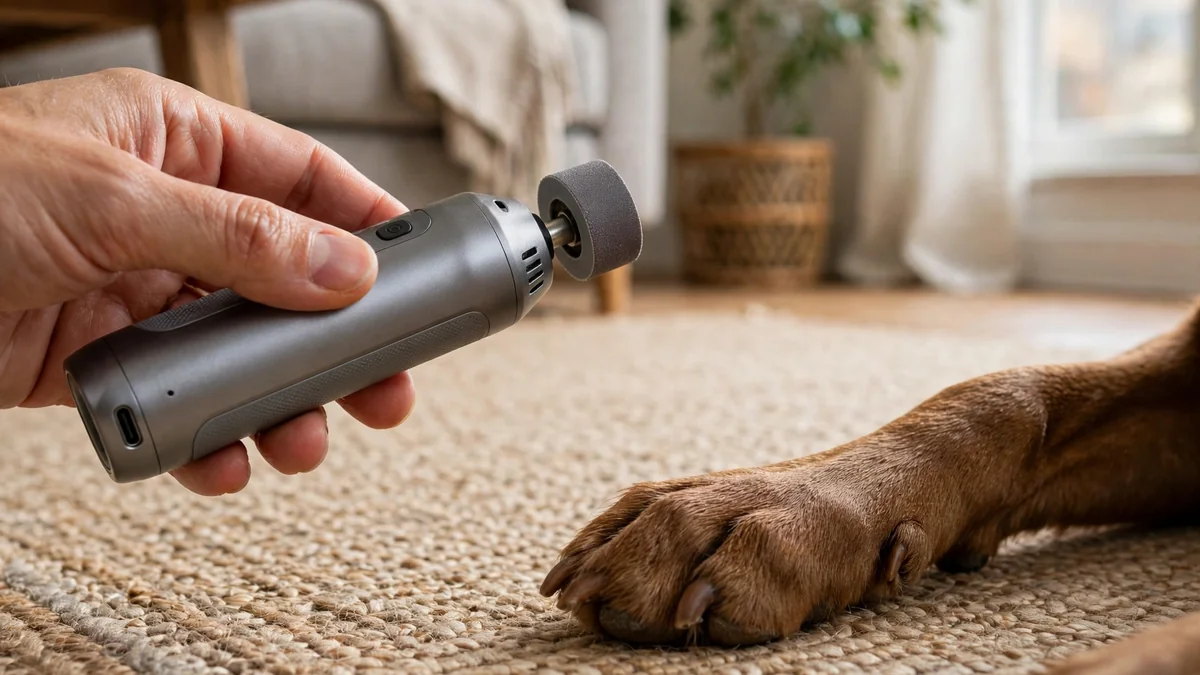
Pet nail grinders vs clippers is the choice every dog and cat owner faces sooner or later: one tool cuts the nail off in a single squeeze, the other files it down with a spinning drum. The best pet nail grinders in 2026 suit nervous owners and dark nails — but they are slower and noisier. This guide compares grinders and clippers head to head: how each one works, which pets suit which tool, and how to grind a nail safely.
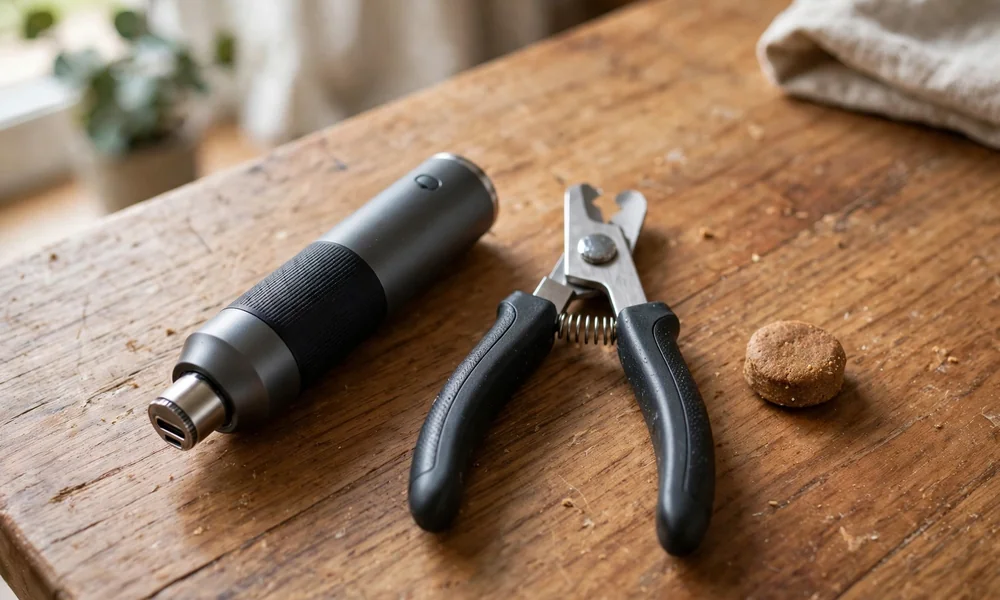
A pet nail grinder is a small rotary tool, closer to a tiny sander than to scissors. A motor spins a sanding drum, and you touch the nail to the drum for a few seconds at a time. A clipper does the opposite: two blades close and the nail is gone in one cut. That difference decides almost everything, from the risk of cutting the quick to the patience your pet will need.
Key Takeaways
- Grinders file gradually, so they almost never cause a sudden bad cut — the main risk with clippers on dark nails.
- Clippers are faster: one squeeze per nail, while grinding needs short passes so the nail does not heat up.
- Noise is the grinder’s weakness: introduce it slowly with treats, and choose at least two speeds and a quiet motor.
- Grinders suit nervous dogs, cats with thin nails, and thick nails that need smoothing after clipping.
- Never grind one spot for more than a few seconds, and let the nail cool between passes — a hot drum hurts and teaches your pet to fear the tool.
How a Pet Nail Grinder Actually Works
A pet nail grinder is a handle with a motor inside and a small sanding drum at the tip. Switch it on, and the drum spins at thousands of revolutions per minute. Touch a nail to the drum, and the abrasive surface files a thin layer away. Each pass removes a little, so you creep up on the right length and can round the tip smooth.
The drum is the part that wears out. Most grinders come with sanding bands or a diamond-coated drum: coarse grits remove length faster on thick dog nails, fine grits suit cats and small dogs. A worn drum files nothing and only heats the nail, so replace the bands when they stop cutting. The better models offer two or three speeds, so you can start low.
Speed, Noise and Vibration
Noise is the first thing your pet notices, and it is the reason many grinders end up in a drawer. A cheap grinder buzzes loudly and vibrates, and a dog that tolerates clippers may still hate it. Look for a motor rated under 50 decibels, and test the vibration in your own hand first: if it numbs your fingers in thirty seconds, it will feel worse on a paw. Two speeds are the minimum worth buying — low for training, high for working.
Power: Corded, Cordless and Battery Life
Most pet nail grinders today are cordless and rechargeable over USB, which makes them easy to use on a sofa or in the garden. A full charge typically lasts several sessions, but a weak battery slows the drum under pressure, and a slowing drum files badly and heats up. Check the runtime before you buy, and prefer a model that holds its speed. Corded grinders are stronger and never run flat, but the cable gets in the way around a wriggling pet.
Pet Nail Grinders vs Clippers Compared
| Factor | Pet nail grinder | Pet nail clippers |
|---|---|---|
| How it shortens | Files gradually with a spinning drum | Cuts in one squeeze |
| Risk of cutting the quick | Very low, you creep up on it | Higher, especially on dark nails |
| Speed | Slower, several passes per nail | Fast, minutes for all four paws |
| Finish | Smooth and rounded, no snagging | Can leave sharp or split edges |
| Noise and stress | Buzz and vibration, needs training | Quiet, but the snap can startle |
| Skill needed | Low, hard to make a bad cut | Higher, needs a steady hand and good light |
Grinders: Who They Suit Best
Grinders suit the owner who is afraid of cutting too short, and that is most owners at first. If your dog has dark nails and you cannot see the quick, a grinder removes the guesswork: you file a little, look, and file a little more, and the nail tells you when to stop. Grinders also suit thick nails that crush under a dull clipper, cats, whose thin nails file quickly with a fine drum, and older dogs with brittle nails that can split under a clipper.
A dog that flinches at the snap of a clipper may accept the steady hum of a grinder, because there is no sudden moment to fear — once the pet is used to the sound. Keep the first sessions short, with the grinder switched on near the pet but not touching a nail.
Clippers: Who They Still Suit Best
Clippers still win on speed. A calm dog with pale nails can have all four paws clipped in five minutes, while grinding takes three times as long. Clippers also work anywhere with no charging and no noise, and they cost less than most grinders.
The clipper family has two main types. Guillotine clippers suit small and medium dogs; scissor clippers suit large dogs with thick nails, giving more leverage. Our guide to the best dog nail clippers of 2026 compares both types by dog size, and our guide to the best cat nail clippers of 2026 covers the smaller tools for cats. If your pet already accepts clippers calmly, there is no reason to switch.

How to Grind a Nail Safely, Step by Step
Start with the grinder off. Let your pet sniff it, give a treat, and hold the paw as you will during grinding. Switch it on at its lowest speed, away from the paw, and touch the drum to one nail for two or three seconds, then lift it away and praise the pet. That is the whole technique: short passes, lots of praise, and never more than a few seconds on one spot.
Hold the nail steady and grind at a slight angle, working around the tip. Check the nail after every pass: a pale centre means you are close to the quick and should stop. Do two or three nails, then take a break. Keep styptic powder nearby in case you nick the quick.
Noise, Vibration and Nervous Pets
Most pets dislike a grinder at first. Train in stages over several days: day one, grinder on the table, treats nearby. Day two, grinder switched on in the same room. Day three, one second on one nail, then a treat and done. If your pet still panics after a week of patient training, the grinder is not the right tool, and clippers — or a groomer — are the kinder choice.
Long hair is the other hazard: a grinder can catch and wind up the fur around a paw in a second. Hold the fur back, or use the guard that shields the drum and leaves only the nail exposed.

Corded vs Cordless, and Battery Life
Cordless grinders dominate the market now, and for home use they are the right choice: no cable to trip over and easy to use on a lap. Look for a USB-rechargeable model with at least an hour of runtime and a battery indicator. A grinder that fades halfway through the back paws is worse than a slow one, because a fading drum heats the nail instead of filing it. Corded grinders still have a place for groomers, because they hold full speed and never fade.
What to Avoid
Avoid the cheapest grinders with a single speed and no guard: they are loud, they vibrate, and they give you no way to slow down for a nervous pet. Avoid grinding one spot for more than a few seconds — heat is the commonest cause of a pet that will not sit still next time. Avoid a nail that is already cracked, because the drum can catch the crack and tear it further. And never use human nail clippers on a dog or a cat: they crush a pet’s curved nail. Our guide to nail clippers that cut clean explains what makes a good clipper for people — and why that design does not transfer to paws.
Checklist: Before You Buy a Pet Nail Grinder
- Choose at least two speeds, with a low speed quiet enough for training and a high speed strong enough for thick nails.
- Check the noise: a quiet motor under 50 decibels is worth paying for if your pet is nervous.
- Match the drum to your pet: coarse grit for large dogs, fine grit for cats and small dogs, and spare bands in the box.
- Confirm the battery lasts a full session — at least 45 minutes.
- Make sure the grinder has a guard or a cap that keeps long fur away from the spinning drum.
- Buy styptic powder too, so a nicked quick is a thirty-second fix.
Frequently Asked Questions
Are pet nail grinders better than clippers?
For safety, yes: a grinder almost never causes a sudden bad cut. For speed, no: clippers finish all four paws in minutes. The best tool is the one your pet tolerates and you use regularly.
Do pet nail grinders hurt dogs?
Not when used properly. Short passes with pauses to let the nail cool are painless. If your dog flinches, stop and let the nail cool before you continue. Holding the drum on one spot heats the nail quickly, and that does hurt — so keep the passes short.
Can I use a pet nail grinder on a cat?
Yes, with a fine drum and the lowest speed. A cat’s nails are thin and file quickly, so a few seconds per nail is enough. Keep sessions short, and stop while your cat is still calm.
How often should I grind my pet’s nails?
Every one to two weeks for most dogs, and every two to three weeks for most cats. Nails that click on hard floors are too long. Little and often is better than a long session once a month.
Can I use a regular rotary tool instead of a pet nail grinder?
You can, but a workshop rotary tool is usually too fast, too loud, and too strong for a pet’s nail, and it has no guard for fur. A dedicated pet grinder runs slower and quieter, with a smaller drum.
What if my dog is scared of the grinder?
Train in stages over several days: grinder on the table, then switched on nearby, then one second on one nail, with treats at every step. If your dog still panics after a week, switch to clippers or ask a groomer.
The Bottom Line
Pet nail grinders vs clippers is not a contest with one winner: it is a choice between safety and speed. Grinders win for nervous owners, dark nails, and thick nails that need a smooth finish, because they file gradually and almost never cause a sudden bad cut. Clippers win for calm pets and busy owners, because they finish the job in minutes. If you choose a grinder, buy two speeds, a quiet motor, and spare drums, train your pet in short stages, and grind in passes of a few seconds. The best tool is the one you actually use every fortnight.


