A pet stroller is one of those purchases that looks like a luxury until the first time you actually need one. An older dog who still loves the park but cannot walk the whole way, a puppy who has not finished vaccinations, a cat who panics at the sight of a lead, a small dog with a sore leg after surgery — all of them still want to be out in the world, and a good stroller is what makes that possible. The best pet strollers of 2026 are not the prettiest ones and they are not the most expensive ones. They are the ones that roll smoothly, keep a pet safe and calm inside, fold without a fight, and survive being used every single day.
What Makes a Pet Stroller Good
The first thing to judge is how it rolls. A good pet stroller pushes with one hand, turns without wrestling, and does not pull to one side on a slope. The wheels should be large enough to handle cracked pavements, gravel paths and grass without jolting the passenger, and the front wheels should swivel for tight turns but lock when you need to go straight over rough ground. If you have to push hard on flat ground, something is wrong: either the wheels are too small, the frame flexes, or the weight is badly balanced. Push it with a bag of shopping in the basket before you decide, because that is how it will really be used.
The second thing is the cabin itself. Your pet needs room to sit up, turn around and lie down, not just to squeeze in. Measure your pet lying down, nose to tail, and add a few inches: that is the cabin length you need. The floor should be firm and padded, not a sagging sheet of fabric, and it should be removable and washable, because muddy paws and the occasional accident are part of pet life. Mesh windows matter more than most people expect. They let air flow through on a warm day, let your pet see out without feeling trapped, and let you check on them without unzipping anything. A stroller with only one small window feels like a box; one with mesh on three sides feels like a seat.
The canopy is the third thing to get right. It should open wide enough to shade your pet from sun and light rain, and close down far enough to give a nervous animal a dark, quiet space. Look for a canopy that stays where you put it rather than flopping back at the first bump, and for a peek-a-boo window in the top so you can check on your pet from behind the handle.
The Main Types of Pet Stroller
Three-wheel strollers are the sporty option. One large wheel at the front and two at the back makes them easy to steer with one hand and good on uneven ground, which suits longer walks, park trails and people who walk fast. They are usually lighter than four-wheel models and fold flatter, but they can feel less stable when a heavy dog shifts its weight suddenly, and they are not the best choice for a pet that leans hard to one side. If your walks are mostly on paths and you value easy steering, a three-wheeler is a strong pick.
Four-wheel strollers are the steady option. Four wheels spread the weight evenly, so the stroller feels planted even when a large dog moves around inside, and they are generally the better choice for heavier pets and for older animals who need a stable ride. They take up a little more space when folded and can be harder to turn in a narrow shop aisle, but for everyday use around town they are the most forgiving design. Most of the best pet strollers of 2026 for medium and large dogs are four-wheel models, and that is no accident.
Convertible strollers do two jobs in one. The cabin lifts off the frame and becomes a pet carrier, a car seat or a bed, which is useful if you travel by car or public transport and do not want to carry a separate carrier as well. The idea is excellent, but the execution varies: the cabin must click onto the frame with a firm, obvious lock, and it must be genuinely comfortable as a carrier, not just a basket with handles. If you travel a lot, a convertible saves real space and hassle, and it pairs naturally with a dedicated carrier for longer journeys. A good pet carrier is still the better choice for flights and long car trips, where a stroller frame is just extra bulk.
Choosing by Your Pet
Small dogs and cats are the easiest passengers. A cabin of about sixty centimetres long suits most of them, and the weight limit is rarely the problem. What matters is the details: a low entry so a small or stiff pet can step in without being lifted, a safety tether inside the cabin that clips to a harness rather than a collar, and a cabin that zips fully closed so a cat cannot bolt at the sound of a dog. Cats in particular need a stroller that feels enclosed. An open-top stroller that a dog loves will terrify most cats, so for a cat, choose a model with a full canopy and mesh that zips shut on every side.
Medium dogs, from about ten to twenty kilograms, are where weight limits start to matter. Check the stated limit and then leave a margin: a stroller rated to twenty kilograms carrying a nineteen-kilogram dog will wear out faster and roll worse than the same stroller carrying a twelve-kilogram dog. The frame should be metal, not plastic, at the joints, and the wheels should be at least eight inches across for pavements and park paths. A padded floor matters more at this size too, because a heavier dog puts real pressure on the cabin base, and a sagging floor makes the ride uncomfortable and the stroller hard to push.
Features Worth Paying For
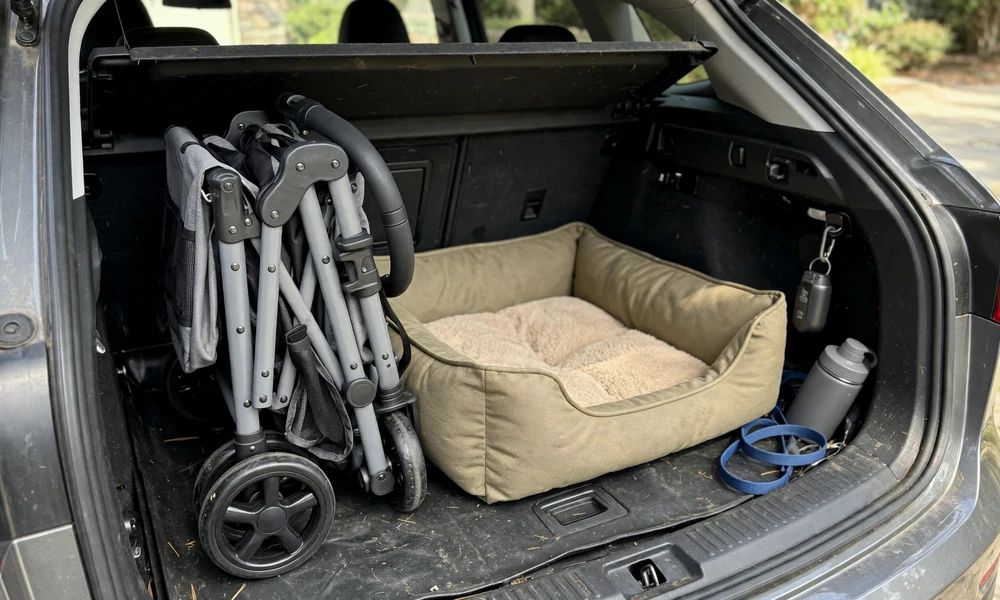
A one-hand fold is the feature people miss most when they do not have it. You will often be holding a lead, a bag or a wriggling pet in one hand and folding the stroller with the other, and a fold that needs two hands and a foot will be cursed every time you use it. Test it in the shop if you can: fold it, lift it into a car boot, and open it again, all with one hand free. If it takes more than a few seconds, or if it pinches your fingers, it is not a one-hand fold however the box describes it.
Brakes matter more than they seem. A foot brake that locks both back wheels with one press keeps the stroller still on a slope while you open a gate or pick up after your dog, and it should be easy to press in ordinary shoes and easy to release without bending down. Test it on a slope if you can, with weight in the cabin: a brake that holds an empty stroller and slips with a dog inside is not a brake at all.
Strollers for Travel and Days Out
A pet stroller earns its keep on days out, not just on daily walks. At a market, a garden centre or a busy high street, a stroller keeps a small dog safe from feet and traffic while still letting it see everything, and it keeps a cat calm in a crowd that would terrify it on a lead. Choose a model that turns tightly for shop aisles and that fits through a standard doorway without scraping the frame. The cabin should zip closed quickly when a crowd thickens, and the stroller should be narrow enough to pass other pedestrians without forcing them onto the road.
Mistakes to Avoid
The most common mistake is buying too small. People measure their pet standing up and forget that a pet needs to lie down and turn around in the cabin, and a stroller that looked roomy in the shop feels cramped after ten minutes. Measure your pet lying down, nose to tail, and check that measurement against the cabin length, not the overall stroller length. If in doubt, go one size up: a slightly roomy stroller is comfortable, a slightly small one is a cage, and no pet will happily ride in a cage twice.
The second mistake is ignoring the weight limit. A stroller rated for fifteen kilograms carrying an eighteen-kilogram dog will feel hard to push, wear out its wheels, and may fail at a joint. Manufacturers state limits for a reason, and the limit includes anything else in the cabin, such as a blanket and a water bottle. Leave a margin of at least a few kilograms, and remember that a growing puppy will be heavier in six months than it is today. Buying for the dog your puppy will become is cheaper than buying twice.
The third mistake is buying for looks instead of for use. A stroller that matches your coat is a poor reason to choose one that is hard to fold, has tiny wheels or a cabin your pet hates. Colour and style are fine as a tie-breaker between two good strollers, but they should never be the deciding factor. The same goes for brand names: a well-known label does not guarantee a good fold or a comfortable cabin, and some of the best pet strollers of 2026 come from brands that most people have never heard of. Judge the stroller in front of you, not the name on it.
The fourth mistake is forgetting care at home. A stroller that stays folded in a hallway needs a little upkeep, and a pet gate can keep a curious pet away from its wheels and fabric while it is stored. Check the brakes now and then and wash the cabin pad regularly.

The Bottom Line
The best pet stroller is the one your pet actually enjoys riding in and that you actually enjoy pushing. That means a cabin big enough to lie down in, mesh on more than one side, a canopy that shades and shelters, wheels big enough for real pavements, a fold you can do with one hand, and brakes you can trust on a slope.
If you walk mainly around town with a small dog or a cat, a light four-wheel stroller with a full canopy and a one-hand fold will do everything you need. If you walk trails and parks with a medium dog, spend a little more on bigger wheels and suspension. If your dog is large or older, buy the sturdiest frame you can lift into the car, and check the folded size first. And once you have the stroller, use it: the point is not the stroller itself, it is the walks, the parks and the days out that your pet gets to enjoy again. A clean, dry pet makes those outings better for everyone, and a pet towel in the basket means a wet dog can dry off before climbing back into the cabin. Choose well, and the stroller becomes one of the best things you ever bought for your pet.