
A good pet gate is one of the simplest purchases a pet owner ever makes, and one of the easiest to get wrong. Buy the wrong width and it wobbles. Buy the wrong bar spacing and a determined cat slips straight through. The best pet gates of 2026 are not the prettiest or the most expensive. They are the ones that fit your doorway properly, hold firm when a pet leans on them, open easily with one hand, and stay put for years without damaging your walls.
This guide covers freestanding and pressure-mounted gates for dogs and cats: gates that keep pets out of rooms, keep them safely contained, and keep staircases off limits. Baby gates are a different product with different safety standards, built for children rather than animals, so they are not the subject here.
How to choose a pet gate
Start with the pet, not the gate. A gate that contains a calm older dog will not contain a bored adolescent husky, and a gate that stops a dog may be no obstacle at all to a cat. Dogs test gates with weight and persistence: they lean, paw, nudge and chew. Cats test them with geometry: if the head fits, the cat fits, and if the top is low enough to clear, the gate is decoration. Note your pet’s height at the shoulder and whether your animal jumps, climbs or pushes.
Next, measure every opening where a gate might go. Measure at the top, the middle and the bottom, and use the narrowest number. Skirting boards and uneven floors all eat into the fit. Write the numbers down before you shop, because most returns happen when someone buys from memory. Finally, think about daily use: a kitchen gate gets opened dozens of times a day, so its latch must work one-handed.
The main types of pet gate
Pressure-mounted gates wedge between two walls or door frames using adjustable spindles, so there is no drilling and no permanent marks. They install in minutes, move easily between rooms, and suit renters. Their weakness is strength: a large, determined dog can push one out of place, especially on smooth floors or wide openings. They need solid, flat surfaces on both sides to grip.
Hardware-mounted gates screw into the wall or banister and are the right choice for the top of stairs and for large or powerful dogs. They cannot be pushed over. The trade-off is permanence: you will drill holes, and you will need to fill them when the gate comes down. For stairs, that trade is worth making. A gate that gives way at the top of a staircase is worse than no gate at all.
Freestanding gates stand on their own feet and need no wall at all. They work in wide openings, across open-plan spaces, and as room dividers where there is no doorway to mount to. Some fold flat for storage, and some can be shaped into a pen around a dog bed or a litter tray. Their weakness is stability: they rely on their own weight, so a big dog can shove one aside. They are best for calm pets and small dogs.
Retractable gates roll up like a blind and disappear when not in use. They suit modern homes and awkwardly shaped openings, but they are less sturdy than a rigid gate and no match for dogs that chew fabric or push hard.

The best pet gates of 2026
The best all-round pressure-mounted gate for most homes is a tall, steel, walk-through model with a one-handed latch and a hold-open feature. Steel beats wood and plastic for durability, and a walk-through door means you stop climbing over the gate within a week. Look for a height of at least 76 centimetres for medium dogs, plus extensions for openings up to a metre wide. The latch should click shut firmly and need a deliberate lift or squeeze to open, so a clever dog cannot nose it loose.
The best hardware-mounted gate for stairs is a sturdy steel gate that screws into the wall or banister, opens in one direction only at the top of the stairs, and has no bottom threshold bar to trip over. You will cross that gate in socks, in the dark, carrying a laundry basket, so a clear floor matters. A gate that swings away from the stairs rather than over them is the safe configuration, and most good models can be set up either way.
The best freestanding gate for open-plan living is a wide, folding panel gate in wood or steel that can be arranged in a zigzag or stretched straight across a room. It adapts to wide openings, folds away behind a sofa when guests arrive, and can be shaped into a pen for a puppy. Choose one with rubber feet, a low centre of gravity and enough weight to stay put when a dog leans on it.
The best tall gate for jumpers and climbers is an extra-tall model, 90 centimetres or higher, with vertical bars and no horizontal rails that a cat can use as a ladder. Height is the only reliable answer to a dog that clears a standard gate, and vertical bars are the only reliable answer to a cat that climbs. Measure your pet’s jumping height honestly: if your dog can clear a kitchen counter, a standard gate will not hold them.
The best pet gate for cats is a tall gate with narrow bar spacing, ideally under five centimetres, and a small cat door built into the frame. The cat door lets the cat come and go while keeping the dog out of the cat’s food, the litter tray or the quiet room. Narrow spacing matters because cats squeeze through gaps that look far too small. Check the cat door against your largest cat, and make sure the main latch stays dog-proof when the cat door is in use.
The best budget pet gate is a simple pressure-mounted steel gate with no walk-through door, bought in the right width the first time. Skipping the walk-through door saves money and removes the most common point of failure, and a basic steel frame is stronger than a fancy wooden one at the same price. The catch is convenience: you will step over it several times a day, so it suits a doorway you cross rarely.

Measuring and fitting
Measure the opening at three heights and buy for the narrowest. Skirting boards are the usual surprise: a gate that fits at the top of the frame may not fit at the bottom where the skirting sticks out. If the gap is small, wall cups or a thin spacer will bridge it. If the gap is large, you need a wider gate or an extension, not a harder push on the spindles. Over-tightening a pressure-mounted gate to force a fit bends the frame, strains the latch and marks the wall.
For the top of stairs, fit the gate so it opens away from the stairs and cannot swing over the drop. Use the hardware mounts, even if the instructions say pressure mounting is an option, and fit wall cups on both sides. Check the fixings monthly, because houses move, screws loosen and banisters flex. A gate at the top of stairs deserves ten extra minutes of fitting and a monthly check.
Pet gates for dogs and cats
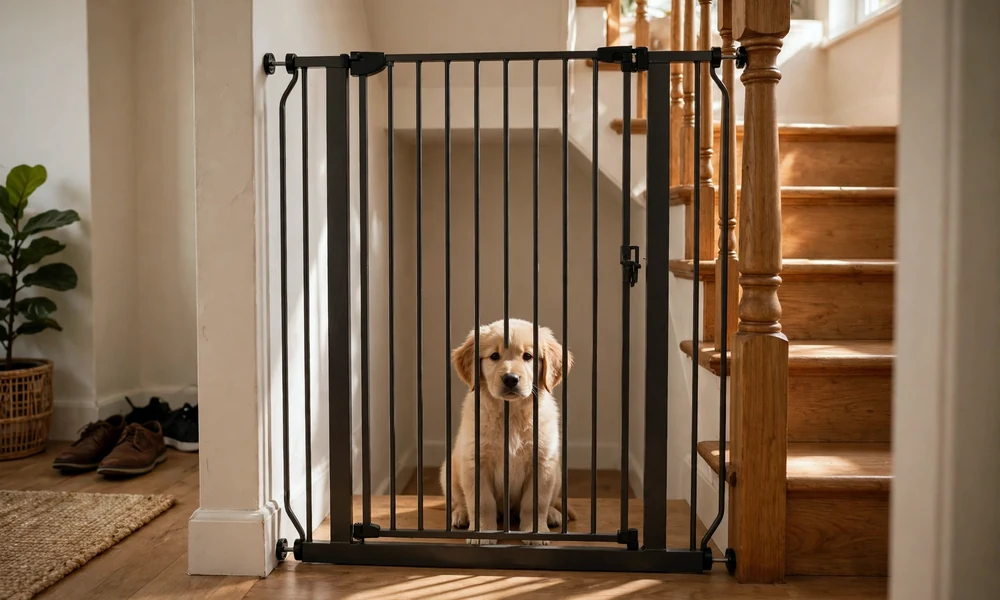
For dogs, the priorities are strength, height and a latch that cannot be nosed open. Large breeds need a hardware-mounted or heavy pressure-mounted steel gate, and a dog that jumps needs height more than anything else. Puppies need narrow bar spacing too, because a small puppy can squeeze through gaps an adult dog cannot, and a puppy that learns to escape will keep trying for life.
For cats, the priorities are narrow spacing, height and the absence of climbing aids. A cat that wants to get through a gate will go over it, under it or between the bars, in that order. Vertical bars defeat climbing better than horizontal rails. In a mixed-pet home, think in zones: a gate at the kitchen door, a gate with a cat door protecting the litter tray, and a gate at the stairs. Two well-chosen gates usually work better than one expensive gate in the wrong place.
Mistakes to avoid
The most common mistake is buying a gate that is too short. Measure your pet’s shoulder height, add a generous margin, and if your dog has ever cleared a fence or a sofa back, go extra tall. The third is trusting a pressure-mounted gate at the top of stairs, where hardware mounting is non-negotiable.
The fourth mistake is leaving a gate permanently half-open, which teaches a pet that gates are optional. The fifth is ignoring the gap at the bottom: too high, and a small dog or cat wriggles underneath; too low, and the gate catches on rugs. The gap should be small enough that your smallest pet cannot pass. A gate is not a fit-and-forget purchase: check the latch, spindles and wall cups monthly, and replace a gate whose frame is bent or whose latch no longer clicks firmly.
Frequently asked questions
Will a pet gate work for a large dog? Yes, if it is a hardware-mounted or heavy-duty pressure-mounted steel gate of the right height, fitted properly with wall cups. Freestanding and fabric gates will not hold a large, determined dog.
Can a cat get through a pet gate? Often, yes. Cats climb, jump and squeeze, so a standard dog gate is rarely cat-proof. Choose a tall gate with vertical bars, spacing under five centimetres, and no horizontal rails.
Are pet gates and baby gates the same thing? No. Baby gates are built to child safety standards, with different bar spacing, latch requirements and strength tests.
Do pressure-mounted gates damage walls? They can leave marks, especially on freshly painted walls, but wall cups spread the pressure and prevent most damage. Hardware-mounted gates leave screw holes, which are easy to fill when the gate is removed.
How wide a gate do I need? Measure the opening at the top, middle and bottom and buy for the narrowest measurement. Most pressure-mounted gates fit openings of about 75 to 85 centimetres without extensions, and extension panels cover wider gaps.
The verdict
The best pet gate is the one that fits your doorway, suits your pet’s size and temperament, and gets used properly every day. For most homes, that means a tall steel pressure-mounted gate with a walk-through door and a one-handed latch. For stairs, it means a hardware-mounted gate with no threshold bar. For cats, it means narrow spacing and vertical bars. For open-plan rooms, it means a folding freestanding panel.
If you are setting up a new space for a dog, think about the whole area at once. The gate keeps the dog where you want them, and the right bed makes them happy to stay there, which is why choosing a comfortable dog bed your dog will actually use matters just as much as the gate itself. If you want to keep an eye on a new puppy settling behind the gate while you are out, a pet camera is the simplest way to check in. And if your household also has a baby, child safety has its own rules, so read up on why a baby gate is the first safety buy before assuming one gate can do both jobs.


