
Why a Baby Gate Is the First Safety Buy in 2026
A baby gate is the first safety buy most new parents should make, and it is the one that gets used every single day. Long before a baby can walk, they can roll, crawl and pull themselves up, and the stairs, the kitchen and the front door are all within reach of a determined little explorer. A good baby gate turns a whole house into a place a baby can move around in safely, and it does that job quietly for years. The best baby gates of 2026 are sturdier, easier to open one-handed and simpler to fit than the fiddly gates of a few years ago, but the worst ones still wobble, jam and leave gaps a small child can squeeze through. This guide explains which type belongs where, what to check before you buy, and the fitting mistakes that undo even a good gate.
Key Takeaways
- A baby gate should be bought before a baby starts crawling, not after the first scare on the stairs.
- The top of the stairs always needs a hardware-mounted gate screwed into the wall, never a pressure-mounted one.
- Bars should be no more than 6.5 centimetres apart, and the gate should be at least 75 centimetres tall.
- A latch an adult can open one-handed while carrying a baby is worth more than any extra feature.
- Measure every opening twice, because no two doorways, banisters or stair tops are quite the same width.

Why the Gate Comes Before Everything Else
Most baby safety shopping starts with the nursery, but a baby spends far more of their waking time on the floor of the living room and the hallway than in the nursery, and the floor is where the real hazards are. The stairs are the obvious one, and a fall down even a short flight can cause a serious injury, but the kitchen is just as risky, with hot ovens, sharp drawers and cleaning products under the sink. A baby gate is the only single purchase that deals with all of those at once, by drawing a line a baby cannot cross and an adult can step through in two seconds.
Timing matters more than most parents expect. Babies often start crawling between six and ten months, but they can roll into trouble even earlier, and once they can pull themselves up on furniture, the stairs become a magnet. A gate bought in a panic after a near-miss is a gate bought in a hurry, and hurried choices are how wobbly pressure gates end up at the top of the stairs. Buying early means you can measure properly and fit the gate on a calm afternoon rather than a frantic evening.
Pressure-Mounted or Hardware-Mounted: Which Belongs Where
Every baby gate falls into one of two families, and choosing the wrong one for the spot is the most common mistake. A pressure-mounted gate is held in place by rubber feet pressing against the walls or door frame. It needs no screws, leaves no holes, and can be moved from room to room in a minute, which makes it ideal for doorways and hallways on flat ground. But it is held in place by friction alone, and a toddler leaning on it can push it out of place. That is why a pressure-mounted gate must never be used at the top of the stairs.
A hardware-mounted gate is screwed into the wall or the banister, and once it is fitted it does not move. It takes longer to install and leaves small screw holes, but it is the only safe choice for the top of the stairs. Many still open and close like a door, with a latch an adult can work one-handed. If you rent, ask the landlord before drilling; most agree once they understand it is a child-safety fitting.
| Feature | Pressure-Mounted | Hardware-Mounted |
|---|---|---|
| How it stays up | Rubber feet pressed against the frame | Screwed into the wall or banister |
| Best for | Doorways and hallways on flat floors | Top of the stairs, always |
| Install time | A few minutes, no tools | Thirty minutes or so, drill needed |
| Can it be moved? | Yes, easily | No, it stays put |
| Leaves marks? | Rarely, sometimes light marks | Small screw holes |
| Main risk | Can be pushed out of place | Bad fitting if measured wrong |
Retractable gates are a roll of tough mesh that pulls across an opening and retracts when not in use, leaving no bar to trip over. They suit wide or awkward openings, but they are not as rigid as a metal gate, so they should not be the gate at the top of the stairs. If you are also thinking about the nursery, our guide to the best vs worst baby cribs covers the other big sleep-time safety decision in the same way.
Where to Put Gates First
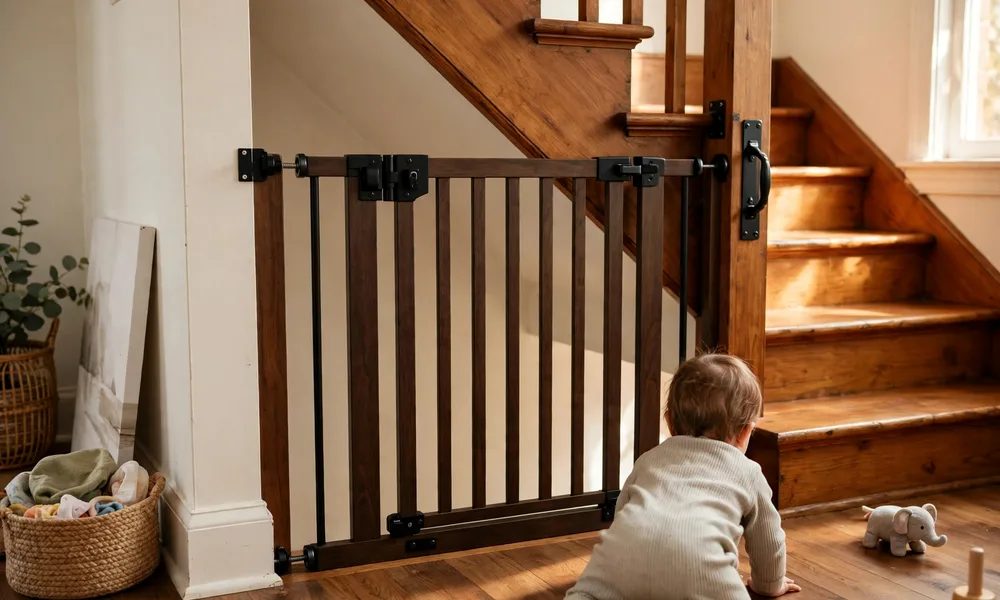
Start with the top of the stairs, because that is where a fall hurts most. Fit a hardware-mounted gate there before the baby can crawl, and check that it opens away from the stairs, not over them. The bottom of the stairs deserves a gate too: a baby who climbs up two or three steps and then topples backwards can be badly hurt, and a gate at the bottom stops the climb before it starts. If your stairs have a banister with round spindles, you may need a banister adapter kit, which clamps around the spindles so the gate has something flat and solid to screw into.
The kitchen doorway is the second priority. Kitchens hold hot hobs, boiling kettles, sharp knives and cleaning chemicals, and they are the room where a parent is most often busy with both hands. A gate across the kitchen doorway lets a baby play safely in the living room while dinner is cooking. A pressure-mounted gate usually suits a kitchen doorway well, since the floor is flat and there is no drop on either side.
After the stairs and the kitchen, think about the rooms you want to keep a baby out of: a home office with cables, a bathroom, and a front door that opens onto a road. A gate across a hallway can turn a whole safe zone into a play area, which is often easier than gating every doorway.
What Makes a Good Baby Gate
Height is the first thing to check. A baby gate should be at least 75 centimetres tall, and taller is better if your child is a climber, because a toddler who can get a foot on the top rail can haul themselves over. Bar spacing matters just as much: the gaps between vertical bars should be no more than 6.5 centimetres, so a baby cannot get their head stuck, and the gap under the gate should be small enough that a baby cannot roll underneath it. Check for sharp edges and a smooth finish, because a curious baby will chew on anything within reach.
The latch is the part you will use dozens of times a day, so it deserves more attention than it usually gets. A good latch opens with one hand, because the other hand will be carrying a baby, and it should close and lock itself when the gate swings shut behind you. It should also be hard for a small child to work out: a two-year-old who watches you open the gate fifty times a day will copy you, so the mechanism needs a squeeze, a lift or a two-step action that little fingers cannot manage.
Width and fit are where most returns happen. Measure the opening at the top, the middle and the bottom, because walls are rarely perfectly straight, and use the widest measurement. Most gates come with extensions, and it is better to buy a gate that fits with one extension than to stretch a too-narrow gate to its limit. A gate designed for a flat doorway will not sit properly across a stair newel post without an adapter. Our guide to the best vs worst door locks is a useful companion read, because a good gate and a good lock are the two things that keep a small child safely inside.
The Gates to Avoid
The worst baby gates are usually the oldest style still on sale: the concertina gate with a diamond lattice that folds like a trellis. These have wide V-shaped openings that can trap a small head, and they are often sold as a cheap way to block a doorway, but safety experts have warned against them for years. If you inherit one from a relative or find one at a car boot sale, do not use it, however sturdy it looks. The same goes for any gate with a horizontal top bar a toddler can use as a step, or with gaps wider than 6.5 centimetres between its bars.
Second-hand gates need a careful check before they go up. Safety standards have changed, and a gate made a decade ago may not meet the current ones, so look for a recent standard mark and check for missing parts, bent frames and loose hinges. If you cannot identify the model or find its instructions, it is not worth the saving. When you are out and about with a baby instead of at home, our guide to the best vs worst baby carriers covers the gear that keeps a baby close and safe on the move.
Measuring and Fitting Checklist
- Measure the opening at the top, middle and bottom, and use the widest figure.
- Fit a hardware-mounted gate at the top of the stairs, and make sure it opens away from the steps.
- Check the gap under the gate and between the bars before the baby ever reaches it.
- Test the latch one-handed, with a baby in your arms, before you call the job done.
- Tighten pressure-mounted gates until the gate barely moves when you push it firmly.
- Recheck every fitting monthly, because houses settle and screws loosen over time.

Frequently Asked Questions
When should I buy a baby gate?
Buy it before your baby starts crawling, usually around five to six months, so it is fitted before it is needed.
Can I use a pressure-mounted gate at the top of the stairs?
No. A pressure-mounted gate is held by friction alone and can be pushed out of place. The top of the stairs always needs a hardware-mounted gate screwed into the wall or banister.
How tall should a baby gate be?
At least 75 centimetres, and taller if your child is a climber. A gate a toddler can get a foot over is a gate that has stopped working.
How far apart should the bars be?
No more than 6.5 centimetres apart, so a baby cannot get their head stuck between them. Check the gap under the gate as well, so a baby cannot roll underneath.
When can I take the gates down?
Most families take them down when the child is around two to three years old and can use the stairs safely, holding a rail. Some keep the kitchen gate longer.
Do I need a gate at the bottom of the stairs too?
Yes, if your baby can reach the stairs at all. A gate at the bottom stops a baby climbing up and toppling backwards, which is a common cause of stair injuries in crawlers.
The Bottom Line
A baby gate is the first safety buy because it is the one that protects a baby in the rooms where they actually spend their day, and it costs less than almost any other piece of baby gear. Buy it early, put a hardware-mounted gate at the top of the stairs, measure every opening before you order, and test the latch one-handed before you trust it. Do that, and the gate will do its quiet job for years: keeping a small explorer safe while the rest of the house carries on as normal.


