
What Is a Picture Ledge — and Which Ones Hold Art Best in 2026
A picture ledge is a narrow shelf with a raised lip at the front, made for leaning framed art against the wall instead of hanging it. You rest the bottom edge of a frame on the ledge, tilt the top back against the wall, and the little lip stops the frame sliding forward and off. It fills a blank wall fast: one ledge, two screws, and art you can rearrange in a minute.
Picture ledges suit people who change their minds. A print you loved in spring can be swapped for a photograph in autumn, a tall frame can move to the back, and a small one can slide to the front, while nothing about the wall changes. This guide explains what a picture ledge is, how it differs from a floating shelf, and which types hold art best.
Key Takeaways
- A picture ledge is a narrow display shelf with a front lip; frames lean on it, they are not hung from it.
- Wood ledges hold art best for most homes: they look warm, grip frames well, and suit prints of every size.
- Keep the load under 5 kilograms per ledge, and fix into a stud or a proper wall anchor.
- Layer frames tallest at the back and smallest at the front, and leave a third of the ledge empty.
- A ledge is for display, not storage: if it must hold books or heavy objects, buy a shelf instead.
What Is a Picture Ledge?
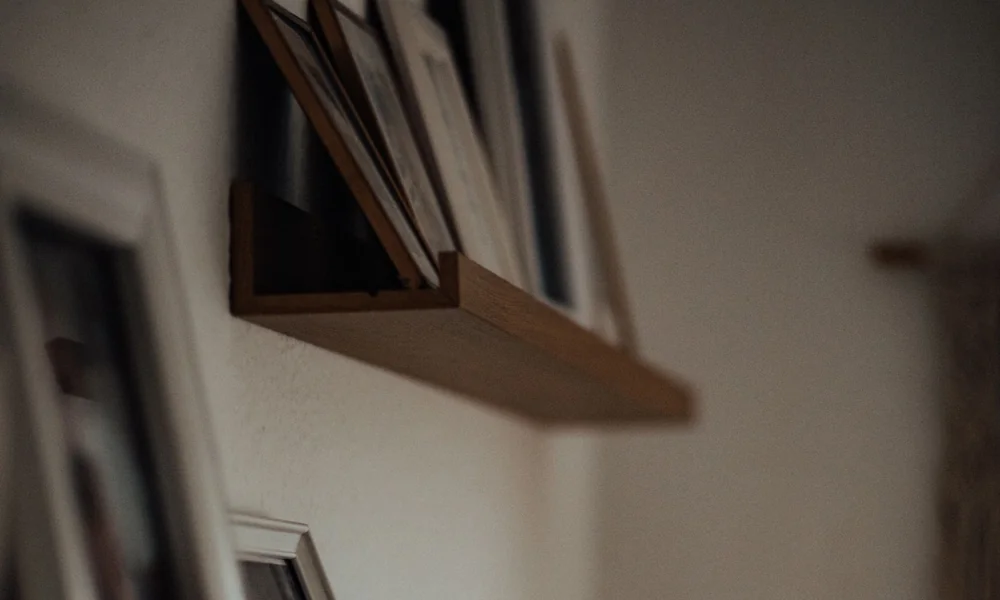
A picture ledge is a slim, shallow shelf, usually 5 to 10 centimetres deep, with a raised edge or groove along its front. The frame sits on the flat of the ledge and leans back against the wall at a slight angle, usually around 10 to 15 degrees. The raised lip, often only a centimetre or two high, catches the bottom of the frame and stops it sliding forward.
Ledges run from about 30 centimetres for one small frame to 120 centimetres or more for a row above a sofa. Most are made from solid wood, MDF, painted timber, or metal. Wood is the most forgiving choice: it looks good in almost any room, and a frame leaning on wood does not slip the way it can on smooth metal.
Picture Ledge vs Floating Shelf: the Difference That Matters
A picture ledge and a floating shelf look similar from across the room, but they do different jobs. A floating shelf is a storage shelf mounted with hidden brackets: it is deeper, usually 15 to 25 centimetres, it is built to hold weight, and things sit flat on it. Our guide to floating shelves that display without the clutter covers that kind of shelf, and it is the right choice when you want to put books, plants and ceramics on a wall.
A picture ledge is narrower, shallower and lighter. It is built for leaning, not for storing: the art is the point, and the ledge is almost invisible behind it. Put books on a picture ledge and they will lean, slide and eventually fall; put a leaning frame on a deep floating shelf and it looks lost. The rule is simple: if it stands on its own bottom edge, it belongs on a shelf; if it leans against the wall, it belongs on a ledge.
The Main Types of Picture Ledge Compared
Five types cover almost every ledge you will find in 2026.
| Ledge type | Best for | Typical length | Look |
|---|---|---|---|
| Solid wood ledge | Most homes, all frame sizes | 60 to 120 cm | Warm, natural, visible grain |
| White painted ledge | Pale walls, small prints | 40 to 90 cm | Clean, quiet, almost invisible |
| Black metal ledge | Modern rooms, dark frames | 40 to 90 cm | Slim, sharp, industrial |
| Clear acrylic ledge | Small prints, rented rooms | 30 to 60 cm | Invisible, light, modern |
| Extra-long ledge | Gallery rows above sofas | 120 to 180 cm | Bold, gallery-like, needs 3 fixings |
Solid wood is the best all-rounder. Oak and walnut suit living rooms and hallways, pine suits bedrooms, and a waxed or oiled finish grips frames better than a high-gloss varnish, which can be slippery. White painted ledges are best when the wall is white and the frames are the focus: from a few steps away, the ledge disappears and the art appears to float. Black metal ledges look smart with black frames, but they show dust, and heavy frames can slide on smooth metal, so a small strip of museum putty under the frame helps. Avoid very cheap thin MDF ledges: they sag in the middle over time.
Which Picture Ledges Hold Art Best in 2026
The best picture ledge for most homes in 2026 is a solid wood ledge, 60 to 90 centimetres long, 7 to 9 centimetres deep, with a lip at least 1.5 centimetres high. The depth matters more than it looks: a ledge shallower than 5 centimetres will not hold a frame with a deep moulding, while a ledge deeper than 10 centimetres stops being a ledge and starts looking like a shelf.
Check the lip before you buy, because the lip is what does the work. Run a finger along it: it should be square and at least a centimetre high, not a shallow rounded bump. A good lip catches the frame even when the frame is bumped. Also check the back: a proper ledge sits flush to the wall, so the frames lean at a steady angle. A ledge that rocks or tilts forward will slowly walk its frames off the front.
How Much Weight Can a Picture Ledge Hold?
Less than you think, and that is fine, because frames are light. A typical framed print weighs between 500 grams and 2 kilograms, so a ledge holding three frames carries roughly 2 to 5 kilograms in total. Most well-fixed ledges are rated for 5 to 8 kilograms. The limit is rarely the ledge itself; it is the fixing in the wall. A screw into a stud holds far more than the ledge will ever carry, while a bare screw in plasterboard may pull out overnight.
A large frame with glass can weigh 3 kilograms or more, and two of those on one short ledge is already near the limit. Swap glass for acrylic glazing on large frames: it looks the same on the wall, weighs about half as much, and will not shatter if the frame ever falls. Keep heavy objects off ledges entirely.
How to Hang a Picture Ledge Level
Hanging a ledge is a twenty-minute job, and most of it is measuring. Hold the ledge against the wall at the height you want and mark the fixing points with a pencil. The centre of the frames should sit at eye level, about 145 to 150 centimetres from the floor.
Use a spirit level, not your eye: walls and floors are rarely as level as they look, and a ledge out by even a few millimetres will show, because the frames will slowly slide to the low end. Drill into a stud where you can; where you cannot, use a proper plasterboard anchor rated for at least 10 kilograms per fixing, never a bare screw and never an adhesive strip for anything longer than 40 centimetres. Fix one end, check the level again, then fix the other. Before loading the frames, pull down firmly on the ledge: if it moves at all, the fixing is wrong.

How to Style a Picture Ledge So It Looks Good
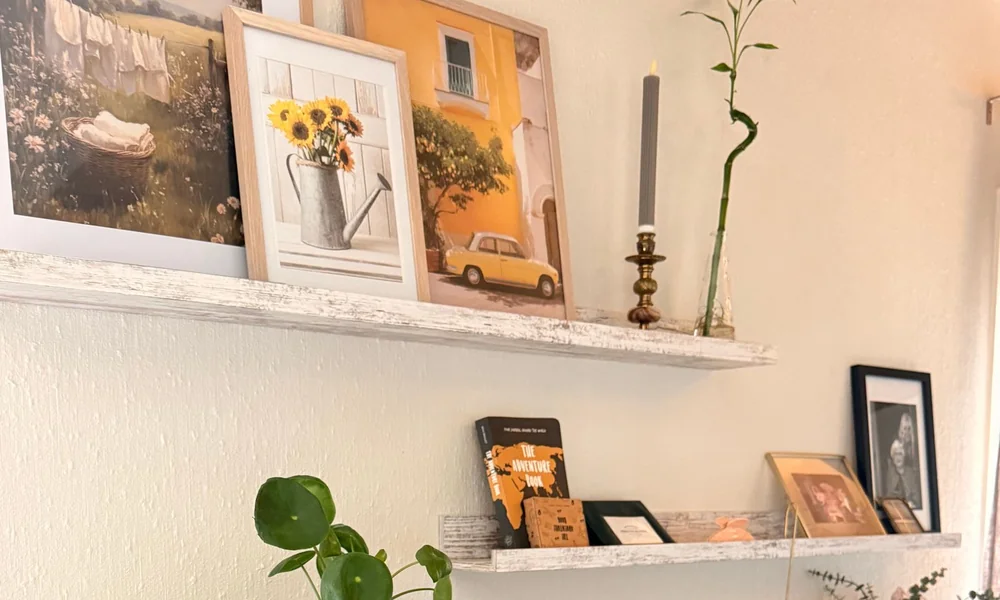
Styling a ledge is mostly about restraint. Start with the tallest frame at the back, usually at one end, and layer smaller frames in front of it, overlapping the edges by a few centimetres. Overlap is what makes a ledge look collected rather than lined up like books on a shelf, but every frame should still be visible: if a frame is completely hidden, take it off.
Leave a third of the ledge empty. The empty space is what makes the full part look intentional, and it gives you room for one small object, such as a tiny vase or a small plant at one end. To refresh the display, change one frame, not all of them: swap the smallest frame for a new print, and the whole wall feels new.
Think about the room, not just the ledge. In a living room, the art above the sofa should span about two-thirds of the sofa’s width, which usually means a ledge of 90 to 120 centimetres. In a hallway, a long ledge at eye level turns a corridor you walk through into a gallery you actually look at. In a bedroom, one short ledge above a chest of drawers holds two or three calm prints and nothing else. Our guide to choosing wall art that fits your home covers sizing and colour matching in more detail.
Where Picture Ledges Work Best, and Where They Do Not
Picture ledges work best on walls you look at often and touch rarely: living rooms, hallways, bedrooms and home offices, above furniture that protects them from passing shoulders. They do not work well in bathrooms, where steam warps wood and fogs glass, or above a busy kitchen worktop. In those spots, hang the art properly instead: our guide to picture hangers that hold frames straight explains which hanger suits each weight.
Picture Ledge Checklist
- Measure the furniture below first: the ledge and its frames should span about two-thirds of its width.
- Choose solid wood, 60 to 90 centimetres long, 7 to 9 centimetres deep, with a lip at least 1.5 centimetres high.
- Fix into a stud or a proper plasterboard anchor rated for at least 10 kilograms per fixing.
- Check the level twice, then pull down firmly on the empty ledge before loading any frames.
- Layer frames tallest at the back, smallest at the front, and leave a third of the ledge empty.
- Keep the total load under 5 kilograms, use acrylic instead of glass on large frames, and dust the ledge when you change a frame.
Picture Ledge FAQ
What is a picture ledge?
A picture ledge is a narrow shelf with a raised lip, made for leaning framed art against the wall. The frame rests on the ledge, tilts back, and the lip stops it sliding forward.
Are picture ledges better than floating shelves for art?
For art, yes. A ledge is shallow and made for leaning, so frames sit at a natural angle with no wasted space in front of them. A floating shelf is deeper and made for storage, so a leaning frame looks lost on it.
How much weight can a picture ledge hold?
Most well-fixed ledges hold 5 to 8 kilograms, which covers three or four framed prints easily. The fixing matters more than the ledge: a screw into a stud holds far more than a bare screw in plasterboard.
Do picture ledges damage walls?
Far less than a gallery wall. A ledge needs only two or three fixings for a whole row of art, while hanging each frame separately needs a nail per frame.
Can I put books on a picture ledge?
Not really. Books are too deep and too heavy for a narrow ledge, and they lean, slide and fall. A ledge is for flat, leaning things: frames, small prints and thin tiles. Books belong on a proper shelf.
How do I stop frames sliding off a picture ledge?
Make sure the ledge is level, check the lip is at least a centimetre high, and put a small blob of museum putty under the front edge of each frame.
The Bottom Line
A picture ledge is the simplest way to live with art you actually change: a narrow wooden ledge, fixed level into a stud or a proper anchor, holding two or three leaning frames with a third of the ledge left empty. Buy solid wood, 60 to 90 centimetres long, and keep the load under 5 kilograms.


