Best Plant Supports for Every Plant in 2026
The best plant supports in 2026 are the ones that match the plant in front of you, not the ones that look tidiest in the shop. A tomato that flops onto damp soil rots before you pick it, and a dahlia that nobody staked snaps in the first strong wind of August. This guide sorts the main kinds of support by the plant they suit, so you buy the right frame the first time.
A plant support does one job: it holds a plant where you want it while the plant does the growing. The trick is that plants grow in very different shapes. Some grow one straight stem, some grow into a bushy ball, some climb by tendrils, and some get too heavy for their own stems once the fruit arrives. No single frame suits all of them.
Key Takeaways
- Match the support to the plant’s shape first: a stake for one straight stem, a cage for a bushy plant, a flat panel for a wall climber, and a tower for a freestanding climber.
- Buy the support for the plant’s full height at the end of the season, not its size on planting day.
- Put the support in at planting time: forcing a frame over a grown plant snaps stems.
- Tie loosely and retie as the plant grows, leaving room for the stem to thicken.
- Anchor every tall support properly: a frame full of leaves catches the wind like a sail.
Plant Supports Compared
| Support | Best for | Typical height | Strength | Watch out for |
|---|---|---|---|---|
| Single stake | One-stem plants: tomatoes pruned to one stem, dahlias, delphiniums | 120–200 cm | Medium to strong | Needs regular tying as the plant grows |
| Tomato cage | Bushy tomatoes, peppers, aubergines | 90–180 cm | Light to strong | Too short and narrow for tall varieties |
| Flat trellis | Wall and fence climbers: roses, jasmine, clematis, beans | 120–240 cm | Medium to strong | Needs a gap behind it for air and stems |
| Obelisk | Freestanding climbers in beds and pots | 120–200 cm | Medium to strong | Narrows toward the top, so no good for spreading plants |
| Hoops and rings | Peas, sweet peas, low sprawlers | 30–90 cm | Light to medium | Too weak for heavy fruiting plants |
| Grow-through ring | Peonies, dahlias, tall perennials | 45–90 cm | Medium | Must go in before the plant leafs out |
Start With the Plant, Not the Product
Look at how each plant actually grows before you buy anything. A plant that grows one straight stem, like a delphinium or a tomato pruned to a single leader, needs one strong upright to lean on. A plant that grows into a bush, like an unpruned tomato or a pepper, needs a frame that surrounds it on all sides. A plant that climbs by tendrils, like a sweet pea or a bean, needs something thin to wrap around, while a sprawler like a squash needs a low frame to lift it off the soil.
Height matters as much as shape. A support that is tall enough in May is often far too short by August, and by then the plant has grown through it and you cannot swap it without breaking stems. Buy for the plant’s full height in its third year, or for the tallest it will reach in one season if it is an annual. Buying too small is the most common mistake, because you pay twice: once for the small frame, and again for the replacement. Weight matters too: a frame that holds a sweet pea will not hold a tomato loaded with fruit.
Stakes: The Simplest Support of All
A stake is a single upright post that one stem leans on, tied at intervals as it grows. It is the oldest support in the garden and still the best for any plant that grows as one main stem, like a pruned tomato, a dahlia or a delphinium.
Drive the stake in at planting time, about ten centimetres from the stem, sunk at least thirty centimetres into the soil. Bamboo canes suit light plants and cost almost nothing, but they snap under a heavy tomato. Hardwood stakes last for years, while coated metal stakes are the strongest and easiest to clean. Tie the stem loosely with soft twine or fabric strips, in a figure of eight around the stake and the stem, leaving room for the stem to thicken. A tie that is tight in May will cut into the stem by July.
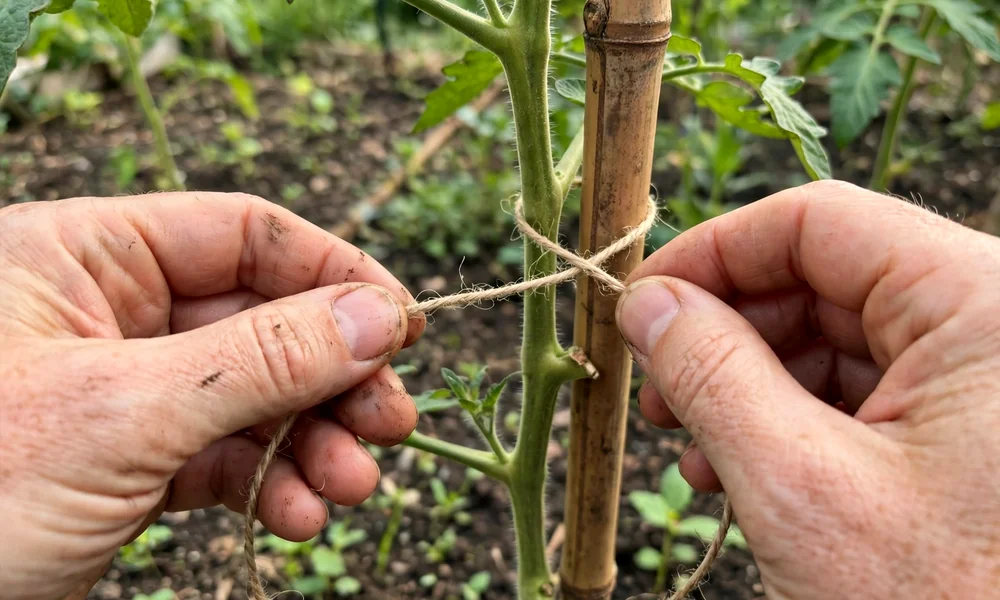
Retie every twenty to thirty centimetres of new growth, and check the ties after wind.
Cages: A Frame That Surrounds the Plant
A cage is a frame that stands around one plant and lets the stems grow up through its rings. It suits bushy plants that no single stake can hold: tomatoes left to grow naturally, peppers, and aubergines. The fruit hangs inside the frame where air can move around it and the leaves stay off the damp soil.
Buy the cage for the plant’s full height, not its size today. Determinate tomatoes, the bush types that grow to a set height of around a metre, are happy in a standard round wire cage of ninety to a hundred and twenty centimetres. Indeterminate tomatoes keep growing all season and need a tall square folding cage or a heavy-gauge round cage of at least a hundred and fifty centimetres. Our guide to the best tomato cages of 2026 covers the cage types in detail, from round wire cones to square folding frames. A cage is not a stake: a stake holds one main stem upright with ties, while a cage holds the whole bushy plant. Anchor the cage legs well into the soil.
Trellises: Flat Panels for Wall Climbers
A trellis is a flat panel that fixes to a wall or a fence, and it is the right tool for a climbing plant that needs to cover a boundary. A rose, a jasmine or a clematis wants a flat surface to grow against, with crossing points for tendrils to grip.
Wood looks warm and natural but needs treatment every two or three years, while powder-coated metal lasts longer with almost no upkeep and holds far heavier plants. Leave a gap of at least five centimetres behind a wall trellis, so air can move and stems can pass behind it. Our guide to the best trellises of 2026 compares the main types, from diamond lattice panels to fan trellises and garden arches. A trellis is no use for a tomato standing in the middle of a bed, because there is no wall for it to lean on.

Obelisks: Towers for the Middle of a Bed
An obelisk is a tall, freestanding, four-sided frame that narrows toward the top, and it is the right support for a climber that needs height in open ground rather than against a wall. A clematis, a rose or a sweet pea given an obelisk will climb it and flower all the way up. The plant climbs all four sides, which is what makes an obelisk different from a trellis: a trellis is a flat panel that fixes to a wall, while an obelisk stands on its own in the middle of a bed or a pot.
Metal obelisks are strongest for heavy roses and vigorous clematis, while wood suits lighter climbers. Anchor every obelisk properly, with its feet sunk into the soil or weighted in a pot. Our guide to the best garden obelisks of 2026 explains the tower shape and how to match height, strength and material to the plant. An obelisk is the wrong choice for a plant that spreads outward as it grows, because the tower narrows toward the top while the plant wants to get wider.

Hoops, Rings and Grow-Through Supports
Not every plant needs a tall frame. Peas and sweet peas climb best on low hoops and pea sticks: thin twigs pushed into the soil in a row, which the tendrils grip as they grow. The sticks cost nothing if you prune them from the garden.
Grow-through rings are a different idea: a circular grid on legs that you place over a young plant in spring, and the plant grows up through the grid, which holds the stems upright without any tying at all. Peonies are the classic case: their heavy flower heads flop in rain, and a ring set in place before the shoots appear is invisible by flowering time. The ring must go in before the plant leafs out, or you will snap the very stems you meant to protect.
Materials: Wood, Metal, Bamboo and Plastic
Wood is the warmest-looking material and the easiest to cut to size, but it needs care: cedar and redwood resist rot naturally, while treated pine is cheaper. Expect to treat or repaint wood every two or three years. Metal is the strongest option: powder-coated steel holds a mature rose and needs little care beyond touching up chips in the coating, where rust starts. Bamboo is light and cheap for annual crops, but it splits after a season or two. Plastic-coated wire is the workhorse of the vegetable garden: cheap, rust-proof, and strong enough for a tomato cage if the gauge is heavy enough.
Size It Right, Put It In Early, Tie It Loosely
Three habits keep plants standing. First, size the support for the plant’s full height: a support that is too short is money wasted. Second, put the support in early: a frame installed at planting time lets the plant grow into it, while a frame forced over a grown plant snaps stems. Third, tie loosely, in a figure of eight, and check the tie as the stem thickens. Twine, fabric strips and soft rubber ties all work; wire and cable ties do not, because they cut into the stem. Clean the frames at the end of the season and check for rust or rot.
Your Plant Support Checklist
- Look at how the plant grows: one stem, a bush, a climber, or a sprawler.
- Buy for the plant’s full height, not its size today.
- Put the support in at planting time.
- Anchor tall frames properly.
- Tie loosely in a figure of eight and retie as stems thicken.
- Clean and store frames dry at the end of the season.
Frequently Asked Questions
Do I need a different support for each plant?
Yes, in practice. Plants grow in different shapes, and the support that suits a single-stem dahlia will not suit a bushy tomato or a climbing rose. A few stakes, one or two cages, a trellis panel and an obelisk cover most gardens.
When should I put plant supports in?
At planting time, or as soon after as you can. A frame installed early lets the plant grow into it. Forcing a cage over a grown plant snaps stems and costs you fruit.
Can one trellis hold several climbers?
Yes, if the panel is strong enough. A rose and a clematis share a panel well, flowering at different times. Two vigorous climbers on one small panel will fight for light.
Are metal supports better than wooden ones?
For strength and low maintenance, yes. Powder-coated steel holds heavy plants and needs almost no care, while wood needs treating every two or three years.
How do I stop ties cutting into stems?
Tie loosely, in a figure of eight, and leave a finger’s width of slack. Use soft twine or fabric strips, never wire, and check the ties every fortnight.
What support suits a plant in a pot?
A small obelisk or a short stake, anchored by the weight of the pot. A freestanding tower needs a heavy pot or it will topple in wind.
Bottom Line
Plant supports are not about buying the prettiest frame. They are about matching a frame to the way a plant grows, sizing it for the plant’s full height, putting it in early, and tying loosely. Get those four things right and the support disappears while the plant does the showing off.