How to Choose Motion Sensors That Catch Movement Without False Alarms in 2026
A motion sensor is the quiet watcher of the modern home: it notices movement, then does something about it. The best motion sensors in 2026 catch a person crossing a room, ignore the cat on the rug, and trigger exactly what you asked for. The worst fire at every draught and cry wolf so often that you switch them off within a week.
This guide is about the sensor itself, not the light it switches on. A motion sensor is a small detector that watches a space and sends a signal when something moves inside it. It has no bulb of its own and records nothing. What it triggers is up to you.
Key Takeaways
- A PIR sensor watches for moving body heat, which suits most rooms, but a sunny window or a radiator can fool it.
- Microwave sensors see through thin walls and cover larger areas, but they trigger more often, so they suit garages better than bedrooms.
- Dual-tech sensors need both heat and movement before they fire, so they false-alarm far less than either type alone.
- Pet immunity is a height and weight limit, not a promise: a large dog on the stairs will still set off a sensor rated for pets.
- Mount the sensor in a corner, about two metres high, aimed across the path of movement, never straight at a door or a window.
Motion Sensors 2026 at a Glance
| Best for | Sensor type | Range | Power | Standout strength |
|---|---|---|---|---|
| Best overall | PIR wall sensor | Up to 12 metres | Battery or mains | Reliable, cheap, ignores still objects |
| Best for large rooms | Ceiling PIR sensor | 360 degrees, up to 8 metres | Mains | Covers a whole room from one spot |
| Best for garages | Microwave sensor | Up to 15 metres | Mains | Sees through thin partitions |
| Best for security | Dual-tech sensor | Up to 12 metres | Battery or mains | Two checks before it fires |
| Best for rentals | Stick-on battery sensor | Up to 9 metres | Battery | No wiring, peel-and-stick mount |
| Best for smart homes | Smart PIR sensor | Up to 10 metres | Battery | Triggers lights and scenes via a hub |
How a Motion Sensor Actually Works
PIR sensors: watching for body heat
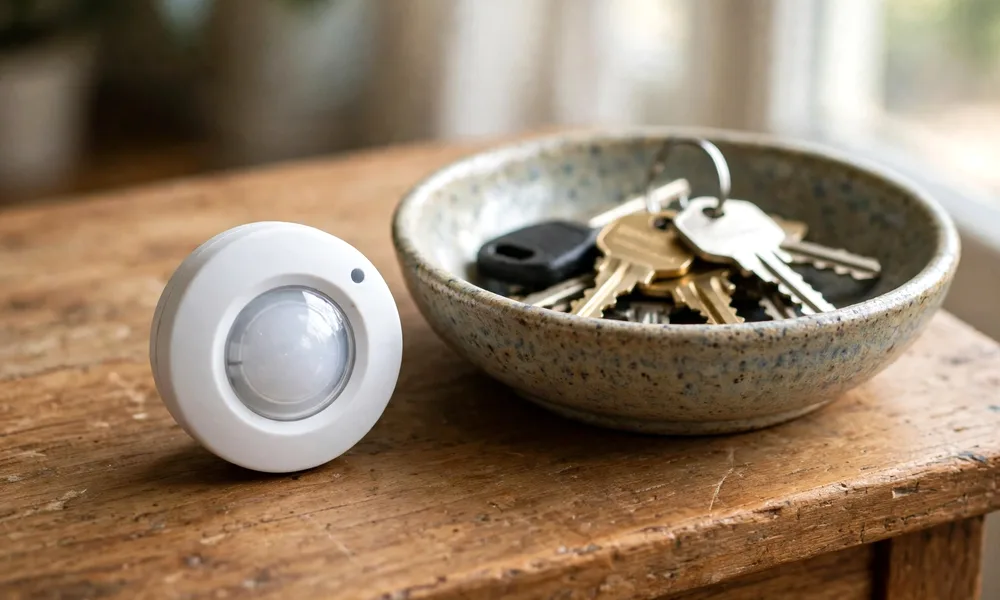
Almost every home motion sensor is a PIR sensor, short for passive infrared. It watches for changes in infrared heat across its field of view. A person walking past is warmer than the wall behind them, so their heat stands out as a moving warm shape, and the sensor fires. It works in complete darkness and ignores furniture and anything that stays still. PIR sensors are cheap and sip battery power, lasting years on a single cell. Their weakness is heat: a warming radiator or a patch of sun can look like a moving warm shape.
Microwave sensors: watching for movement itself
A microwave sensor sends out low-power radio waves and listens for the echo. When something moves, the echo changes, and the sensor fires. It does not care about heat, so sunlight and radiators never fool it, and it can see through thin walls, glass and plasterboard. That reach is also its problem: it can fire for movement behind a partition wall, or for rain on a window. It covers more ground than a PIR sensor, often up to fifteen metres, and costs more to run, so most microwave sensors are mains powered. They suit garages and large open rooms, where a PIR sensor would need three units to cover the same floor.
Dual-tech sensors: two checks before firing
A dual-tech sensor combines both technologies in one housing: a PIR element and a microwave element, and both must agree before it fires. The microwave element notices movement, the PIR element confirms it is warm, and only then does the sensor trigger. A sunny patch fails the heat test, and a person behind a wall fails the movement test. The result is the lowest false-alarm rate of any sensor type, which is why dual-tech sensors are the standard choice for alarm systems. They cost more than a PIR sensor, but they are worth it where false alarms matter.
The Main Types of Motion Sensor
Sensor types are sold by shape and by job, and the shape usually tells you the job. A wall sensor sits in a corner and watches one room in a wide fan, usually about 110 degrees. A ceiling sensor looks straight down in a full circle and covers a whole room from one fitting, which suits large square rooms and open-plan spaces. A curtain sensor watches a narrow vertical strip, ideal for guarding a single window or doorway. An outdoor sensor is weatherproof, tolerant of temperature swings, and tuned to ignore rain, branches and small animals.
Then there is the question of what the sensor is connected to. A standalone sensor works alone, switching on a light or sounding a chime directly. A smart sensor talks to a hub instead, and the hub decides what happens next: a light, a phone notification, or a camera starting to record. A smart sensor is only as good as its hub, so check compatibility before you buy. Our guide to smart home hubs explains which hubs tie lights, sensors and cameras together, and which ones leave your sensor stranded on its own. Battery sensors last one to three years on a cell and suit renters; mains sensors never need a battery change and suit busy hallways.

Motion Sensors vs the Things They Are Confused With
Three confusions cause most bad purchases. The first is the sensor versus the light. A motion-sensor light is a light fitting with a sensor built into it: the sensor exists only to switch that one light on. A standalone motion sensor is the detector on its own, and it can trigger any light, alarm, or smart-home scene you choose. If you only want the porch to glow, buy the light; if you want one sensor to run the hall light, the camera and a message, buy the sensor.
The second confusion is the sensor versus the camera. Security cameras record what happened, and the best ones do it without a monthly subscription. A motion sensor records nothing: it has no lens, no memory card, and no footage to review. What a sensor does better is react instantly, in the dark, without needing to recognise anything. Many homes use both: the sensor does the instant job, the camera keeps the record.
The third confusion is the sensor versus the contact sensor. A door sensor, also called a contact sensor, is a two-part switch that only knows whether a door or window is open or closed. It cannot tell you that someone is moving around inside a room. A motion sensor watches a whole volume of space, so it catches movement anywhere inside it, whether or not a door opened. A contact sensor guards the entry point; a motion sensor guards the space behind it.
Where Motion Sensors Work Best
The hallway comes first. It is the room everyone crosses, often in the dark and often with hands full, and a sensor that switches the light on as you step in changes the whole arrival. Mount it in the corner opposite the front door, aimed across the hallway rather than down its length, so it sees you the moment you cross the threshold. Stairs come next: a sensor at the top and the bottom stops night-time stumbles without waking the house. Keep bathroom sensors away from the shower, where steam can fool a PIR element.
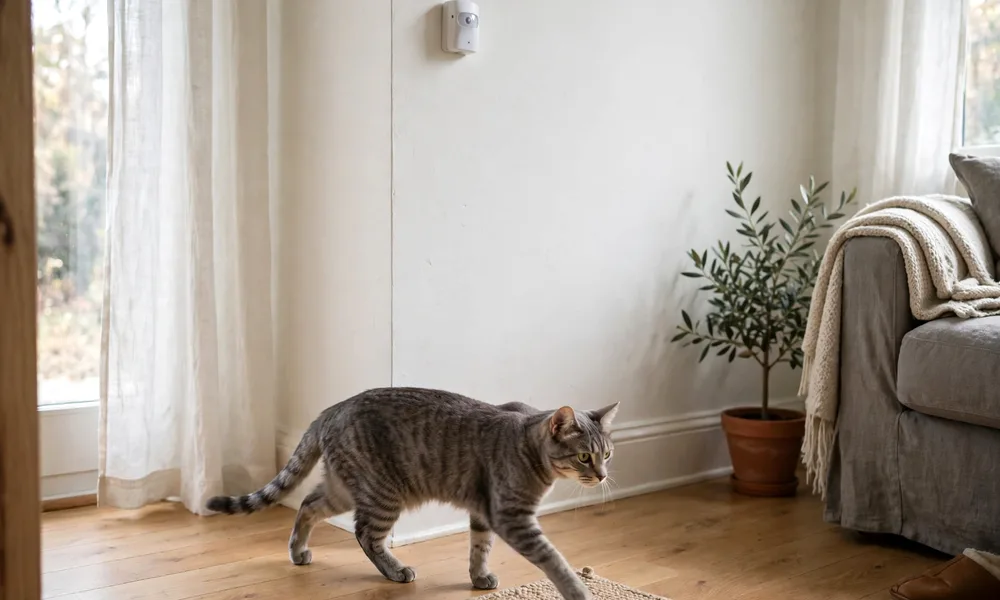
Living rooms and kitchens are where pet immunity earns its keep. A sensor here must ignore a cat crossing the floor and a dog asleep on the rug, and that is what the pet-immunity setting is for. Set the sensor high, aim it slightly downward, and choose a model rated for the weight of your pet. Outdoors, a sensor belongs beside the front door, over the driveway and at the back gate, but only a weatherproof outdoor model, mounted under an eave where rain cannot hit the lens directly.
How to Choose the Right One
Detection range is the first number to check. Indoors, eight to ten metres is plenty for most rooms, and more range mostly buys false alarms from the next room. Outdoors, look for ten to twelve metres and an angle of at least 110 degrees.
Pet immunity is the second number, and it needs reading carefully. A sensor rated pet-immune to 25 kilograms ignores animals up to that weight on the floor. With a large dog, buy a dual-tech sensor.
Power and connectivity come next. Battery sensors suit renters and finished rooms, but check the battery type: a sensor that takes a common AA cell is cheaper to run than one that takes a coin cell. Smart sensors need a hub or a direct Wi-Fi connection. A hub sensor sips battery and responds fast, while a Wi-Fi sensor needs no hub but drains its battery faster.
Finally, check the adjustments. A good sensor lets you change sensitivity, time delay, and daylight level. Sensitivity turns down a sensor that fires for cats. Time delay decides how long the light stays on after the last movement: thirty seconds indoors or sixty seconds outdoors is a sensible starting point. Daylight level stops the sensor working in bright daylight.
Before You Buy: The Checklist
- Match the sensor type to the room: PIR for most rooms, dual-tech for security, microwave for garages.
- Check the detection range and angle against the size of the room you are covering.
- Confirm the pet-immunity weight limit covers your animals, at the recommended mounting height.
- Decide battery or mains before you buy, and check the battery type and expected life.
- Confirm smart compatibility with your hub, or choose a standalone sensor if you have no hub.
- Check that sensitivity, time delay and daylight level are all adjustable on the model you choose.
Frequently Asked Questions
Do motion sensors work in complete darkness?
Yes. A PIR sensor watches infrared heat, not visible light, so it works just as well in a pitch-dark hallway as in daylight.
Will a motion sensor detect my cat?
It depends on the sensor and the cat. A sensor with pet immunity rated above your cat’s weight, mounted at about two metres and aimed slightly downward, will usually ignore a cat on the floor. A cat on furniture, or a sensor mounted too low, will still trigger it.
Can a motion sensor see through walls?
A PIR sensor cannot see through walls, glass or any solid object: it needs a clear line of sight to the moving heat. A microwave sensor can see through thin walls, which is useful in a garage and a nuisance in a hallway.
How long do motion sensor batteries last?
A PIR battery sensor in a normal hallway lasts one to three years on a single cell,. A sensor in a busy hallway, or a Wi-Fi sensor that stays connected, will drain its battery in months.
Do I need a motion sensor if I already have security cameras?
Often, yes, because they do different jobs. A camera records what happened; a sensor reacts the instant it happens. A sensor can switch on a light, sound a chime, or wake a sleeping camera.
Where should I never put a motion sensor?
Never aim one at a radiator, a fireplace, a sunny window, or an air-conditioning vent, and never mount one directly above a door. Avoid bedrooms, where it will fire when you move in your sleep.
The Bottom Line
The best motion sensor is the one that fires when a person moves and stays silent for everything else. For most homes that means a PIR sensor indoors, a dual-tech sensor where security matters, and a weatherproof outdoor sensor at the doors. Mount it in a corner at about two metres, aim it across the path of movement, set the pet immunity for the animals you actually have.