Why Carbon Monoxide Detectors Are the Quiet Alarm Every Fuel-Burning Home Needs in 2026
Carbon monoxide is the danger you cannot see, smell, or taste, and it kills quietly, often while a household sleeps. It comes from fuel burning without enough air: a faulty boiler, a blocked chimney, or a generator too close to the house. The best carbon monoxide detectors in 2026 catch that invisible gas early, sound an alarm loud enough to wake a sleeping house, and keep watching for years without asking for anything in return.
This guide is about the carbon monoxide detector itself: the small device that measures one gas, carbon monoxide, and alarms when it reaches a dangerous level. That narrow job is what makes it essential, because no other device in the home does it. A smoke detector watches for smoke, not gas. An air-quality monitor watches dust and smells, not carbon monoxide.
Key Takeaways
- Carbon monoxide is colourless and odourless, so a detector is the only warning you will ever get.
- Put a detector in the hallway outside every bedroom and in any room with a fuel-burning appliance.
- Electrochemical sensors are the standard: they measure carbon monoxide directly and alarm on a time-weighted level, not a single spike.
- A detector that also senses smoke is a useful extra, but it is not a substitute for a dedicated carbon monoxide detector in the right place.
- Test every detector once a month, and replace the whole unit when its sensor reaches the end of its life, usually after seven to ten years.
Carbon Monoxide Detectors 2026 at a Glance
| Best for | Detector type | Power | Sensor life | Standout strength |
|---|---|---|---|---|
| Best overall | Plug-in with battery backup | Mains plus battery | Seven to ten years | Always on, still works in a power cut |
| Best for bedrooms | Battery detector | Sealed ten-year battery | Ten years | No wiring, no battery changes |
| Best for boiler rooms | Wall-mounted detector | Battery or mains | Seven to ten years | Sits close to the appliance |
| Best for whole homes | Interconnected detector | Mains plus battery | Seven to ten years | One alarm sounds them all |
| Best for travel | Portable detector | Rechargeable battery | Five to seven years | Goes with you to rentals |
| Best for smart homes | Smart detector | Mains plus battery | Seven to ten years | Phone alert when nobody is home |
What Carbon Monoxide Is and Where It Comes From
Carbon monoxide is made whenever a fuel burns without enough oxygen to burn cleanly. A healthy gas boiler burns gas completely and makes mostly carbon dioxide and water vapour. A boiler with a blocked flue, a cracked heat exchanger, or a starved air supply burns the same gas badly, and carbon monoxide is what comes out instead. The same is true of wood burners, coal fires, oil boilers, gas cookers, and portable heaters.
How a Carbon Monoxide Detector Actually Works
Almost every carbon monoxide detector sold today uses an electrochemical sensor. Inside the sensor is a chemical cell that reacts with carbon monoxide and produces a tiny electric current. The more gas in the air, the stronger the current, and the detector’s electronics turn that current into a reading in parts per million.
The alarm does not sound at the first trace of gas. It works on time and level together: a low level for a long time is as dangerous as a high level for a short time, so the detector alarms sooner as the level rises. A reading of 30 parts per million might take two hours to trigger the alarm, while 400 parts per million triggers it in minutes.
The sensor itself wears out. The chemical cell dries out slowly over seven to ten years, and when it does, the detector can no longer measure the gas, however fresh its batteries are. A good detector tells you when its sensor has expired, with an end-of-life chirp or a warning light, and the only fix is a new unit.
Carbon Monoxide Detectors vs Smoke Detectors
Smoke detectors and carbon monoxide detectors look alike, sit in similar places, and both save lives, but they watch for different things with different sensors. A smoke detector watches for smoke particles: a photoelectric sensor watches light scatter off smoke, and an ionisation sensor watches smoke disrupt an electric current. A carbon monoxide detector watches for one invisible gas with an electrochemical cell, and smoke does not trigger it, just as carbon monoxide does not trigger a smoke detector.
Placement is different too, because the two dangers behave differently. Smoke rises, so a smoke detector belongs on the ceiling, high up, where the smoke gathers first. Carbon monoxide mixes evenly through the air, so a carbon monoxide detector works at any height, but it belongs where people breathe: on a wall at head height in a hallway, or on a bedside table in a bedroom.
The other confusion is the gas detector. A general gas detector sniffs for leaks of natural gas or LPG, the fuel itself, using a sensor tuned to methane or propane. A carbon monoxide detector measures the poisonous gas made when that fuel burns badly. They are different gases, different sensors, and different jobs: a gas detector tells you the pipe is leaking, a carbon monoxide detector tells you the boiler is poisoning the air.

The Main Types of Carbon Monoxide Detector
Plug-in detectors are the simplest choice for most homes. They plug straight into a wall socket, usually in a hallway, and carry a battery backup so they keep working through a power cut. They suit hallways and living rooms, where a socket is always nearby. Battery detectors are the flexible alternative: a sealed ten-year battery means no wiring and no battery changes for the life of the sensor, and they can go anywhere, including rooms with no free socket.
Interconnected detectors are the safest choice for a larger home. When one sounds, they all sound, so a detector in the boiler room wakes the bedrooms upstairs before the gas reaches them. They connect by wire or by wireless radio, and the wireless kind can be added to an existing home without chasing cables. Smart detectors go one step further and send an alert to your phone, which solves the oldest problem in gas safety: the leak that starts when nobody is home. A standard detector can sound for hours to an empty house; a smart detector tells you within seconds.
Where to Put Them: The Room-by-Room Plan
Start with the hallway outside the bedrooms. That is the detector that wakes you, and it is the one that matters most. Put it on the wall at head height, about one to three metres from the bedroom doors, where the alarm is loud enough to wake a sleeper but not so close that it is muffled by a closed door.
Next, put a detector in every room with a fuel-burning appliance: the room with the boiler, the room with the wood burner or fireplace, and the kitchen if it has a gas cooker. Keep detectors away from cookers and extractor fans, which pull air past the sensor too fast for a proper reading.

How to Choose the Right One
Sensor life is the first number to check. Seven to ten years is the standard for an electrochemical sensor, and a detector with a sealed ten-year battery matches the sensor’s life, so the whole unit is replaced in one go. A detector with replaceable batteries needs new cells every year or two, and a dead battery is the most common reason a detector fails when it is needed.
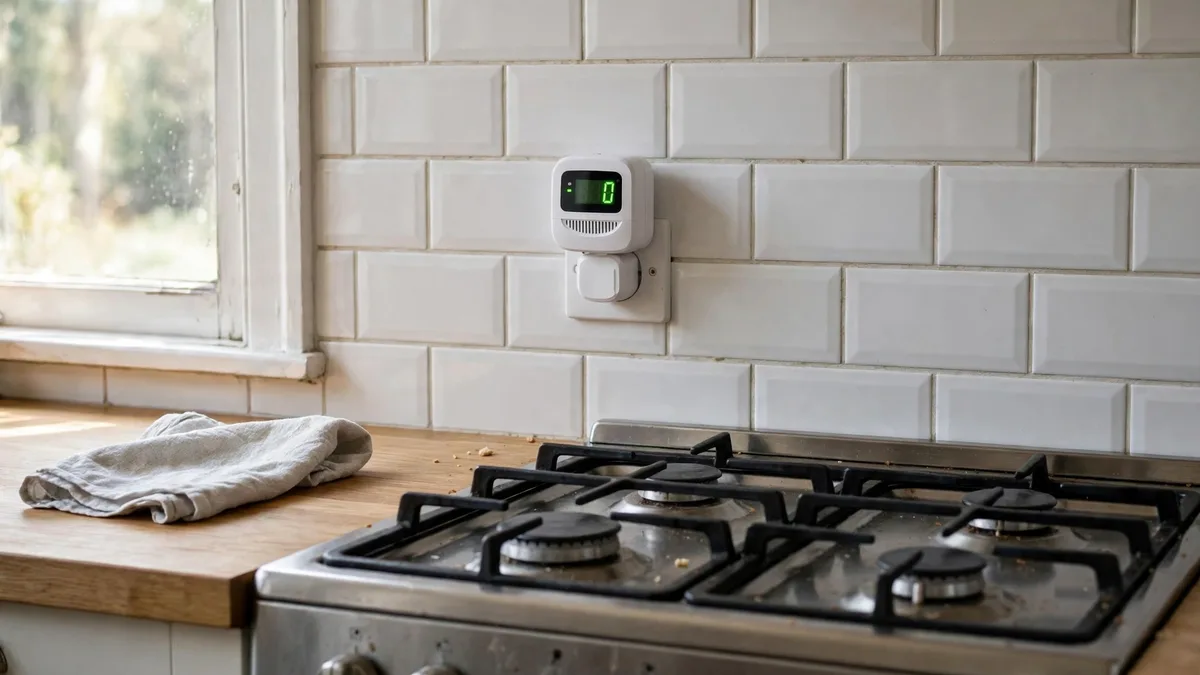
A digital display is the second feature worth paying for. A detector without a display can only tell you that the gas has reached the alarm level, which is already late. A detector with a display shows the low readings that never reach the alarm, and a reading that creeps upward over days is the early warning of a boiler going wrong.
Power and interconnection come next. A plug-in detector with battery backup is the best of both worlds for a hallway: mains power for everyday use, battery for the power cut. Interconnection matters more than any single feature in a larger home, because one alarm sounding alone in the boiler room will not wake a sleeper upstairs.
Finally, check the alarm itself. It should sound at 85 decibels or more, loud enough to wake a sleeper through a closed door, in a pattern you can tell apart from your smoke alarm. Check that the detector carries a recognised safety standard. A detector with no standard marking is a decoration, not a safety device.
What to Do When the Alarm Sounds
An alarm sounding is not a moment for troubleshooting. Get everyone outside into fresh air first, and call the emergency services from outside, not from inside the house. Do not open windows and wait to see if it stops, do not switch the boiler off first, and do not go back inside to look for the source. Carbon monoxide poisoning gets worse with every minute you stay, and the symptoms, headache, dizziness, nausea, feel mild until they suddenly are not. Do not use the appliance again until a qualified engineer has checked it and cleared it.
Carbon Monoxide Detectors and the Rest of Home Safety
A carbon monoxide detector is one part of a home safety system, and it works best alongside the others. An air quality monitor watches dust, pollen and everyday smells, and it tells you how clean your air feels, but it does not detect carbon monoxide at all: our check of the leading air quality monitor guide found zero mentions of the gas. And a generator deserves special attention: never run one indoors, in a garage, or near an open window.

Before You Buy: The Checklist
- Count the rooms that need one: the hallway outside the bedrooms, and every room with a fuel-burning appliance.
- Choose electrochemical sensing, with a sensor life of seven to ten years and an end-of-life warning.
- Pick a digital display, so you can see low readings before they reach the alarm level.
- Decide plug-in with battery backup for hallways, or sealed-battery for bedrooms with no free socket.
- Choose interconnected or smart detectors for larger homes, so one alarm wakes the whole house.
- Check the alarm is 85 decibels or louder, and that the detector carries a recognised safety standard.
Frequently Asked Questions
Do I need a carbon monoxide detector if I have a smoke detector?
Yes. A smoke detector watches for smoke particles, and carbon monoxide is an invisible gas that a smoke detector cannot sense. A home with a fuel-burning appliance needs both.
Where is the best place for a carbon monoxide detector?
In the hallway outside the bedrooms, on the wall at head height, and in every room with a fuel-burning appliance.
How often should I test my carbon monoxide detector?
Test it once a month by pressing the test button, and check the display reading at the same time.
How long does a carbon monoxide detector last?
Seven to ten years, depending on the sensor. The electrochemical cell wears out slowly, and when it expires the whole unit must be replaced, however fresh the batteries are.
Will my air quality monitor warn me about carbon monoxide?
No. Air quality monitors measure dust, pollen and everyday smells, and they do not detect carbon monoxide.
What should I do if the alarm goes off?
Get everyone outside into fresh air straight away, and call the emergency services from outside.
The Bottom Line
The best carbon monoxide detector is the one that is fitted, tested, and in the right place before you ever need it. For most homes that means a plug-in detector with battery backup in the hallway outside the bedrooms, a battery detector in any bedroom with a fuel-burning appliance, and one beside the boiler. Choose an electrochemical sensor with a digital display, test it every month, and replace it when the sensor expires.