
The best smart home hubs of 2026 do one job that no single gadget can do on its own: they make the lights, locks, thermostat, speakers and cameras in a house behave like one home instead of a dozen separate apps. A good hub listens for a voice command, runs a routine without being asked, and keeps devices from different brands talking to each other, even when the internet drops out for a few minutes.
That is why choosing a hub is less about the speaker on the shelf and more about the system underneath it. The best smart home hubs in 2026 are judged here on the ecosystems they support, the radios built into them, how well they run automations locally, how clearly they handle privacy, and how painless they are for someone who simply wants the hallway light to come on at dusk.
This guide compares seven hubs that cover those different homes, from the simplest voice-first pick to the most powerful local system for people who like to tinker. Every pick below works with Matter, the standard that finally lets devices from rival brands share one home, and every one has been weighed on real daily use: morning routines, evening wind-downs, guests who just want to turn a light on, and the moment a device goes offline.
Key Takeaways
- Pick your ecosystem first, then your hub: a home built on Alexa, Google Home or Apple HomeKit works best with a hub made for that world.
- Matter support is now essential, and a hub with built-in Zigbee, Z-Wave or Thread radios connects far more devices without extra bridges.
- Local processing matters: hubs that run routines on the device itself keep working when the internet is slow or briefly down.
- Voice-first hubs suit most homes, while a dedicated local hub suits larger homes and anyone who wants deeper automation.
- Start with the rooms you use most, add devices slowly, and test one routine at a time before automating the whole house.
Best Smart Home Hubs 2026 at a Glance
| Hub | Best for | Voice assistant | Key radios |
|---|---|---|---|
| Amazon Echo Hub | Alexa homes | Alexa | Zigbee, Thread, Matter |
| Google Nest Hub (2nd gen) | Google homes | Google Assistant | Thread, Matter |
| Apple HomePod mini | Apple homes | Siri | Thread, Matter |
| Samsung SmartThings Station | Mixed-brand homes | Alexa, Google | Zigbee, Thread, Matter |
| Hubitat Elevation C-8 | Local automation | Via Alexa, Google | Zigbee, Z-Wave, Matter |
| Home Assistant Green | Power users | Via Alexa, Google | Zigbee, Thread, Matter |
| Aqara Hub M3 | Budget Matter homes | Alexa, Google, Siri | Zigbee, Thread, Matter |
How We Chose the Best Smart Home Hubs
We started with compatibility, because a hub that cannot see your devices is useless no matter how clever it is. Each pick supports Matter, the shared standard that lets a light from one brand work with a hub from another, and most add Zigbee, Z-Wave or Thread so older and newer devices alike can join without a separate bridge for every brand.
What Is a Smart Home Hub, Really?
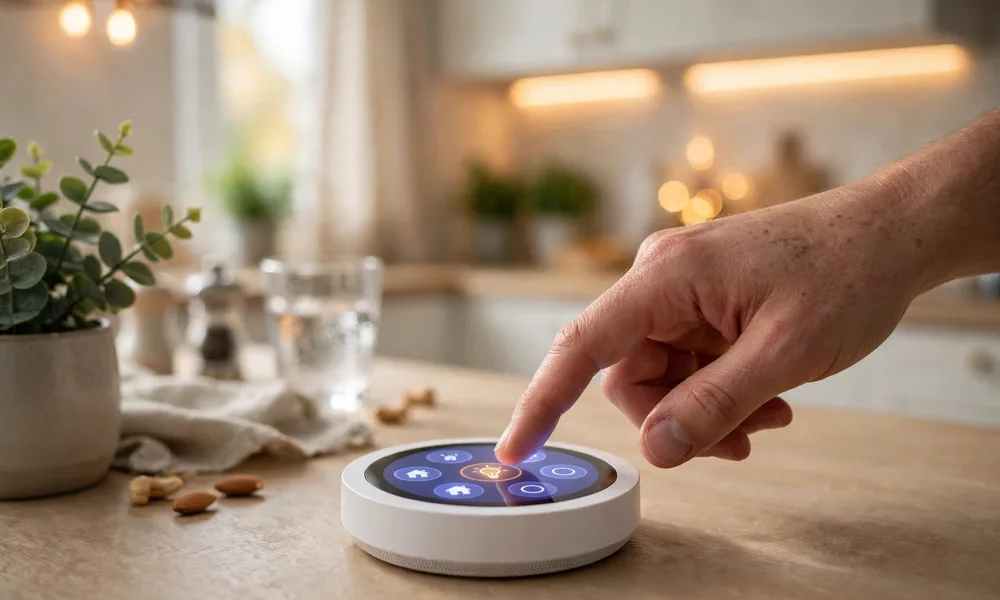
A smart home hub is the translator and the traffic controller of a connected home. Lights, plugs, locks and sensors speak different wireless languages, and many of them are too small or too power-hungry to talk to a phone directly. The hub sits in the middle, listens to each device in its own language, and turns those signals into one set of controls, one app and one set of routines.
The 7 Best Smart Home Hubs in 2026
1. Amazon Echo Hub — Best Smart Home Hub for Alexa Homes
The Echo Hub is the clearest pick for a home that already runs on Alexa. It is a small wall-mountable panel with an eight-inch touch screen, and it brings every Alexa device, routine and camera feed into one dashboard that anyone in the house can use without opening an app. It has Zigbee, Thread and Matter built in, so it talks directly to a wide range of lights, plugs and sensors, and it doubles as a control panel by the front door or in the kitchen.
2. Google Nest Hub (2nd gen) — Best Smart Home Hub for Google Homes
The Nest Hub is the friendliest face of a Google smart home. Its seven-inch display shows the weather, the calendar, camera feeds and music controls, and Google Assistant answers questions, sets timers and runs routines in plain, forgiving language. It supports Matter and Thread, so newer devices join easily, and it fits naturally on a bedside table or a kitchen worktop, where it doubles as a photo frame when idle.
3. Apple HomePod mini — Best Smart Home Hub for Apple Homes
The HomePod mini is small, round and surprisingly capable as the heart of an Apple home. It works as a HomeKit hub, so automations keep running when phones are away, and it supports Matter and Thread, which means it can control a growing range of devices from brands far beyond Apple. Siri handles lights, music, intercom messages and timers, and the sound quality is far better than a speaker this size has any right to be.
4. Samsung SmartThings Station — Best Smart Home Hub for Mixed-Brand Homes
The SmartThings Station is a small, affordable hub that solves the most common smart home problem: devices from different brands that refuse to work together. It supports Matter, Zigbee and Thread, and the SmartThings app pulls lights, plugs, sensors and appliances into one dashboard, with routines that can span brands in a single tap. It also works as a wireless phone charger, which earns it a permanent place on a bedside table.
5. Hubitat Elevation C-8 — Best Smart Home Hub for Local Automation
The Hubitat Elevation C-8 is the hub for people who want their automations to run at home, not in a distant cloud. It has Zigbee, Z-Wave and Matter support, and it processes rules locally, so lights, locks and sensors respond quickly and keep working when the internet is down. Its rule engine is deep: a single automation can weigh time of day, motion, temperature, presence and the state of other devices before it acts.
6. Home Assistant Green — Best Smart Home Hub for Power Users
Home Assistant Green is the most flexible hub on this list, and the most rewarding for anyone who enjoys building a system of their own. It is a small, quiet box that runs Home Assistant, the open platform that supports thousands of devices and integrations, from lights and locks to energy monitors and weather stations. It supports Zigbee, Thread and Matter, and its automations can be as simple as a sunset light or as detailed as a whole-house energy routine.
7. Aqara Hub M3 — Best Smart Home Hub on a Budget
The Aqara Hub M3 is proof that a good Matter hub does not have to cost much. It supports Zigbee, Thread and Matter, works with Alexa, Google Home and Apple HomeKit, and connects Aqara’s wide range of affordable sensors, switches and cameras into one system. It is small enough to hide on a shelf, and it can act as a Matter bridge, bringing older Aqara devices into a modern Matter home.

Matter, Zigbee, Z-Wave and Thread Explained
The alphabet soup of smart home radios is simpler than it looks. Matter is the shared language that lets devices from different brands work together, so a light bought today should work with a hub bought tomorrow, whichever brand made either one.
Routines That Actually Make Life Easier
The best routines are the ones nobody notices, because they remove a small daily chore. A morning routine can raise the blinds, start the coffee machine plug, read the weather and warm the bathroom before anyone is fully awake. An evening routine can dim the living room, lock the doors and switch the hallway to a low night light.
Start with three routines and let them prove themselves before adding more. Pairing a hub with a strong network helps here too, since a mesh Wi-Fi system keeps every room connected while routines run.
Choosing the Right Ecosystem
Every hub in this guide works, but each one works best inside its own ecosystem. Alexa homes get the widest choice of compatible devices and the most forgiving voice control. Google homes get the best answers to everyday questions and the smoothest display experience.
Think about who lives in the house, not just who buys the gadgets. Children, guests and older relatives should be able to turn on a light without a lesson, and a hub with a screen or a simple button helps here more than any app. A smart speaker in the living room is often the first device a household actually talks to, so it is worth choosing a voice assistant the whole family likes.
Finally, think about the devices you already own. A home full of smart bulbs needs a hub that speaks their language, and a home with a smart thermostat needs a hub that can fold heating into its routines.

Smart Home Hub Buying Checklist
- List every smart device you already own, and check that the hub supports its brand and its wireless language.
- Choose one main ecosystem — Alexa, Google or Apple — and buy a hub built for it, even if you keep a second voice assistant for guests.
- Look for Matter plus at least one mesh radio, such as Zigbee, Z-Wave or Thread, so new devices join without extra bridges.
- Prefer hubs that run common routines locally, so lights and locks keep working when the internet is briefly down.
- Place the hub centrally, in the open and away from thick walls, so its wireless signal reaches every room.
- Test three routines for a week before adding more, and keep a simple manual switch for every automated light.
Frequently Asked Questions
Do I need a smart home hub if I already have a smart speaker?
Often, yes, because a speaker and a hub do different jobs. A smart speaker is mainly a voice assistant and a music player, while a hub is the translator that connects lights, locks and sensors across different wireless languages.
What is Matter, and why does it matter for a hub?
Matter is a shared standard that lets smart home devices from different brands work together in one home. A Matter-certified light should work with a Matter hub from any brand, which ends the old problem of buying a device only to find it cannot join your system.
Can a smart home hub work without the internet?
Some of it can. Hubs that process routines locally, such as Hubitat and Home Assistant, keep lights, locks and sensors working when the broadband drops, although voice control and remote access usually still need the cloud.
Which smart home hub is best for beginners?
For most beginners, the best hub is the one that matches the voice assistant they already use. An Alexa household should start with the Echo Hub, a Google household with the Nest Hub, and an Apple household with the HomePod mini.
How many devices can a smart home hub handle?
Most hubs in this guide handle dozens of devices without trouble, and mesh networks actually improve as more powered devices join, because each one helps pass messages along. A small flat may need only ten devices, while a large house can pass a hundred.
Is a smart home hub safe for privacy?
A hub is as safe as its settings. Choose a hub from a brand you trust, turn off voice recordings you do not need, review which devices can see each other, and keep the hub’s software updated.
The Bottom Line
The best smart home hub for most homes in 2026 is the one that matches the household’s ecosystem, speaks the languages its devices already use, and runs its routines without fuss. For Alexa homes that is the Echo Hub, for Google homes the Nest Hub, for Apple homes the HomePod mini, and for mixed or budget homes the SmartThings Station or the Aqara Hub M3.


