The best portable fans for travel in 2026 are lighter, quieter and far more powerful than the flimsy gadgets that used to fill airport gift shops. Whether you face a long-haul flight with weak cabin air, a stuffy hotel room in a heatwave, or a crowded train in midsummer, a good travel fan can turn an uncomfortable journey into a pleasant one. The best portable fans for travel now run for ten hours or more on a single charge, fold flat into a carry-on, and weigh less than a paperback book.
We tested the latest handheld, neck, clip-on and folding fans on real trips, from overnight flights to humid city walks, judging each one on airflow, battery life, noise, weight and how easily it packs.
This guide covers nine standout fans across every style and budget, and shows you how to pack and use a travel fan so it lasts the whole journey.
Key takeaways
- Handheld fans give the strongest direct airflow, while neck fans keep your hands free for luggage, tickets and phones.
- Look for at least 8 hours of battery life on low speed, USB-C charging, and a weight under 200 grams.
- Clip-on fans are the best choice for planes, trains and strollers because they attach to tray tables and armrests.
- Brushless motors run quieter and last longer, so check the motor type before you buy.
- A fan that folds flat is far more likely to travel with you.
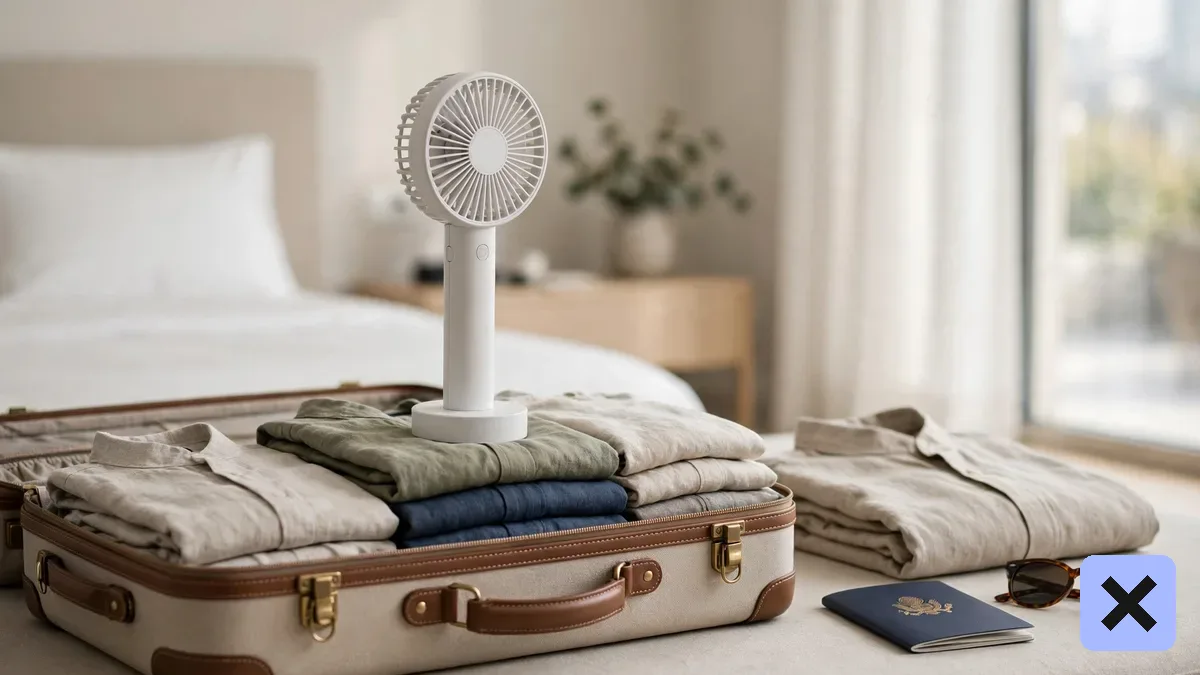
The 9 Best Portable Fans for Travel in 2026
The nine fans below cover every travel situation, from hands-free cooling on a walking tour to a steady breeze on a night train.
1. Best Overall: The Folding Turbo Handheld
The folding turbo handheld is the best portable fan for travel in 2026 because it does everything well and nothing badly. It folds flat to the size of a phone, opens into a powerful handheld with three speeds, and doubles as a desk fan thanks to a fold-out stand. Battery life reaches around twelve hours on low and three hours on full power, and it recharges over USB-C in about two hours.
2. Best Neck Fan: The Bladeless Neck Cooler
Neck fans are the only travel fans that cool you while leaving both hands completely free, and the best bladeless neck cooler of 2026 is a genuine step forward. Instead of exposed blades, it uses a ring of small vents that push air upward around your face and neck, so there is no hair to catch and no spinning blade near your skin.
3. Best Clip-On Fan: The Stroller and Tray Table Clip
A clip-on fan earns its place by going where no other fan can, clamped to a tray table, a stroller handle, a tent pole or a train seat. The best clip-on model of 2026 has a strong spring clamp, a flexible neck, and a quiet brushless motor.
4. Best for Flights: The Whisper-Quiet Mini Desk Fan
Long flights are where a bad fan becomes obvious, because anything loud or bulky will annoy you and everyone around you. The best flight fan of 2026 is a compact mini desk model that sits neatly on a tray table, runs almost silently below 30 decibels on its first two speeds, and still moves enough air to make a stuffy cabin comfortable.
5. Best Budget Pick: The Pocket Turbo Stick
You do not need to spend a lot to stay cool, and the pocket turbo stick proves it. This slim, pen-shaped fan costs a fraction of the premium models yet still delivers three speeds, a surprisingly strong top setting, and around eight hours of battery life on low. It weighs barely 120 grams, charges over USB-C, and slips into a shirt pocket or the side pocket of a backpack.
6. Best Premium Pick: The Turbo Jet Handheld Pro
For travellers who want the strongest airflow money can buy, the turbo jet handheld pro is in a class of its own. Its high-speed brushless motor produces a focused jet of air that can cool you down in seconds after a hot walk or a crowded platform. Battery life is around four hours at full power and ten hours on low, and it doubles as a power bank in an emergency.
7. Best for Hot Climates: The Misting Travel Fan
When the air itself feels hot, moving it around is not always enough, and that is where a misting fan earns its keep. The best misting travel fan of 2026 pairs a strong handheld fan with a small water tank that releases a fine, cool mist, dropping the temperature of the breeze by several degrees. It is the ideal companion for desert cities, tropical beaches and summer festivals.
8. Best for Families: The Dual-Head Stroller Fan
Travelling with children means cooling two people at once, and the dual-head stroller fan is built for exactly that. Two independently adjustable fan heads clip to a stroller, a car seat handle or a bunk bed, so one head can cool your child while the other cools you. Each head has its own speed control, the battery lasts up to sixteen hours across both heads on low, and the whole unit folds down small enough for a nappy bag.
9. Best Ultralight Pick: The Card-Sized Flat Fan
The card-sized flat fan is barely thicker than a smartphone and weighs less than 100 grams, making it the most packable fan in this guide. It slides into a laptop sleeve, a passport holder or a jacket pocket, and it unfolds in seconds into a surprisingly capable little fan with two speeds and around six hours of battery life.
Portable Fan Types Compared
Choosing between fan types is easier once you see them side by side.
| Fan type | Best for | Battery life | Weight | Noise level |
|---|---|---|---|---|
| Handheld | Strong direct cooling | 8 to 12 hours | 120 to 200 g | Low to medium |
| Neck fan | Hands-free walking | 8 to 10 hours | 200 to 280 g | Low |
| Clip-on | Planes, strollers, desks | 10 to 14 hours | 180 to 300 g | Very low |
| Folding desk | Hotel rooms, tray tables | 8 to 12 hours | 150 to 250 g | Very low |
Many experienced travellers carry two: a handheld for strong cooling and a neck or clip-on fan for hands-free moments.

How to Choose the Best Portable Fan for Travel
A good travel fan is defined by a handful of specifications. The most important number is airflow, usually quoted in cubic feet per minute or as a maximum wind speed, and higher is genuinely better for hot weather. Battery life matters just as much, because a fan that dies halfway through a flight is dead weight, so look for at least eight hours on the lowest speed.
Check the Battery and Charging
USB-C charging is the standard you should insist on, because it means one cable charges your fan, your phone and your headphones. A good power setup makes all the difference on a long trip, and our guide to the best portable chargers for travel will help you pick a charger that keeps your fan, phone and headphones running all day.
Size, Weight and Packing
Every gram counts when you are carrying a bag all day, so weight deserves more attention than most buyers give it. A fan under 200 grams is easy to forget you are carrying, while anything over 300 grams starts to feel like a burden by the afternoon. Folding designs are worth seeking out because they protect the blades in transit and slide into pockets a fixed fan cannot reach.
Noise, Safety and Airline Rules
Noise is the factor most often overlooked, yet it decides whether you can use your fan on a plane, in a quiet carriage or beside a sleeping child. Brushless motors are quieter and more durable than brushed ones, so they are worth paying a little extra for, and a fan with a low-speed setting below 30 decibels will never disturb anyone. Portable fans with lithium batteries are allowed in cabin baggage on almost all airlines, but they must travel in your carry-on, never in checked luggage, so check your airline’s battery policy before you fly.
Packing and Using Your Travel Fan
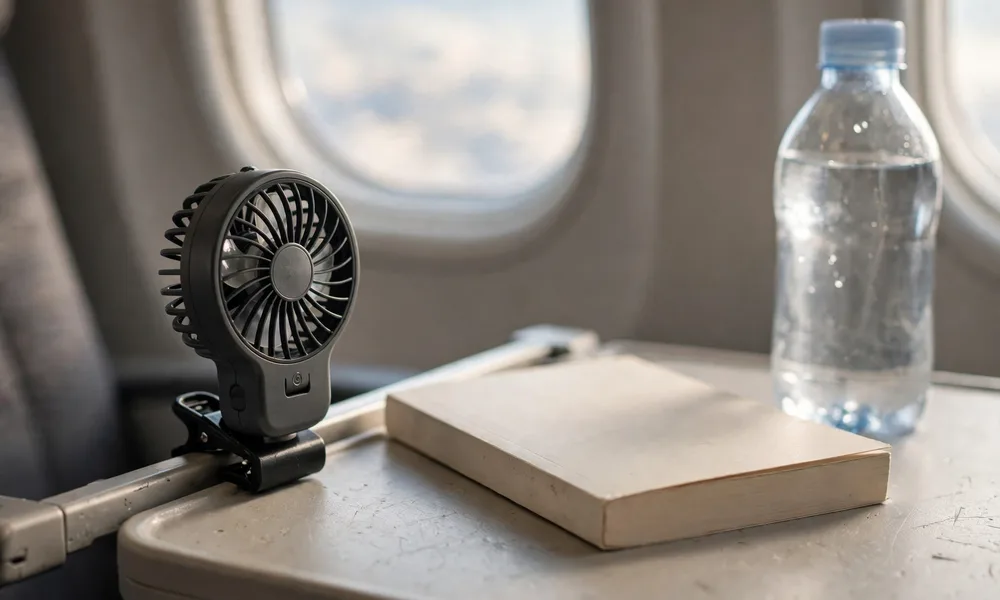
Getting the most from a travel fan starts before you leave home. Charge it fully, test every speed, and pack it in your personal item or daypack rather than your main suitcase, so it is within reach on the plane, the train and the walk to your hotel.
On the plane, a clip-on or small desk fan works best, aimed at your face from the tray table while the cabin air conditioning catches up. In a hotel room, prop a folding fan on the bedside table and let it run on low overnight. Keep your kit organised; our roundup of the best travel backpacks for day trips shows packs with pockets that keep small gadgets easy to reach.
Keeping Your Fan Clean on the Road
Dust and lint build up quickly on fan blades, especially in dry or sandy destinations, and a dirty fan moves less air and makes more noise. Wipe the blades with a dry cloth every few days, and use a soft brush or a cotton bud to clear the grille if your fan has one.

Travel Fan Checklist
- Charge the fan fully the night before departure and confirm all speeds work.
- Pack a short USB-C cable and a portable charger so you can top up on the move.
- Carry the fan in your personal item or daypack, not in checked luggage.
- Slip the fan into a small pouch to protect the blades and keep out dust.
- Check your airline’s lithium battery rules before you fly.
- Empty the water tank of any misting fan before packing it away.
Frequently Asked Questions
Can I take a portable fan on a plane?
Yes, portable fans are allowed in cabin baggage on almost all airlines, because their lithium batteries are small and fall well within the usual limits. Keep the fan in your carry-on or personal item, never in checked luggage, and make sure it is switched off during takeoff and landing.
How long do portable travel fans last on one charge?
Most good travel fans run for eight to twelve hours on their lowest speed and two to four hours on their highest speed.
Are neck fans safe for long wear?
Yes, modern bladeless neck fans are safe for long wear, because they have no exposed blades and the air vents sit away from your skin.
What is the quietest type of portable fan?
Clip-on and small folding desk fans are usually the quietest, because their brushless motors run at low speeds and their larger blades move air efficiently without spinning fast. Handheld turbo fans are the loudest at full speed, though most are still quiet enough for outdoor use.
Do portable fans actually help on a hot flight?
Yes, they make a real difference, especially in the first twenty minutes after boarding when the cabin air conditioning has not yet caught up. A small fan aimed at your face creates a personal breeze that lowers how hot you feel, even though it does not change the cabin temperature. For overnight flights, our guide to the best travel blankets for airplanes covers staying comfortable once the cabin cools down.
How do I clean a portable fan while travelling?
Wipe the blades and grille with a dry cloth or a tissue every few days, and use a cotton bud to clear dust from tight spaces. Avoid water unless the fan is rated waterproof, and never use a wet wipe on the charging port.
The Bottom Line
The best portable fans for travel in 2026 are small, quiet and powerful enough to change how a hot journey feels, and the folding turbo handheld is the pick that suits the most travellers. If your hands are often full, add a bladeless neck fan, and if you fly often, add a quiet clip-on fan for the tray table.