A projector without a screen is a bright picture on a wall, and a wall is not a screen. It has texture, it has a colour that is never quite white, and it washes out the moment the lights come on. A projector screen is the part of a home cinema that makes the projector look like it was worth the money: it gives the picture a flat, even surface, it reflects the light back to the seats, and it turns a room into a cinema. The best projector screens of 2026 are the ones that make the picture look better, not the ones that cost the most.

What Makes a Projector Screen Good
The first thing to judge is the surface. A screen’s surface decides how bright the picture looks, how wide the viewing angle is, and how much the picture washes out when the room is not dark. A matte white surface is the standard choice: it reflects light evenly in every direction, so the picture looks good from any seat, and it is the most forgiving surface for a room that is not perfectly dark. A grey surface helps in a room with some light, because it darkens the blacks and keeps the contrast up, but it also dims the picture a little. A high-gain surface is brighter in the centre but dimmer at the edges, and it suits a narrow room where everyone sits in front of the screen.
The second thing is flatness. A screen that waves, curls or sags will show a picture that is distorted at the edges, and a picture that is distorted at the edges is a picture that is never quite right. The best screens stay flat: a fixed frame screen is flat by design, and a good pull-down screen has a tensioning system that keeps it flat when it is down. A cheap pull-down screen without tensioning will curl at the edges within a year, and a screen that curls is a screen that needs replacing.
The Main Types of Projector Screen
Fixed frame screens are the classic choice. They are a frame with a screen stretched across it, mounted permanently on a wall, and they give the flattest, most even picture of any screen type. They suit a dedicated home cinema room, where the screen never needs to be hidden, and they are the best choice for the sharpest picture. The trade-off is permanence: a fixed screen is always there, it takes up a whole wall, and it is not the right choice for a living room where the television is the main display.
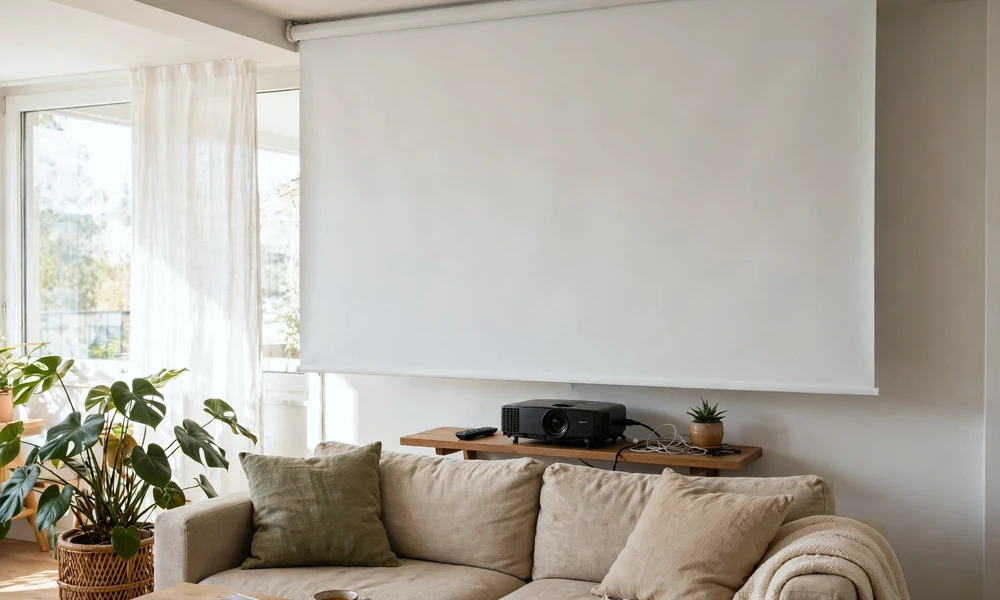
Pull-down screens are the practical option. They roll up into a case on the wall or ceiling when they are not in use, and pull down when the film starts, so a living room can be a living room by day and a cinema by night. They suit the household that wants a big picture without a permanent screen on the wall, and they are the most popular choice for a living room. The downside is flatness: a pull-down screen without tensioning will curl at the edges over time, so a tensioned screen is worth the extra money.
Motorised screens are the convenient option. They roll down at the touch of a button, or automatically when the projector turns on, and they roll back up when the film is over. They suit the home cinema where the screen should appear and disappear without anyone touching it, and they are the most impressive option for guests. The trade-off is price and complexity: a motorised screen costs more than a manual one, it needs power, and a motor that fails is a screen that stays down.
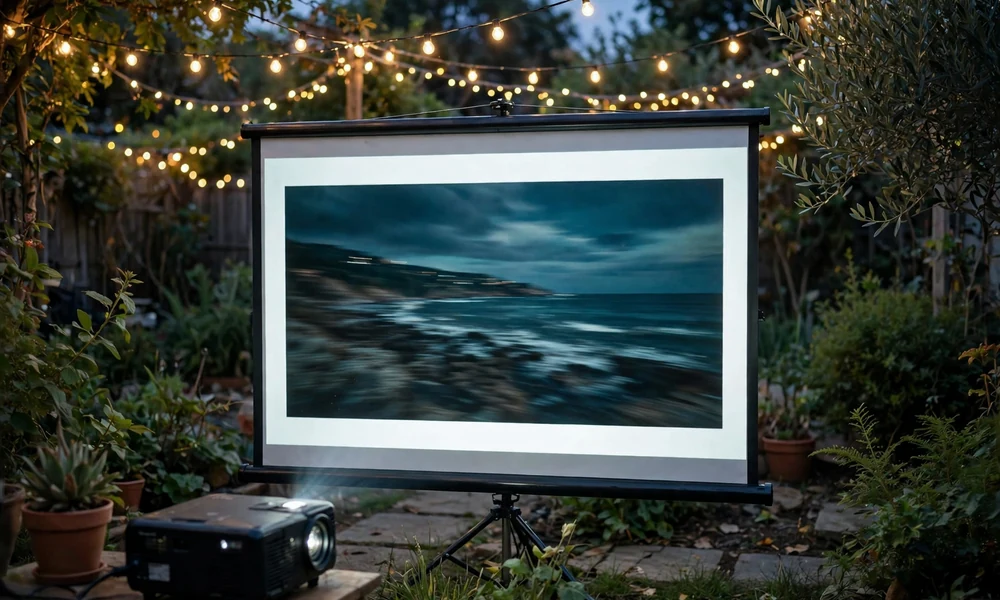
Portable screens are the flexible option. They stand on a tripod or fold into a case, so they can be set up in a garden, taken to a friend’s house, or used for a presentation in a hall. They suit the household that watches films outdoors in summer, or the person who presents to a room full of people. The downside is size and stability: a portable screen is smaller than a fixed one, and a tripod screen will wobble in a breeze.
Ambient light rejecting screens are the specialist option. They are designed for a room that cannot be made dark, with a surface that reflects the projector’s light back to the seats while rejecting light from the sides and above. They suit a bright living room, a conservatory, or a room with large windows, where an ordinary screen would wash out. The trade-off is price and viewing angle: an ALR screen costs several times more than a white screen, and the picture dims quickly from the side.
How to Choose the Right Screen
Start with the room, not the screen. A dark room needs a matte white screen, because there is no ambient light to fight, and a white screen gives the brightest, most even picture. A room with some light needs a grey screen, because the grey keeps the blacks dark and the contrast up. A bright room needs an ALR screen, because nothing else will hold the picture together.
Then check the size. A screen that is too big for the room will force the viewer to sit too close, and a screen that is too small will waste the projector’s picture. The rule is simple: sit at a distance of about one and a half times the screen’s width, and the picture will fill the view without forcing the eyes to move. Measure the wall, measure the seating distance, and buy the screen that fits both. And check the aspect ratio: a 16:9 screen suits films and television, while a wider screen suits a cinema-style picture. A screen that fits the room and the seating is a screen that will be enjoyed.
The Best Projector Screens of 2026
The best fixed frame screen for most cinema rooms this year is a 100-inch matte white screen in a slim black frame, flat by design, with a picture that is bright and even from any seat. It is the screen for a dedicated room, it looks like a cinema, and it makes the projector look like it was worth the money. It is not cheap, but it is the part of the cinema that lasts the longest.
The best pull-down screen of 2026 is a tensioned 100-inch matte white screen that rolls up into a slim case and pulls down flat every time. It is the screen for a living room that is a cinema by night, it hides away when it is not needed, and it stays flat for years. It costs more than a non-tensioned screen, but the flatness is worth it.
The best motorised screen is a 110-inch screen that rolls down at the touch of a button, with a quiet motor and a tensioned surface that stays flat. It is the screen for the cinema room that should feel like a cinema, it appears when the film starts and disappears when it ends, and it is the most impressive option for guests.
The best portable screen of 2026 is a 100-inch tripod screen that sets up in a minute, folds into a carry case, and gives a bright, even picture outdoors or in a hall. It is the screen for summer films in the garden, for presentations, and for a house where the screen needs to move.
The best budget screen is a simple 100-inch manual pull-down screen with a matte white surface, at a price that is less than a night at the cinema. The surface is even, the picture is bright, and it is genuinely enjoyable to watch. It will curl at the edges over time, because it has no tensioning, but for a first screen, or for a room that is used occasionally, it is all that is needed.
What Else You Need
A screen works best with the right projector. A projector that is too dim for the room will wash out on any screen, and a projector that is too bright for a small screen will be uncomfortable to watch. A good television is worth a look for anyone who watches mostly in daylight, because a television is brighter than any projector and screen combination. And a home theater setup, with speakers placed properly and the room treated for sound, turns a good picture into a real cinema.
Common Mistakes to Avoid
The biggest mistake is buying a screen that is too big for the room. A screen that fills the wall will force the viewer to sit too close, and a picture that is too close is tiring to watch. The second mistake is ignoring the light: a white screen in a bright room will wash out, and an ALR screen in a dark room is money wasted. The third mistake is buying a cheap pull-down screen without tensioning, because it will curl within a year and the picture will never be right again.
Another common mistake is forgetting the wall. A fixed frame screen needs a wall that is flat, strong and big enough, and a screen mounted on a wall that is not flat will never look right. Check the wall, check the mounting, and check that the screen will be level. And do not forget the projector’s throw distance: a projector that is too close to the screen will not fill it, and a projector that is too far away will spill light past the edges.
How Projector Screens Fit a Home Cinema
A projector screen is the part of a home cinema that makes the room feel like a cinema. The lights go down, the screen comes down, and the room changes from a living room into a place where a film is watched properly. It is the simplest upgrade a home cinema can have, and it is the one that makes the biggest difference to the picture. A good screen does not just show the film; it makes the film feel like an event, and that is why people build a cinema room in the first place.
The habit also pairs naturally with a little care for the room. A dark wall behind the screen, curtains that close properly, and a sofa placed at the right distance all make the picture better, and none of them cost much. A little attention to the light, the seating and the sound will turn a good screen into a great evening, and a great evening into a habit that the whole household looks forward to.
The Verdict
The best projector screen of 2026 is the one that suits the room. For a dedicated cinema room, a fixed frame matte white screen is the best choice. For a living room, a tensioned pull-down screen is the one that makes the most sense. For a bright room, an ALR screen is the only one that works. Whatever the choice, match the screen to the light, measure the seating distance before buying, and spend the extra money on tensioning. A screen chosen this way will not just show a film; it will turn the room into a cinema, and that is worth more than any specification on a box.