
A reading light is a small light made for one job: putting enough warm, steady light on the page without lighting up the whole room. It sounds simple, and it is, but anyone who has tried to read in bed beside a sleeping partner, or in a dim corner of a living room, knows the difference a good one makes. A bad reading light is too bright, too cold, too harsh, or it shines straight into tired eyes, while a good one fades into the background and lets the book do the talking. The best reading lights of 2026 are the ones that disappear while you read, leaving only clear words on the page.
What Makes a Reading Light Good
The first thing to judge is the quality of the light itself. A reading light should be warm rather than cold, bright enough to read by without squinting, and even across the page, with no harsh spot in the middle and no dim edge where the words fade away. A light that is too cold feels like an office at midnight, and a light that is too dim makes the eyes work too hard, so the best reading lights let the brightness be turned down low and the colour kept warm. A light that is comfortable for an hour is a light that earns its place beside the bed.
The second thing is where the light goes, and where it does not go. A reading light should aim at the page and nowhere else, so the beam needs to be narrow enough to stay off a partner’s face and off the ceiling, while still covering both pages of an open book. The best reading lights have a head that can be aimed and a neck or arm that holds its position, so the light stays where it is put all evening.
The Main Types of Reading Light
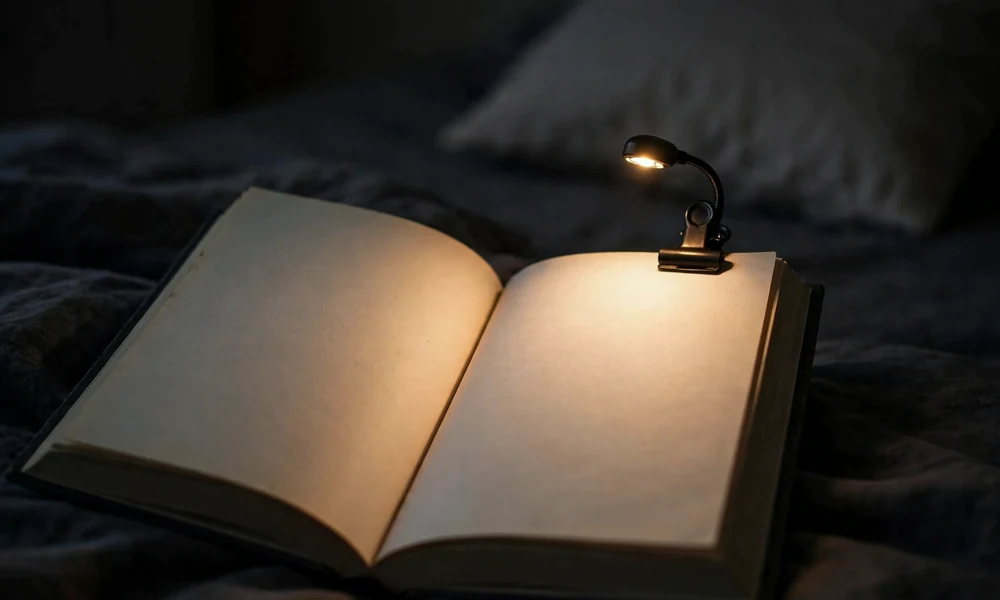
Clip-on reading lights are the classic choice for readers in bed. They clip straight onto the book, they are small, light and cheap, and they are the best choice for most people, because they travel well and they light only the page. The trade-off is the coverage: a clip-on light suits one book at a time, and it will not light a whole desk. For most bedtime readers, a clip-on reading light is the one to buy.
Neck reading lights are the hands-free option. They hang around the neck with a light on each side, they leave both hands free to hold the book, and they are the best choice for someone who reads for a long time without wanting to hold anything up. They suit a thick book or a long evening, and they are the most comfortable option for a reader who shifts position. The downside is the look: a neck light is not elegant, and the two beams can feel uneven. For a reader who wants both hands free, a neck light is the one that works.
Desk reading lights are the steady option for a reading chair or a desk. They stand on a flat surface, they have a heavier base and a longer arm, and they are the best choice for someone who reads at the same spot every day. The trade-off is the size: a desk light does not travel, and it needs a surface to stand on. For a reader with a favourite chair, a desk light is the one to buy.
Floor reading lights are the generous option for a whole corner. They stand on the floor beside an armchair, they light the chair and the book together, and they are the best choice for someone who reads in a living room and wants the light to feel like part of the room. The downside is the footprint: a floor light takes up floor space, and it costs more than a clip-on. For a dedicated reading corner, a floor light is the one that matters.
Wall-mounted and headlamp reading lights are the specialist options. A wall light sits above the bed and lights the page from behind the reader, while a headlamp straps to the head and follows the eyes wherever they look. They suit a reader who has tried everything else, and they are the most precise options of all. The trade-off is the commitment: a wall light needs fitting, and a headlamp suits a tent better than a bedroom. For most people these are second lights, not first ones, but for the right reader they are the ones that finally work.

How to Choose the Right Reading Light
Start with where you read, not with the light. A reader in bed needs a small light that stays off a partner, while a reader in an armchair needs a light that covers the whole book, and a reader who travels needs a light that fits in a bag. A light that does not match the place will not be used, however good it is. Match the light to the place, and the light will be used every night.
Then check the practical details. Check the brightness steps: the light should go dim enough for a dark room and bright enough for small print. Check the battery or the cable: a rechargeable light should last a whole evening, and a plug-in light should have a cable long enough to reach the socket. Check the colour: warm white suits tired eyes better than cold white, and a light that can change colour is worth having. And check the weight: a clip-on light should not drag the book down, and a neck light should not ache after an hour. A light that fails any of these tests will be a daily annoyance.
The Best Reading Lights of 2026
The best clip-on reading light for most people this year is a small, warm light with three brightness steps, a flexible neck, and a clip that grips without marking the pages. It fits in a pocket, it runs for hours on a charge, and it is the light for a bedtime reader. It is the reading light for most people, it is the one that never wakes a partner, and it is the one that is still working after a year of nightly use. For most people, this is the light to buy.
The best neck reading light of 2026 is a light, balanced neck light with a warm beam on each side and a battery that lasts the whole evening. It suits someone who reads thick books, it is the light for a long evening, and it is the one that leaves both hands free. It looks plain, but the comfort is worth it. For someone who reads for hours without stopping, this is the light that works.
The best desk reading light is a steady light with a heavy base, a long adjustable arm, and a warm, even beam that covers both pages. It costs more than a clip-on, but the light is better. It is the light for a favourite chair, it is the one that makes small print easy, and it is the one that stays put all evening. For someone who reads at the same spot every day, this is the light to buy.
The best budget reading light of 2026 is a simple clip-on light, at a price that is less than a paperback. It is warm, it is easy to use, and it is genuinely useful. It will not have three brightness steps or a long battery, and it will not light a whole desk, but for a first reading light, or for a reader who only reads in bed, it is all that is needed. Cheap does not have to mean useless, and this light proves it.

What Else You Need
A reading light works best with a little help. A good reading lamp beside the bed will give a softer light for the room when the book is put down, and a book light that clips to the cover is the most portable option for travel. And a desk lamp on the study desk will light the whole workspace when reading turns into writing. The reading light is the light for the page; the lamp, the book light and the desk lamp are what make the whole evening comfortable.
Common Mistakes to Avoid
The biggest mistake is buying a reading light that is too bright. A light that is too bright hurts tired eyes, and a light that hurts is a light that gets switched off. Choose a light with a dim setting, and start low, turning it up only as far as the page needs. The second mistake is buying a cold white light for the bedroom: cold light feels harsh at night, and warm light is kinder to eyes that have been reading all day. The third mistake is buying a light with a short battery: a light that dies halfway through a chapter is a light that breaks the habit.
Another common mistake is choosing a light for its looks rather than its beam. A pretty light that leaves half the page in shadow is a useless light, however nice it looks. Choose the light for its beam first, and let the looks follow. And do not forget the partner: a light that shines into the other side of the bed will not be welcome, so aim the beam at the page before buying, and buy a light that keeps the light where it belongs.
How Reading Lights Fit a Better Evening
A reading light is the simplest way to make an evening better. It gives the reader a pool of warm light, it stops the strain that comes from reading in the dark, and it does it without anyone thinking about it. An evening with a good reading light is an evening where the book is the only thing that matters, and an evening where the book matters is an evening that gets repeated. The light is not exciting, but it is essential, and a good one is the kind of thing that is only noticed when it is missing.
The habit also pairs naturally with a little routine. A quick charge after each evening, a wipe of the lens once a week, and a check of the clip once a month will keep the light working and the page bright. It is a small amount of work for a large amount of comfort, and it is the kind of routine that, once started, is hard to give up.
The Verdict
The best reading light of 2026 is the one that matches the reader. For most people that means a small clip-on light with a warm beam and three brightness steps. For someone who reads for hours, a neck light is the better choice. For someone who reads in a favourite chair, a desk or floor light is the one that matters. Whatever the choice, check the warmth first, check the beam, and test the brightness before the light is used every night. A light chosen this way will not just sit beside the bed; it will make the book easier to read, the evening more comfortable, and the habit one that lasts. And that is worth more than any light on a shelf.


