Why Rice Bowls Make Every Meal Feel Complete in 2026
The best rice bowls of 2026 make a simple bowl of rice feel like a proper meal. A good rice bowl is wide enough for toppings, shallow enough that every spoonful is easy to reach, and steady enough to hold in one hand. A bad one is too deep, too small, or too slippery. This guide explains what makes a rice bowl genuinely good, and how to choose the ones you will reach for every day.
Rice carries curries, stir-fries, grilled fish, roasted vegetables, eggs, and beans, yet the bowl it is served in is often an afterthought. That is a mistake: the bowl decides whether the rice stays warm, whether the toppings sit where you put them, and whether the last spoonful is as good as the first.
Key Takeaways
- Wide and shallow beats deep and narrow: a rice bowl should spread the rice out, not pile it up.
- Size matters most: 500 to 600 millilitres suits most adults, 350 to 400 suits children and light meals.
- Stoneware and porcelain are the best everyday materials: stoneware is heavier and more forgiving, porcelain resists staining better.
- A rice bowl is neither a soup bowl nor a noodle bowl: it is built for food eaten from a wide surface, not broth you sip.
- Check dishwasher and microwave safety, a foot ring that drains, and a glaze that survives turmeric and soy sauce.
What a Rice Bowl Actually Is
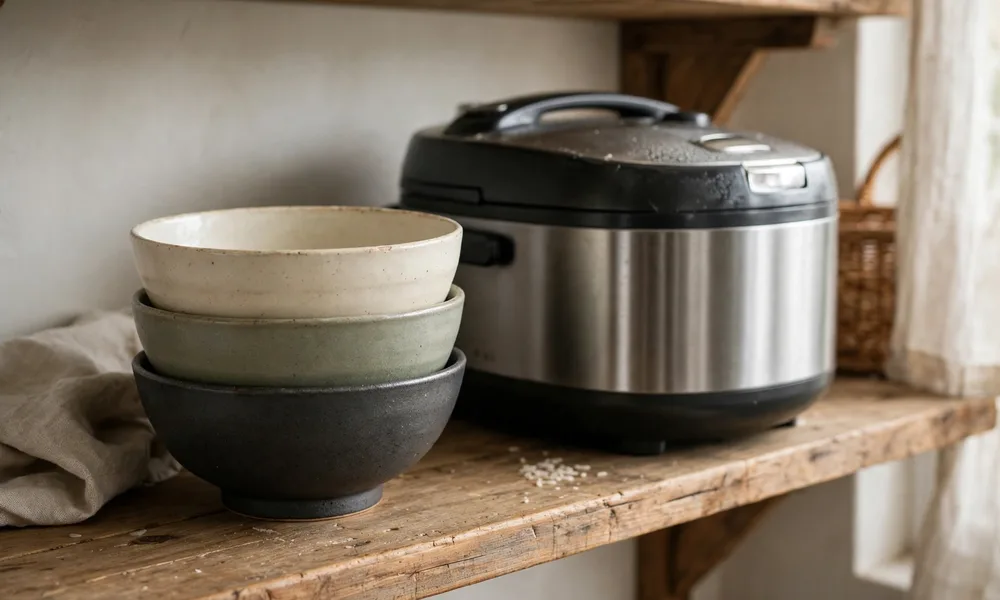
A rice bowl is a wide, shallow bowl made for serving rice as the base of a meal, with toppings arranged on top. The classic shape comes from Japan, where the donburi holds rice topped with meat, fish, or vegetables, and from China, where a similar bowl serves rice alongside shared dishes. In both traditions it is a personal dish: one person, one bowl, one complete meal. That sets it apart from a serving bowl, which feeds the whole table, and from a cereal bowl, made for cold milk and flakes.
The shape is the whole point. Rice spreads, so it needs surface area, not depth. A wide bowl lets a serving sit in a layer roughly two fingers deep, cooling just enough to eat while staying warm in the middle. A deep bowl does the opposite: the rice piles up, the bottom stays scalding, the top goes cold, and the toppings slide into a heap. A good bowl also fits the hand, at roughly 300 to 450 grams empty, with a smooth rim and a flat base.
Size: How Big Should a Rice Bowl Be?
Size is the first decision, and the one most people get wrong. A bowl that is too small forces you to pile rice above the rim, where it cools fast and spills. A bowl that is too large makes a normal serving look lost, and the rice spreads so thin it goes cold. The right size leaves about two fingers of space between the food and the rim: enough room to mix, and enough to carry the bowl without spilling.
For most adults, 500 to 600 millilitres is the sweet spot, fitting a generous serving of rice, roughly 200 to 250 grams cooked, plus toppings. Children and light eaters do well with 350 to 400 millilitres, and 700 suits a very hungry eater. Anything above 800 stops being a personal bowl. Diameter matters as much as volume: a good rice bowl is roughly 15 to 18 centimetres across and 6 to 8 deep, about twice as wide as it is deep.
Shape: Why Wide and Shallow Wins
Shape decides how the meal eats, and for rice the answer is clear: wide and shallow. A wide surface lets steam escape evenly, so the rice cools to eating temperature in a minute or two. It keeps toppings where you put them, so sliced meat, a fried egg, pickles, and herbs sit on top like a picture. In a deep bowl the same toppings slide into the middle and the meal becomes a jumble.
A wide bowl is also easier to eat from with chopsticks, which pick best from a flat surface, and easier to wash, since a shallow curve with no sharp corners lets a sponge reach everywhere. One exception: a slightly deeper bowl, around 8 to 9 centimetres, suits saucy dishes such as curry rice. But even then the bowl should still be wider than it is deep.
The Five Rice Bowl Materials That Matter
Material decides how the bowl feels, how it holds heat, and how it survives daily use.
1. Stoneware
Stoneware is the most popular rice bowl material, and the easiest to live with. Thick, heavy, and slightly rustic, it holds heat well and feels substantial. Its glaze hides small chips better than plain white porcelain. It is usually dishwasher and microwave safe, though cheap pieces can craze after years of use. Good stoneware costs roughly 8 to 20 dollars a bowl.
2. Porcelain
Porcelain is the lightest and most refined option. Fired at a very high temperature, it is dense, hard, and resistant to chipping, and its smooth glaze resists staining better than any other material. Turmeric, soy sauce, and curry wipe off with barely a rinse. Expect roughly 12 to 30 dollars a bowl.
3. Ceramic and Earthenware
Glazed ceramic and earthenware are the handmade end of the market: bowls thrown on a wheel, glazed by hand, each slightly different. They make a weeknight meal feel special, but they are the most variable, and thin earthenware can chip if knocked against a tap.
4. Melamine
Melamine is the practical choice for families with small children, for outdoor eating, and for anyone who has broken one bowl too many. It is light, unbreakable, and cheap, at roughly 3 to 8 dollars a bowl. But it cannot go in the microwave, it can stain, and it does not hold heat like stoneware.
5. Wood and Lacquer
Wooden and lacquered bowls are the traditional choice in Japan, where a lacquered bowl holds rice for a formal meal. They are light, warm to hold, and beautiful, but they need hand washing and good lacquerware is expensive.
| Material | Heat retention | Weight | Stain resistance | Dishwasher safe | Typical price |
|---|---|---|---|---|---|
| Stoneware | Very good | Heavy | Good | Usually | $8–$20 |
| Porcelain | Good | Light | Excellent | Yes | $12–$30 |
| Ceramic / earthenware | Good | Medium | Fair | Check label | $10–$35 |
| Melamine | Fair | Very light | Fair | Yes | $3–$8 |
| Wood / lacquer | Fair | Light | Poor | No | $15–$60 |
The Details That Decide Daily Use
A bowl can be the right size, shape, and material and still end up at the back of the cupboard. The first detail is the foot ring, the unglazed ring on the base. A good one lifts the bowl slightly so it sits flat, and lets air circulate so the base dries. Too narrow and the bowl is tippy; too wide and it traps water in the dishwasher. Run a finger around the base before you buy: it should feel smooth, not sharp.
The second detail is the rim: a smooth, slightly rolled rim is comfortable to hold and resists chipping better than a thin, sharp edge. The third is the glaze. A thick, well-fired glaze stops turmeric, soy sauce, and curry from staining, and keeps a white bowl white after a year of use. Hold the bowl up to the light: the glaze should look even, with no dull patches. The fourth detail is stacking: bowls that nest neatly take up less space.
Our guide to soup bowls that hold the heat makes a similar point about weight and balance: the bowl you can lift comfortably with one hand is the bowl you will reach for every day. Good chopsticks matter as much as the bowl, and our guide to noodle bowls that keep broth hot to the last slurp covers the deep-bowl side of the same table.
Rice Bowls vs Noodle Bowls: The Sibling Distinction
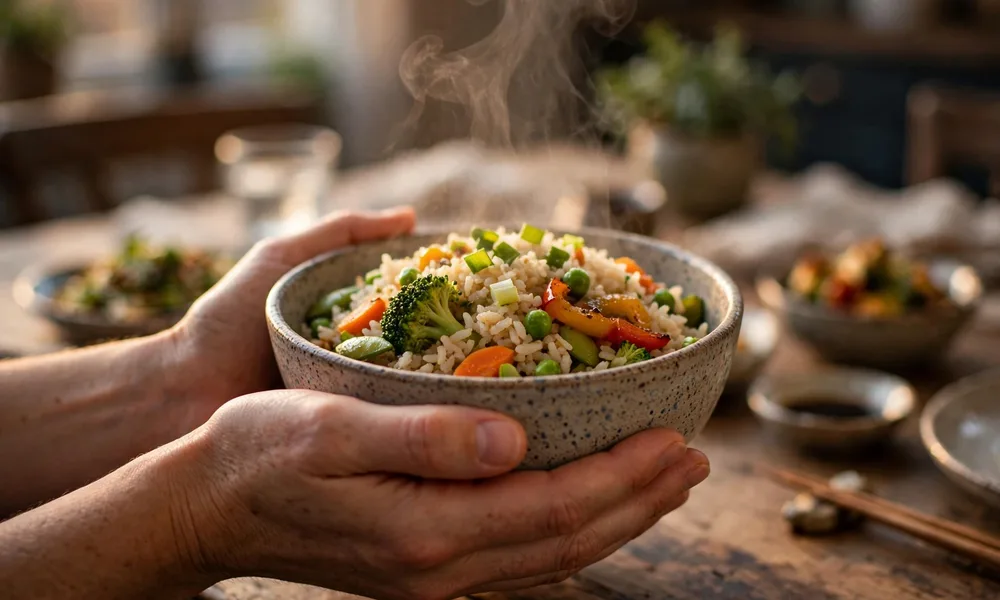
Rice bowls and noodle bowls look like cousins, but they are built for different meals. A rice bowl is wide and shallow, made for food that sits on a surface: rice with toppings arranged on top, eaten from an open, flat layer. A noodle bowl is deep and tall, made for food that floats in liquid: noodles in broth, where the depth keeps the broth hot and leaves space for a chopstick rest on the rim.
The numbers show it. A rice bowl is about twice as wide as it is deep, roughly 15 to 18 centimetres across and 6 to 8 deep. A noodle bowl is closer to as deep as it is wide, often 14 to 16 across and 9 to 12 deep, holding 800 to 1,000 millilitres. Put rice in a noodle bowl and the toppings sink; put noodles in a rice bowl and the broth cools in minutes. Each bowl is right for its own meal and wrong for the other.
How to Choose: A Checklist
- Measure first: 15 to 18 centimetres across, 6 to 8 deep, and 500 to 600 millilitres before you buy.
- Choose the material for your routine: stoneware for everyday use, porcelain if staining worries you, melamine only as a second set.
- Hold it: substantial at 300 to 450 grams, warm rather than hot, and comfortable to lift with one hand.
- Check the rim and base: a smooth rolled rim resists chipping, and a flat foot ring keeps the bowl steady.
- Confirm dishwasher and microwave safety on the label, not the listing, and a glaze that resists turmeric, soy sauce, and tomato.
- Buy four or six matching bowls: they stack neatly and are easier to replace one at a time.
Frequently Asked Questions
What size rice bowl should I buy?
For most adults, 500 to 600 millilitres, roughly 15 to 18 centimetres across and 6 to 8 deep. Children do well with 350 to 400. Under 300 means a second helping; over 800 is a serving bowl.
Are rice bowls and soup bowls the same thing?
No. A rice bowl is wide and shallow, built for rice with toppings on a flat surface. A soup bowl is deeper with a narrower opening, built to keep liquid hot. Rice in a soup bowl piles up; soup in a rice bowl spreads thin and cools fast.
What is the best material for a rice bowl?
Stoneware is the best all-round choice: heavy, durable, good at holding heat, and forgiving of small chips. Porcelain is better if staining worries you. Melamine suits children and outdoor meals.
Can rice bowls go in the dishwasher and microwave?
Most stoneware and porcelain rice bowls can, but check the label on the actual bowl rather than trusting the listing. Handmade ceramic, wood, and lacquer should be hand washed, and melamine must never go in the microwave.
How many rice bowls should I buy?
A set of four suits most households, and a set of six suits families and anyone who hosts. Matching bowls stack neatly, take up less space, and are easier to replace one at a time than a mixed set.
Do I need separate bowls for rice and noodles?
Yes, if you eat both regularly. Rice needs a wide, shallow bowl so toppings stay visible. Noodles need a deep bowl so the broth stays hot. One bowl cannot do both jobs well.
The Bottom Line
The best rice bowls of 2026 are wide, shallow, and steady: 500 to 600 millilitres, 15 to 18 centimetres across, in stoneware or porcelain, with a smooth rim and a flat foot ring. That combination makes every meal feel complete: the rice stays warm, the toppings stay where you put them, and the bowl feels good in your hand from the first spoonful to the last. Buy a matching set of four or six, and keep a pair of deep noodle bowls alongside them for broth nights.