A large home changes everything about choosing a robot vacuum. In a one-bedroom flat, almost any machine can finish the job on a single charge, and a missed corner is a small thing. In a house with several bedrooms, a long hallway and a big open-plan living area, the same machine will run out of battery halfway through, forget where it has been, and leave whole rooms untouched. The best robot vacuums for large homes are built for exactly this problem.
Large homes usually mean more floor types under one roof, more furniture to navigate around, and more dust and hair to collect. The right machine maps your home, lets you set different rules for each room, and returns to its dock to recharge and empty itself before carrying on.
This guide explains what to look for, compares the strongest options for big spaces, and shows you how to set a robot vacuum up so it genuinely keeps a large home clean. The principles are the same in any big house: long runtime, smart navigation, a self-emptying dock, and enough suction for your floors.
Key takeaways
- Look for at least 120 minutes of runtime, or recharge and resume.
- LiDAR mapping is the most useful feature in a large home, because it lets the robot plan efficient routes and clean room by room.
- A self-emptying dock is close to essential above 2,000 square feet, since a standard dustbin fills long before the job is done.
- Match suction and brushes to your dominant floor type, and check it can cross thresholds.
- Multi-floor mapping matters if you have stairs, so the robot can keep a separate map for each level of your home.
What Makes a Robot Vacuum Right for a Large Home
The difference between a robot vacuum that works in a large home and one that only works in a small flat comes down to four things: battery, navigation, capacity and control. A small-home robot can wander in random patterns and hope for the best, but in a large home that wastes battery and leaves gaps.
Battery life is the first filter. Manufacturers often quote runtime measured on hard floors in quiet mode, which is the easiest possible test. Real cleaning on carpet drains the battery much faster, so treat the headline number as a best case.
Navigation is the second filter. LiDAR robots scan the room with a laser, build an accurate map on the first run, and then clean in neat, overlapping rows. Older bump-and-go robots have no map at all, which makes them a poor choice for any home with more than a couple of rooms.
Capacity is the third filter, and it is the one people underestimate most. A robot vacuum with a small dustbin will fill up after one or two rooms in a large home, then either stop or keep running without picking anything up. Finally, control matters: scheduling, no-go zones and virtual boundaries let you choose which rooms to clean and where the robot should never go.
The Best Robot Vacuums for Large Homes 2026
The strongest choices for big spaces share the same DNA: LiDAR mapping, long runtime or recharge and resume, a self-emptying dock, and suction strong enough for carpet. Use the comparison below to narrow the field.
| Pick | Best for | Runtime | Mapping | Self-emptying |
|---|---|---|---|---|
| Best Overall | Most large homes | Up to 180 min | LiDAR | Yes |
| Best for Multi-Floor Homes | Two or more storeys | Up to 150 min | LiDAR, multi-floor | Yes |
| Best for Pet Owners | Homes with pets | Up to 150 min | LiDAR | Yes |
| Best Value | Large homes on a budget | Up to 120 min | LiDAR | Yes |
| Best for Mixed Floors | Hard floors plus carpet | Up to 170 min | LiDAR | Yes |
Best Overall: The Long-Run LiDAR Flagship
The best all-rounder pairs a large battery with precise LiDAR navigation and a self-emptying dock. It maps the whole house on its first run, then cleans in efficient rows. If the battery runs low mid-clean, it returns to the dock, recharges, and resumes exactly where it stopped. It also ranks among the best robot vacuums of 2026.
Best for Multi-Floor Homes: The Multi-Map Specialist
If your home has stairs, a single map is not enough: a multi-floor robot stores a separate map for each level, so it knows where it is without re-mapping. Cliff sensors matter here too: the robot must recognise a stair edge reliably and stop, every single time.
Best for Pet Owners: The Hair and Dander Workhorse
Pets change the maths of cleaning a large home. Hair builds up faster, dander settles into carpet, and a robot that cannot cope with tangled hair will need its brush cleaned after every run. The best pet-focused machines use rubber rollers that resist tangling, strong suction for embedded hair, and a high-efficiency filter to trap dander. If your home has dogs or cats, start with robot vacuums built for pet hair.
Best Value: The Capable Mid-Range All-Rounder
You do not have to buy the most expensive robot to clean a large home well. Mid-range LiDAR models now offer the features that matter most: accurate mapping, room-by-room control, recharge and resume, and a self-emptying dock. That trade-off works if your home is mostly hard floor and you pick up cables before a run.
Best for Mixed Floors: The Vacuum and Mop Combination
Many large homes mix hard floors in the kitchen and hallways with carpet in the bedrooms, and a vacuum-mop combination handles both in one pass. The robot vacuums the carpeted rooms, then mops the hard floors, lifting its mop pad or avoiding carpet when it crosses from one surface to the other. The most useful designs lift the mop pad clear of carpet; simpler ones drag a damp cloth everywhere.
Battery Life and Coverage: The Numbers That Matter
As a rough guide, a robot vacuum covers around 1,000 to 1,500 square feet per hour on hard floors, and less on carpet. A 3,000-square-foot home therefore needs roughly two to three hours of cleaning time, which is beyond the single-charge range of most robots. That is why recharge and resume matters more than the raw battery figure.
Mapping, Room Control and Multi-Floor Cleaning
Good mapping turns a robot vacuum from a novelty into a household tool. After the first mapping run, you can name the rooms, set different suction levels for each one, and schedule the kitchen daily while the guest room gets cleaned weekly. No-go zones keep the robot out of cable-filled rooms or a pet’s feeding area.
Multi-floor mapping extends the same control across storeys, and it is worth checking how many maps a model stores before you buy. The robot should also recognise which floor it is on automatically.

Self-Emptying Docks: Almost Essential at This Size
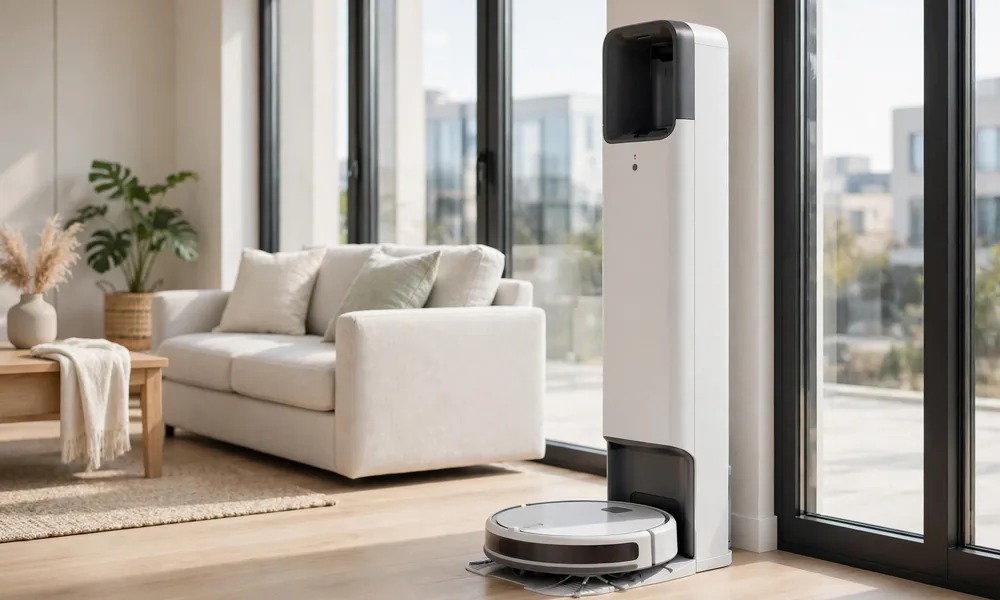
In a large home, the dustbin is the bottleneck. A standard robot dustbin holds around 400 to 500 millilitres, which sounds generous until you see how quickly it fills with dust, hair and carpet fibres across several rooms. Once it is full, suction drops, so a small bin means a poor clean in a big house.
A self-emptying dock solves the problem by transferring the dustbin contents into a sealed bag after every run. Most docks hold 30 to 60 days of debris in sealed bags, an ongoing cost worth paying for a robot that empties itself.
Suction, Brushes and Floor Types
Suction power is measured in Pascals, and the numbers have climbed steadily over recent years. For a large home with mostly hard floors, around 3,000 to 5,000 Pa is plenty. For thick carpet, look for 6,000 Pa or more, and check that the robot automatically boosts suction when it detects carpet. Brush design and airflow matter just as much as raw suction.
Brush rollers deserve attention, especially in homes with long hair or pets. Rubber rollers resist tangles and are easy to clean, while bristle brushes pick up fine dust well but wrap hair around themselves and need regular cutting free. Finally, check threshold climbing: a robot that cannot cross a 2-centimetre door bar will treat each room as a separate island. Homes with extensive wood flooring should also look at robot vacuums for hardwood floors, where soft rollers and gentle suction protect the finish.

How to Set Up a Robot Vacuum in a Large Home
A good setup takes an hour and pays off every day after.
- Do a full mapping run first. Let the robot explore the whole house with the floors clear before its first proper clean, so the map it builds is complete and accurate.
- Place the dock centrally. A dock near the middle of the home shortens the return trip, so the robot wastes less battery travelling to recharge.
- Name every room. Label bedrooms, kitchen, hallway and living areas on the map so you can schedule and target rooms by name.
- Set no-go zones early. Block off cable nests, pet bowls and fragile furniture before the robot gets stuck there.
- Pick up before the first clean. Clear cables, socks, small toys and rug tassels so the robot maps open space rather than obstacles.
- Schedule room by room. Clean high-traffic rooms daily and quiet rooms weekly, so the battery is spent where the dirt actually is.
Common Mistakes to Avoid
The most common mistake is buying on suction alone. A robot with huge suction but no mapping will clean one patch three times and miss the bedroom entirely. The second mistake is ignoring the dustbin: a small bin in a large home means the robot stops cleaning properly halfway through, no matter how good the rest of the machine is.
Another frequent error is placing the dock in a corner or behind furniture. The robot needs a clear approach to dock reliably, and a blocked dock leads to failed returns and unfinished cleans. Finally, do not skip maintenance: empty the dock bag, clean sensors and brushes weekly, and replace the filter on schedule.
Frequently Asked Questions
How long does a robot vacuum take to clean a large home?
Expect two to four hours for a home of 2,500 to 3,500 square feet, including recharge breaks, which a robot with recharge and resume handles automatically.
Can one robot vacuum clean a two-storey house?
Yes, if it supports multi-floor mapping. You carry the robot between floors and it loads the right map for each level. It cannot climb stairs itself, so each floor is cleaned as a separate job.
Do I need a self-emptying dock for a large home?
It is not strictly required, but it is very close to essential. A standard dustbin fills after one or two rooms in a large home, so without a dock you will be emptying the bin several times per clean.
Will a robot vacuum work on thick carpet?
Yes, provided it has strong suction and carpet boost: look for at least 6,000 Pa and a brush roller designed for carpet. Very deep pile carpet is still a challenge for most robots.
How often should a robot vacuum run in a large home?
Daily in high-traffic areas like the kitchen, hallway and living room, and two or three times a week in bedrooms and quiet rooms.
Can a robot vacuum replace a normal vacuum cleaner?
For daily maintenance cleaning, yes. Most homes still benefit from a traditional vacuum every few weeks for stairs, upholstery and deep carpet cleaning.
The Bottom Line
The best robot vacuum for a large home is the one that can cover your whole house without running out of battery, getting lost, or filling its dustbin halfway through. Prioritise LiDAR mapping, a long runtime with recharge and resume, and a self-emptying dock, then match suction and brushes to your floors and pets. Get those four things right, and a robot vacuum stops being a gadget and becomes the easiest way to keep a large home clean every single day.