
Sewing Needles That Glide Through Every Fabric in 2026
Sewing needles that glide through every fabric in 2026 are the cheapest upgrade in your sewing box, and the one that changes your sewing the most. A needle is a sliver of steel with an eye, a point and a groove, and it does the hardest job in the machine: piercing the fabric hundreds of times a minute without snagging, skipping or breaking the thread. When the needle matches the fabric, the stitches lie flat and even, and the seam feels smooth. When it does not, the fabric puckers, the thread shreds, and the needle snaps at the worst moment.
Most sewers use one needle for everything, and then wonder why silk puckers and denim defeats them. Needles are made in different sizes, points and shapes because fabrics behave differently: a fine needle that slips through silk will bend on denim, and a heavy needle will leave holes in lawn cotton. This guide explains the main types, how to match them to fabric, and how to fit and replace them.
Key Takeaways
- A sewing needle must match the fabric: fine, sharp needles for light fabrics, and heavier, stronger needles for thick fabrics.
- Ballpoint needles suit knits and stretch fabrics, while sharp and universal needles suit wovens such as cotton, linen and denim.
- Change a needle after about eight hours of sewing, or sooner if it bends, burrs, or starts skipping stitches.
- Fit the needle with the flat side to the back and push it fully home, because a needle fitted too low or backwards will skip and snap.
- Keep needles sorted by type and size in their packets, and throw away any needle that is bent, blunt or rusty.
What a Sewing Needle Actually Does
A sewing needle carries the top thread through the fabric and back again, hundreds of times a minute. The point pierces the weave, the groove along the shaft shelters the thread as it passes through the cloth, and the eye carries the thread down to meet the bobbin thread below. The scarf, the small cut-out above the eye, gives the hook room to catch the loop of thread and form the stitch. Each part is tiny, and each one matters: a burr on the point snags the weave, a rough eye shreds the thread, and a bent shaft makes the hook miss the loop.
That is why a needle is a consumable, not a tool for life. The point dulls, the eye roughens, and the shaft bends a fraction at a time. Skipped stitches, a clicking sound, thread that frays at the needle, and small pulls in the fabric are all signs of a tired needle. Changing it takes a minute and costs very little.
Needle Sizes Explained
Needle sizes are given in two systems, and both appear on the packet. The European system runs from 60, the finest, to 120, the heaviest. The American system runs from 8 to 19 for the same range. A 60/8 needle is a fine needle for silk and lawn; a 90/14 is the all-rounder for medium cotton and linen; a 110/18 is a heavy needle for denim and canvas. The size is the diameter of the shaft, so a larger number means a thicker needle and a larger hole in the fabric.
A needle that is too fine for the fabric will bend and snap, and the stitches will skip. A needle that is too heavy will punch visible holes, especially in fine fabrics. Use the finest needle that will sew the fabric without bending or skipping: 70/10 or 80/12 for light fabrics, 90/14 for medium fabrics, and 100/16 or 110/18 for heavy fabrics. When in doubt, test on a scrap first.
The Main Types of Sewing Needle
Universal needles are the default in most machines, and they suit most woven fabrics. They have a slightly rounded point that slips between the threads of the weave without cutting them, and a standard eye and groove. A universal needle in size 80/12 or 90/14 will handle cotton, linen, poplin and light denim, and it is the needle to reach for when you are not sure what else to use.
Sharp needles, also called microtex needles, have a very fine, acute point that pierces tightly woven fabrics cleanly. They suit silk, microfibre, lawn and fine cotton, where a universal needle would push the weave aside and pucker the seam. Their limit is that the fine point bends easily on heavy fabric, so keep them for the light work they were made for.
Ballpoint needles have a rounded tip that pushes between the loops of a knit instead of piercing them. That matters, because a sharp point cutting a loop in a knit leaves a hole that runs, and the seam fails. Ballpoint needles suit jersey, interlock, fleece and stretch fabrics of all kinds. Stretch needles are a close cousin, with a special scarf that stops skipped stitches on very stretchy fabrics such as lycra and swimwear.
Jeans needles, also called denim needles, are built for heavy, dense fabrics. They have a reinforced shaft that resists bending, a sharp point that pierces thick layers, and a larger eye that carries heavy thread. They suit denim, canvas, twill and upholstery, and they cope with the thick seams where several layers meet. Leather needles are different again: they have a cutting point, like a tiny chisel, that slices through leather and vinyl instead of pushing through.

Thread the needle with the eye facing the light, and cut the thread end cleanly first.
Sewing Needles Compared
| Needle type | Best for | Usual sizes | Watch out for |
|---|---|---|---|
| Universal | Cotton, linen, light denim | 80/12, 90/14 | Skips on stretch knits |
| Sharp / microtex | Silk, lawn, microfibre | 60/8, 70/10 | Bends on heavy fabric |
| Ballpoint | Jersey, fleece, knits | 80/12, 90/14 | Too blunt for tight wovens |
| Stretch | Lycra, swimwear, very stretchy knits | 75/11, 90/14 | Not needed on stable knits |
| Jeans / denim | Denim, canvas, twill, upholstery | 90/14, 100/16, 110/18 | Leaves holes in fine fabric |
| Leather | Leather, vinyl, suede | 90/14, 100/16 | Cuts woven fabric, never use there |
Fitting a Machine Needle
Fitting a machine needle correctly takes a minute, and getting it wrong causes most needle trouble. Turn the handwheel until the needle bar is at its highest point, and loosen the needle clamp screw. Remove the old needle, noting which way the flat side of the shank faced, usually to the back. Take the new needle and push it up into the clamp as far as it will go, with the flat side facing the same way as the old one. Tighten the screw firmly, but do not force it.
Then check the fit before you sew. Turn the handwheel slowly by hand: the needle should move straight up and down without touching anything. If it clicks or bends, stop: it is fitted too low, backwards, or bent. Sew a few stitches on a scrap of the same fabric. If the machine skips or the thread shreds, check the needle first, before you touch anything else.
Matching Needles to Fabric
Matching a needle to a fabric starts with looking at the fabric. Woven fabrics need a sharp or universal point that slips between the threads. Knitted fabrics need a ballpoint that pushes between the loops without cutting them. Light fabrics need fine needles, heavy fabrics need strong ones, and stretchy fabrics need a stretch or ballpoint needle.
Test on a scrap whenever the fabric is new to you. Sew a short seam, then look at both sides. The stitches should be even, the fabric should lie flat, and there should be no skipped stitches, no puckering, and no holes larger than the thread. If the fabric puckers, try a finer needle. If the stitches skip, try a ballpoint or stretch needle. If the needle bends or snaps, go up a size. A scrap test takes two minutes, and it is cheaper than unpicking a ruined seam.

A jeans needle has a reinforced shaft that resists bending on thick seams.
When to Change a Needle
Change a machine needle after about eight hours of sewing, or at the start of each new project, whichever comes first. That sounds frequent, but a needle is the cheapest part of the machine, and a fresh needle sews better than a worn one in ways you can feel. Change it sooner if it hits a pin, sews over a zip, or strikes the needle plate, because any of those can bend or burr it.
Storing and Looking After Needles
Needles are small, sharp and easy to lose, so storage matters. Keep machine needles in their packets, sorted by type and size, with the packet labelled. Many packets have a slot for each needle, so you can see at a glance what you have. Keep hand needles in a needle case or a pincushion, never loose in a drawer.
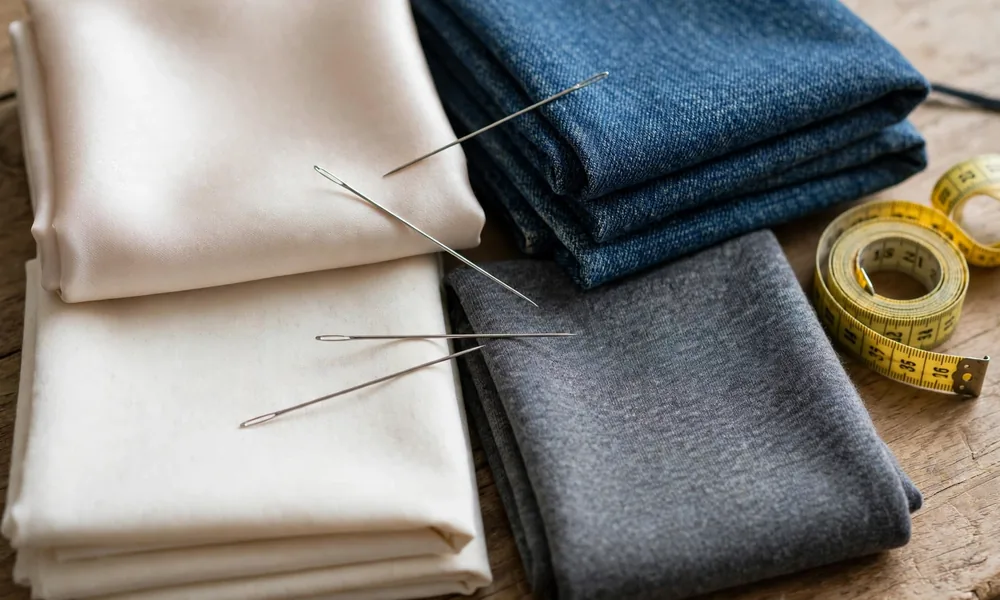
Test a new needle on a scrap of the same fabric before you sew the garment.
Needle Checklist
- Match the needle type to the fabric: sharp or universal for wovens, ballpoint or stretch for knits.
- Use the finest needle that sews the fabric without bending, skipping or snapping.
- Fit the needle with the flat side to the back, pushed fully home, and tighten the clamp firmly.
- Test on a scrap of the same fabric before you sew the garment.
- Change the needle after about eight hours of sewing, or sooner if it bends, burrs or skips.
- Store needles sorted by type and size, and throw away any bent, blunt or rusty needle safely.
Frequently Asked Questions
What size needle should I use for cotton?
A universal needle in size 80/12 suits light cotton, and 90/14 suits medium cotton and linen. Use a sharp 70/10 for very fine cotton such as lawn.
Why does my sewing machine skip stitches?
Skipped stitches usually mean a worn, bent or wrong needle, especially on knits. Fit a fresh needle of the right type, a ballpoint or stretch needle for knits.
Can I use a hand needle in a sewing machine?
No. A machine needle has a shank that clamps into the needle bar, with the eye near the point, while a hand needle has the eye at the opposite end from the point. The two are built differently and are not interchangeable.
How do I know when a needle is worn out?
Change it after about eight hours of sewing, or sooner if it skips, clicks, or frays the thread.
What needle should I use for jersey fabric?
Use a ballpoint needle in 80/12 or 90/14 for most jersey, and a stretch needle in 75/11 or 90/14 for very stretchy jersey or lycra. A sharp needle can cut the loops and leave holes that run.
Why does my needle keep breaking?
A needle breaks when it is too fine for the fabric, fitted too low, or hitting a pin or a zip. Go up a size and refit the needle fully home.
The Bottom Line
The best sewing needles are the ones matched to your fabric: a sharp needle for fine wovens, a universal needle for everyday cotton and linen, a ballpoint or stretch needle for knits, and a jeans needle for denim and canvas. Fit the needle correctly, change it often, and test on a scrap before you commit to the garment. Do that, and the needle will glide through every fabric instead of fighting it. For the rest of the sewing corner, an embroidery hoop that keeps fabric taut is the partner for decorative work. A good sewing kit that covers every quick fix already holds the hand needles for mending, and our guide to sewing machines for beginners puts the needle in the wider picture of the machine.


