Thimbles That Protect Your Fingertips in 2026
Thimbles that protect your fingertips in 2026 are the small caps that sit between your finger and the eye of the needle, and they are the difference between sewing for an hour and stopping after ten minutes with a dented fingertip. A good thimble takes the push of every stitch so your skin does not have to, while a bad one slips, pinches, or feels so awkward that you take it off and go back to a bare finger.
Key Takeaways
- A thimble protects the middle finger of your sewing hand, taking the pressure of pushing the needle through fabric so your fingertip never has to.
- Metal thimbles suit heavy fabrics and quilting, leather thimbles suit long sessions and delicate work, and silicone thimbles suit beginners who want grip without a hard shell.
- Fit matters more than material: a thimble should sit snugly on the middle finger without pinching, and stay put when you shake your hand gently.
- Push with the dimpled end of the thimble, not the side, and let the dimples grip the eye of the needle so it cannot slip and prick you.
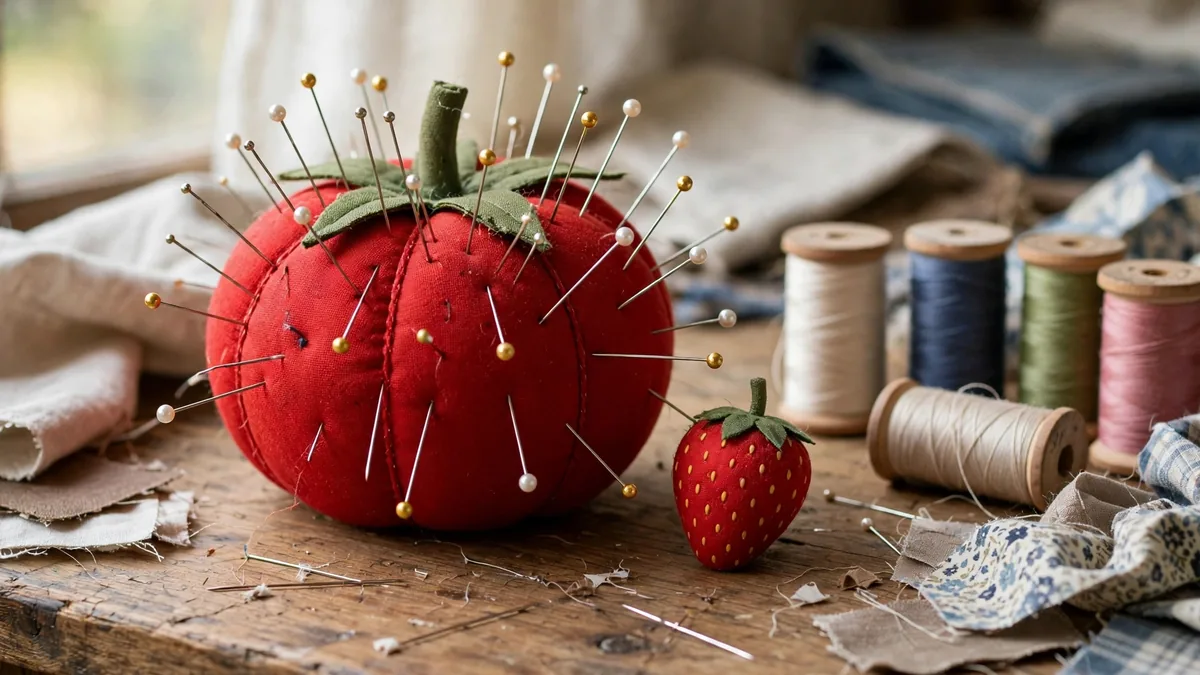
- A thimble is not a pincushion: a thimble guards your finger while you sew, while a pincushion holds your pins between stitches.
What a Thimble Actually Does
A thimble is a small cap, usually worn on the middle finger of the hand that holds the needle, and its job is simple: it gives you a hard surface to push against. When you hand sew, the eye end of the needle presses into your fingertip with every stitch. On light cotton that pressure is nothing, but on denim, canvas, or several layers of quilt, the force needed to drive the needle through is enough to dent the skin, and after a few dozen stitches it hurts. A thimble spreads that force across a hard shell, so the needle pushes against metal or leather instead of flesh.
The dimples on a metal thimble are not decoration. Each little pit catches the eye of the needle and stops it sliding sideways as you push, which is the moment most needle pricks happen. That grip also makes stitching faster: you can push firmly instead of gingerly.
The Main Types of Thimble Compared
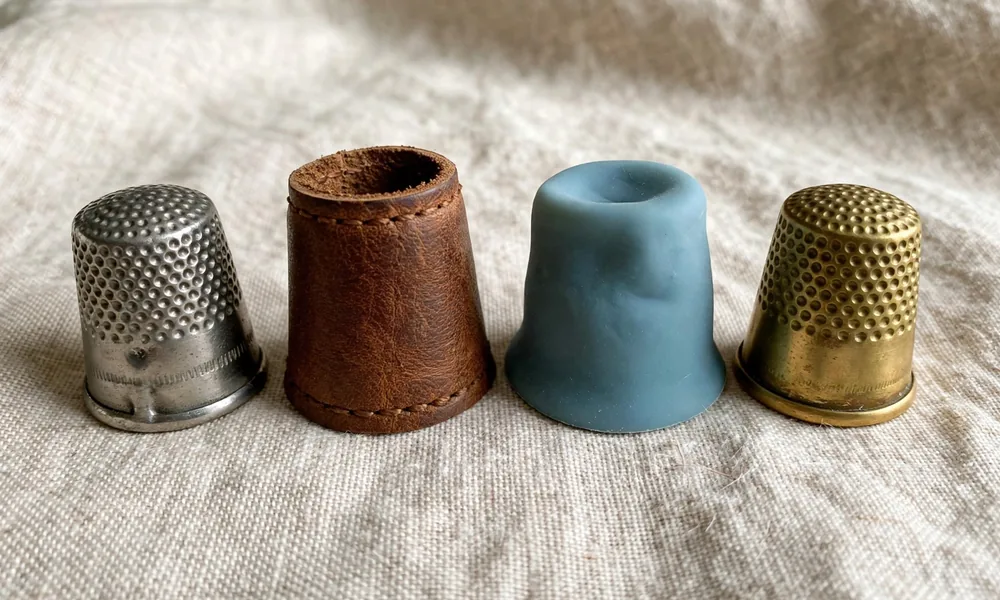
Four types cover almost every hand sewer, and they differ in feel, grip, and the fabrics they suit best.
| Type | Best for | Feel | Drawback |
|---|---|---|---|
| Metal | Quilting, denim, heavy fabrics | Hard, precise, cool | Can feel stiff at first |
| Leather | Long sessions, delicate fabric | Soft, flexible, warm | Wears out and needs replacing |
| Silicone | Beginners, light sewing | Sticky grip, light | Too soft for thick layers |
| Open-top tailor’s | Tailoring, long nails | Open, airy, strong push | Less protection on the fingertip |
Metal Thimbles
The metal thimble is the classic, and for most sewers it is still the best all-rounder. Usually made of nickel-plated steel, brass, or stainless steel, with rows of small dimples pressed into the closed end, it takes the full force of the push without flexing, so it suits the hardest jobs: denim hems, three layers of quilt, or canvas. A good metal thimble lasts for years, which is why the thimble in many family sewing boxes is decades old and still working. The trade-off is that metal feels hard at first and does not breathe, so on a warm day your finger can get damp inside it.
Leather Thimbles
A leather thimble is a pad of thick leather that wraps around the fingertip, usually held in place by an elastic band. It is softer and warmer than metal, and it flexes with your finger, so it feels natural much sooner. Many quilters and embroiderers prefer leather for long sessions, because it does not make the finger sweat and it gives a gentler, more sensitive feel for the needle. The drawback is wear: leather thimbles eventually soften, stretch, and develop a hole where the needle presses, and then they need replacing.
Silicone and Rubber Thimbles
Silicone thimbles are soft, slightly sticky caps that grip both the finger and the needle. They are light, cheap, and very forgiving, which makes them a good first thimble for a beginner who is still learning to sew with one on. The sticky surface holds the needle firmly, and because they are soft they never pinch. Their weakness is strength: on thick fabric a silicone thimble can flex and let the needle press through to the finger, so they are best for light and medium fabrics and for short sessions.
Open-Top Tailor’s Thimbles
A tailor’s thimble is open at the top, with a band of dimpled metal around the side of the finger. Tailors wear them because the open top lets the fingertip breathe and leaves long nails untouched, while the side of the finger does the pushing instead of the tip. It is a different technique, and it takes practice to learn. For most home sewers a closed thimble is simpler, but if you do a lot of tailoring, or if you wear long nails, an open-top thimble is worth trying.
How to Find Your Size
Measure the middle finger of your sewing hand, not your ring finger and not the finger of your other hand. Wrap a tape measure around the middle finger just below the nail. Most thimbles run from about 14 to 20 millimetres across, and the size on the packet is the inside diameter. If you are between sizes, choose the smaller one for metal, because a metal thimble that is slightly tight will settle, while one that is loose will spin and slip off. For leather, choose the larger size, because leather shrinks slightly as it dries.
The shake test is the real check. Put the thimble on, hold your hand out, and shake it gently: it should stay put. Then bend the finger, and the rim should not dig into the skin at the joint. Then press the dimpled end against a table: it should feel solid, with no wobble. If it passes all three, it fits.
Thimbles for Different Kinds of Sewing
The best thimble depends on the sewing you actually do, and buying for the wrong job is the most common reason a thimble ends up unused.
Hand Quilting
Quilting is the hardest work a thimble does. The needle has to pass through the top fabric, the wadding, and the backing, and the quilter repeats that push hundreds of times in a session. A metal thimble is the usual choice, because only metal gives a firm enough surface for that repeated force, and the dimples keep the needle from slipping on the long push.
Embroidery and Delicate Work
Embroidery needs a light touch, and the thimble should not get in the way of feeling the fabric. A leather thimble suits this work best, because it is soft, it lets you feel the needle, and it will not mark delicate cloth. It is a good compromise when the fabric is slightly heavier or the session is long.
Hems, Repairs, and Heavy Fabric
Repair work is where most people first reach for a thimble, usually halfway through a denim hem when the fingertip starts to ache. A metal thimble is the right answer here: denim, canvas, and coat fabric all need real force. For repairs, the thimble is often part of a kit, and our guide to sewing kits that cover every quick fix shows what else belongs in that drawer. Machine sewers need one too, for hand finishing such as slip-stitching a lining or sewing on a button.
What Makes a Good Thimble, and What to Avoid
A good thimble has deep, even dimples across the whole of the closed end, a smooth rim with no sharp edge, and a weight that feels solid without being heavy. The dimples should be deep enough to catch the needle eye; shallow, decorative dimples are the first sign of a cheap thimble. The worst thimbles are the ones that look right and fail in use: dimples only on the very tip, a rough rim, or thin soft metal that bends under pressure. The free thimble in a cheap sewing kit is often the weakest item in the box.
How to Use a Thimble Properly
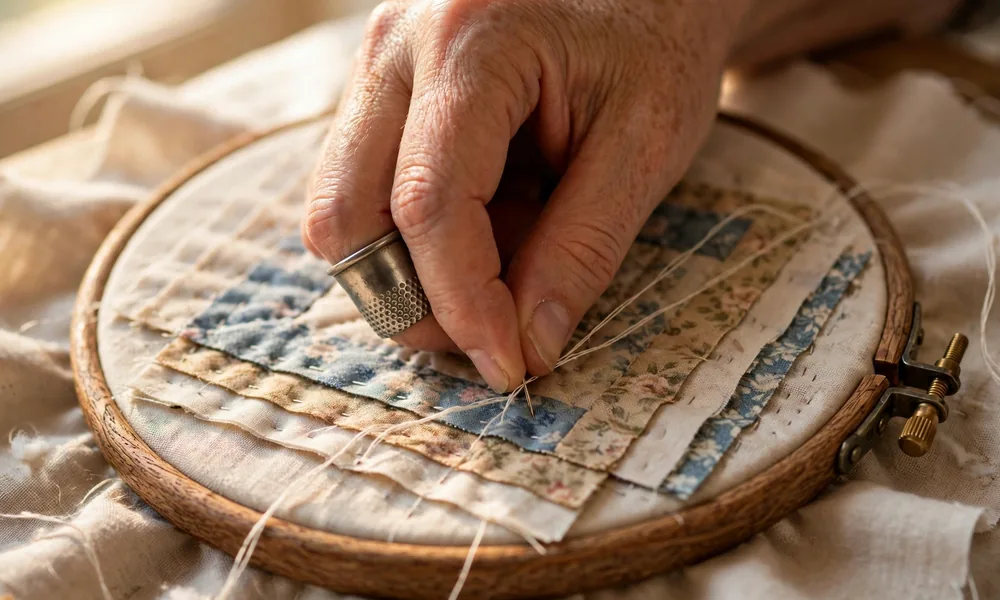
Wear the thimble on the middle finger of the hand that holds the needle. The needle sits between thumb and forefinger, and the middle finger, with the thimble on it, pushes the eye end of the needle through the fabric. It feels strange for the first few minutes, and most beginners give up too soon. Wear it for a whole short project, not just a few stitches, and the habit forms. Push with the dimpled end, not the side, and keep the push straight, in line with the needle. If the needle will not go through, stop and check: the needle may be blunt, or the fabric too thick for that needle, and our guide to sewing needles that glide through every fabric explains how to match the needle to the cloth. When a stitch needs undoing, take the thimble off first and use a proper tool for the job, and keep your pins close at hand with our guide to pincushions that keep pins within reach.
Buying Checklist
- Measure the middle finger of your sewing hand and buy to that measurement, not to a guess.
- Check the dimples are deep and even across the whole closed end, not just the tip.
- Run a finger around the rim and reject any thimble with a sharp or rough edge.
- Do the shake test, the bend test, and the table-press test before you keep it.
- Match the material to your sewing: metal for quilting and heavy fabric, leather for long delicate sessions, silicone for starting out.
- Buy a spare in the same size, because a thimble is small and easy to lose mid-project.
Frequently Asked Questions
Which finger do you wear a thimble on?
On the middle finger of the hand that holds the needle, which is the right hand for most people. The middle finger does the pushing, and the thimble is shaped to sit on it. Left-handed sewers wear it on the middle finger of the left hand.
Do I really need a thimble for light sewing?
Not always. On a single layer of light cotton, a sharp needle goes through with very little force, and many sewers manage without one. The thimble earns its place as soon as the fabric gets thick or the session gets long.
Are leather thimbles as good as metal ones?
For delicate work and long sessions, yes, and some sewers prefer them. For heavy fabric and quilting, no: leather flexes under hard pressure, and metal does not. Many sewers keep both and reach for whichever suits the project.
How do I stop a thimble slipping off?
First check the size, because a thimble that slips is usually too big. If the size is right but it still moves, a thin strip of adhesive tape inside the thimble will hold it. Damp fingers also make metal thimbles slip, so dry your hands before you start.
Can children use thimbles?
Yes, and they should, because children push needles with more force than they need and prick themselves more often. Buy a child-sized thimble, in silicone or leather for comfort, and let them practise on light fabric first.
How long does a thimble last?
A metal thimble lasts for years, often decades, and only needs replacing if it bends or the dimples wear smooth. A leather thimble lasts months to a few years, and needs replacing when the leather thins or a hole appears.
The Bottom Line
The best thimble is the one that fits your middle finger, has deep dimples and a smooth rim, and suits the sewing you actually do: metal for quilting and heavy fabric, leather for long delicate sessions, silicone for starting out. Measure your finger, try the shake test, and give it a whole project before you judge it.