
Best Shower Curtain Rings 2026
A shower curtain is only as good as the rings that hold it up. Rings that stick, squeak, or rust turn a simple morning shower into a small daily annoyance, and a curtain that bunches at one end of the rod leaves the floor wet no matter how good the curtain itself is.
Get the rings right, though, and the curtain glides open and closed with one hand, hangs straight, and stays quiet. These are the best shower curtain rings of 2026, chosen for smooth gliding, rust resistance, grip, and how well they suit different rods and curtains.
Key Takeaways
- Match the ring to your rod first, because a ring made for a thin rod will rattle on a thick one, and a ring made for a thick rod will bind on a thin one.
- Metal rings glide best and last longest, while plastic rings are the quietest and cheapest way to fix a sticking curtain.
- Roller rings are worth the extra cost if you open and close the curtain every day, since the small wheels do the work your fingers used to do.
- Count the eyelets on your curtain before you shop, because most curtains need twelve rings and a short set leaves a gap at one end.
- Rinse the rings when you clean the curtain, since soap scum and hard water are what make smooth rings start to stick.
Shower Curtain Rings 2026 at a Glance
| Best for | Ring type | Material | Standout strength |
|---|---|---|---|
| Best overall | Double roller rings | Stainless steel | Glides with one finger, never rusts |
| Best budget | Simple open rings | Plastic | Cheap, silent, and easy to fit |
| Best for heavy curtains | Closed metal rings | Brass | Strong enough for lined fabric |
| Best for style | Decorative ball rings | Metal | Looks like jewellery for the bathroom |
| Best for renters | Clip-on hooks | Metal and plastic | Fit any curtain without eyelets |
| Best for quiet mornings | Roller rings | Metal with nylon wheels | Almost silent on a metal rod |
What Shower Curtain Rings Are Really For
A shower curtain ring does two jobs at once. First, it carries the weight of the curtain and spreads it evenly along the rod, so the fabric hangs straight instead of sagging between a few overloaded points. Second, it lets the curtain slide, so you can open it with one hand while you are already wet and in a hurry.
Most people only notice their rings when they fail. A ring that catches on the rod makes you tug the curtain, and tugging pulls the rod out of its brackets over time. A ring that rusts stains the top of the curtain, and a ring that snaps drops one whole section of fabric onto the floor of the bath.
It helps to think of the rings, the rod, and the curtain as one set. The curtain itself matters too, and our guide to the best shower curtains of 2026 covers fabrics, liners, and lengths in detail. The rings are the small part of that set that decides whether the curtain moves the way it should.
The Main Types of Shower Curtain Ring
Shower curtain rings fall into a handful of types, and each suits a different kind of bathroom. The right choice depends less on taste than on how heavy your curtain is, how thick your rod is, and how often you open and close it.
The simple open ring is the classic: a C-shaped loop of metal or plastic that hooks over the rod and through the curtain eyelet. It is cheap, it fits almost any rod, and you can replace a single broken ring in seconds. Its weakness is that it can work its way off the rod if the curtain is pulled hard, and cheap plastic ones go brittle after a year or two of hot steam.
The closed ring is a full circle that cannot slip off the rod. You fit it by taking the rod down or by opening a small gate in the ring, depending on the design. Closed rings are the safest choice for a household with children, because no amount of tugging pulls them off, and they suit heavy lined curtains that would drag an open ring sideways.
Roller rings carry a small wheel, or a pair of wheels, that runs along the top of the rod. They are the smoothest rings you can buy, and they make a real difference on a long rod where a plain ring has to slide a long way. They cost more than simple rings, and the wheels can collect soap scum, so they need an occasional wipe.

Double roller rings add a second wheel, one on each side of the rod, which stops the ring tipping forward under the weight of a heavy curtain. They are the best choice for thick fabric curtains and for curved rods, where a single-wheel ring can jam at the bend. They are also the most expensive type, so they make most sense in a bathroom you use every day.
Materials and Rust Resistance
Stainless steel is the safest material for shower curtain rings, and it earns its price. It does not rust in a steamy bathroom, it is strong enough for the heaviest lined curtain, and it keeps its shine with a quick wipe. Look for solid stainless steel rather than steel with a thin chrome coating, because once the coating chips, the steel underneath rusts fast.

Plastic rings are the budget choice, and they have real advantages: they never rust, they are silent on a metal rod, and they cost so little that replacing the whole set every year is still cheap. Their weakness is strength. A plastic ring holding a heavy fabric curtain can stretch and snap, usually at the opening, so keep them for light curtains and liners.
Getting the Fit Right
Fit is where most shower curtain ring purchases go wrong. Measure the diameter of your rod before you shop: most rods are between 19 and 25 millimetres across, and a ring made for a 25-millimetre rod will wobble and rattle on a 19-millimetre one. A ring made for a thin rod will not close around a thick one at all.
Count the eyelets on your curtain next. Most standard curtains have twelve eyelets, and most ring sets are sold in packs of twelve for exactly that reason. A set of ten leaves a gap at one end where the curtain sags, and a set of fourteen leaves two spares in the drawer, which is no bad thing when one ring eventually breaks.
Check the eyelet size too. A ring with a thick hook will not pass through a small eyelet, and a thin hook rattles in a large one. If your curtain has large brass eyelets, a chunky ring suits it; if it has small plastic eyelets, a slim ring is the better fit. The ring should pass through the eyelet easily but not loosely.
Rust, Soap Scum, and Cleaning
Rust starts where water sits, and on a shower curtain ring that means the inside of the curve and the joint where the ring opens. Wipe the rings when you wipe the rod, and leave the curtain open after a shower so air can dry the rings instead of trapping steam behind bunched fabric.
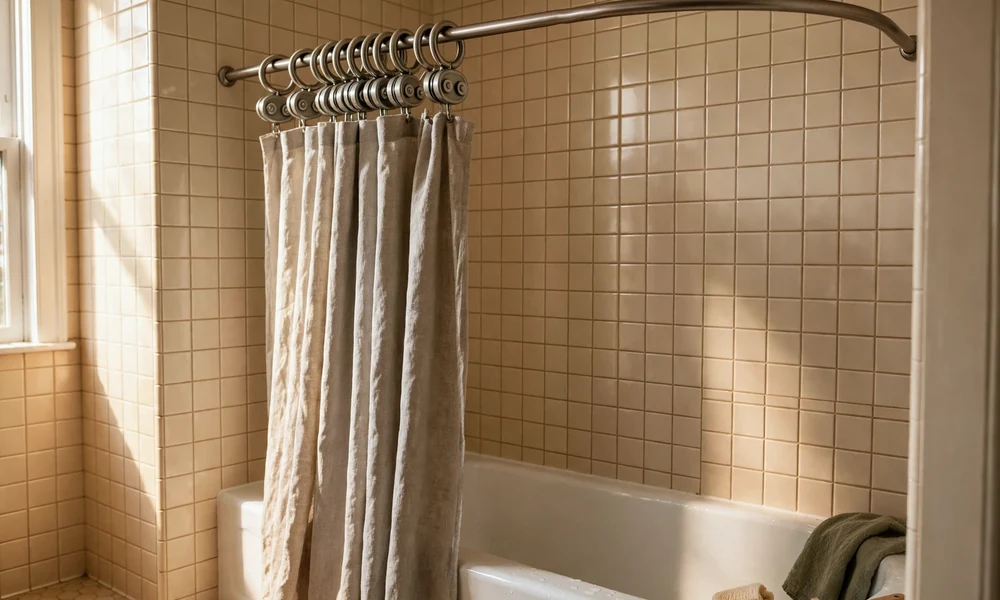
Soap scum is the other enemy, and it is the one that makes good rings feel bad. A thin film of soap builds up on the rod and inside the ring, and the ring starts to catch. A wipe with white vinegar on a cloth dissolves the film in seconds, and a drop of silicone spray on the rod, wiped to a thin film, keeps the rings gliding for weeks.
Matching the Rings to the Rest of the Shower
Rings should suit the shower they serve, not just the curtain they hold. In a bathroom with a powerful shower, a heavier curtain needs stronger rings, and the shower itself sets the tone: our guide to the best shower heads of 2026 explains how flow and spray change what the curtain has to contain.
Common Mistakes to Avoid
The most common mistake is buying rings before measuring the rod: people remember the curtain size and forget the rod diameter, then discover the rings will not close or rattle all day. The second is buying too few rings, which leaves the curtain sagging at one end. The third is choosing a pretty ring that sticks, because the glide matters more than the finish. The fourth is ignoring rust until it stains the curtain. The fifth is fitting heavy fabric on plastic rings, which stretch and snap. Finally, do not mix old and new rings on the same rod: the old ones drag, the new ones glide, and the curtain ends up bunched where the two meet.
Before You Buy: A Short Checklist
- Measure the rod diameter, and buy rings made for that size.
- Count the curtain eyelets, and buy at least that many rings.
- Check the ring passes through the eyelet easily but not loosely.
- Slide a ring along the rod before you fit the set, and reject it if it catches.
- Choose solid stainless steel or solid brass if rust worries you.
- Match the ring finish to the rod and the taps.
- Keep two spares in the drawer, because one ring always breaks first.
Frequently Asked Questions
How many shower curtain rings do I need? Most standard curtains need twelve rings, one for each eyelet. Count the eyelets on your own curtain rather than guessing, and buy a pack of twelve or fourteen so you have spares.
Do roller rings really glide better? Yes, especially on a long or curved rod, where the small wheels roll instead of dragging. They are the smoothest option, and they make the biggest difference if you open and close the curtain every day.
Will metal rings rust in a steamy bathroom? Solid stainless steel and solid brass resist rust well, but plated rings can rust once the coating chips. Wipe the rings dry when you clean the bathroom, and replace any ring that shows rust rather than cleaning it.
Why does my curtain bunch at one end? Usually because a ring is sticking on the rod, often from soap scum, or because there are too few rings and the fabric sags between them. Clean the rod with vinegar, check every ring glides, and add a ring if there is a gap.
The Bottom Line
The best shower curtain rings of 2026 are the ones that glide smoothly, never rust, and fit your rod and curtain without a fight. For most bathrooms that means solid stainless steel double roller rings in a finish that matches the taps, with a spare or two in the drawer.
Start with the tape measure, not the catalogue. Measure the rod, count the eyelets, and test one ring on the rod before you fit the set. A bathroom is a small room, and its floor tells the story: our guide to the best shower mats of 2026 covers what to put underfoot once the curtain itself is hanging straight and staying put.


