Most dining rooms have the same problem, and it is not a lack of space. It is a lack of somewhere sensible to put things. Tablecloths live in a kitchen drawer and the good plates sit on top of the fridge. Sideboards solve that problem better than any other piece of dining-room furniture. A good sideboard hides the clutter of everyday dining behind closed doors, keeps the pieces you use for hosting within arm’s reach, and gives the room a surface for a lamp, a vase, or a row of glasses before guests arrive.
The case for the sideboard over the buffet is practical. A buffet is a low, long serving piece with a shallow body, built for laying out food. A sideboard is taller and deeper, with proper cupboards and drawers, built for storing things. When the meal is over, the sideboard swallows the table linen and the serving dishes, while the buffet leaves you looking for a cupboard somewhere else. This guide explains what a sideboard really is, how it differs from a buffet and a credenza, how to size one, which woods last, and how to organise the inside.
Key Takeaways
- A sideboard beats a buffet for storage: deeper and taller, with enclosed cupboards and drawers instead of a shallow serving surface.
- Measure first: a sideboard should run about two-thirds of the wall it sits on, and roughly the same length as the dining table.
- Depth matters more than length: forty to fifty centimetres fits dinner plates and serving dishes; anything shallower wastes the footprint.
- Solid wood or good veneer over a stable core lasts decades; thin foil-wrapped board sags and chips within a year or two.
- Organise the inside into zones for everyday use, hosting, and linens, and it stays tidy on its own.
Sideboards 2026 at a Glance
| Pick | Size | Storage | Why it wins |
|---|---|---|---|
| Best overall | 150 cm, oak | Two cupboards, three drawers | Swallows a full dinner service plus linens |
| Best for small dining rooms | 120 cm, walnut veneer | One cupboard, two drawers | Deep enough for plates in a tight room |
| Best for large families | 180 cm, mango wood | Three cupboards, four drawers | Separate zones for everyday, hosting, and games |
| Best for modern homes | 160 cm, matt lacquer | Push-to-open doors, wide drawers | Clean lines, no handles to catch on chairs |
| Best for period homes | 150 cm, mahogany style | Two cupboards, cutlery drawer | Traditional proportions for older rooms |
What a Sideboard Actually Is
A sideboard is a low storage cabinet that stands against the wall of a dining room, usually eighty-five to ninety-five centimetres tall, forty to fifty deep, and one hundred and twenty to two hundred long. It has doors, drawers, or both, and a flat top for serving. The name comes from its position: it stands at the side of the room, ready to hold the things a meal needs. The job is always the same: enclosed, reachable storage for dining.
The confusion with buffets and credenzas is understandable, because the three pieces are cousins. A buffet is lower and longer, often with a raised back, built for serving food rather than storing it, with a shallow body and few drawers. A credenza is lower still, around seventy-five centimetres tall, longer and slimmer, made for offices and living rooms as much as dining rooms. It holds less than a sideboard of the same length because it gives up height. A sideboard sits ahead of both in storage, which is why it is the right choice when the problem is clutter rather than display. A console table is a different piece entirely: narrow, tall, and shallow, made for a hallway, as our guide to Console Tables That Make an Entryway in 2026 explains. In many shops the two words mean the same piece, so judge it by the measurements and check the inside before you fall for the outside.
Why a Sideboard Beats a Buffet for Storage
The advantage starts with depth. A forty-five-centimetre-deep sideboard holds a dinner plate with room to spare, with two rows fitting side by side on a shelf. A shallow buffet at thirty centimetres deep holds one row and nothing behind it, so the same length of furniture stores roughly half as much.
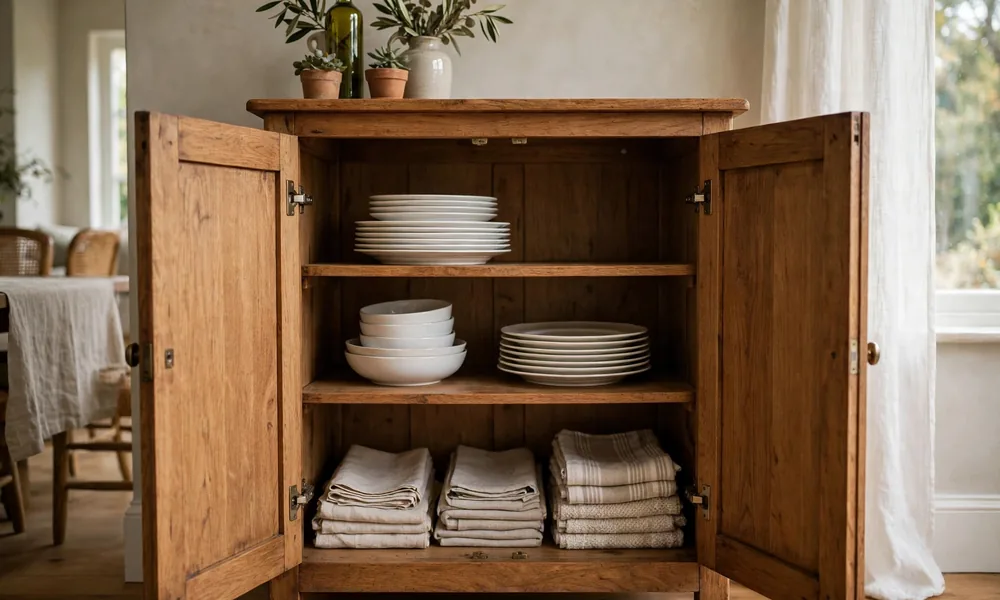
Height is the second advantage: ten to fifteen extra centimetres buys a whole extra shelf inside, or taller drawers that take folded tablecloths without creasing them. Drawers are the third advantage. A buffet often has one shallow drawer, if it has one at all. A good sideboard has two or three, and the top drawer, fitted with a cutlery tray, takes the cutlery, napkin rings, and bottle openers that otherwise rattle around a kitchen drawer. The top still earns its keep: at ninety centimetres high it is the perfect height for glasses and plates before a dinner party. A buffet serves a meal, while a sideboard stores the life around it.
Getting the Size Right
Size is the decision most people get wrong, and it is the one that is hardest to fix afterwards. A sideboard that is too long blocks the walkway; one that is too short holds too little to be worth the floor space. Start with the wall, not the catalogue. Measure the clear wall, then aim for a piece that fills about two-thirds of it. On a three-metre wall, that means a sideboard of about two hundred centimetres. On a two-metre wall, a hundred and twenty to a hundred and forty centimetres is right.
Then check it against the dining table. A sideboard roughly the same length as the table, or a little shorter, looks balanced. Leave ninety centimetres between sideboard and table so a chair can pull out while a door opens. If the room is tight, depth is the dimension to cut first: a forty-centimetre-deep sideboard in a small room works far better than a fifty-centimetre one that eats the walkway. Our guide to Best vs Worst Dining Tables 2026 covers table sizing, and the same habit applies: measure twice, buy once. Check the window sill height first; a sideboard covering the bottom of a window looks like a mistake.
Wood, Finish and Build Quality
A sideboard is a piece you will open every day, so build quality matters more than it does for a display cabinet. Solid oak, walnut, mango, and ash are the safest choices: they take knocks, sand and refinish well, and look better after ten years. Good veneer over a stable core is a fair compromise if the veneer is thick and the edges are finished. Avoid thin foil-wrapped chipboard: it chips at the corners, swells near spills, and sags under plates within a year or two.
Check the drawers before you buy. They should run smoothly on metal runners and have dovetailed joints, not staples and glue. Check the hinges: solid adjustable metal hinges beat pretty handles, because doors sag and adjustable hinges fix the gap in five minutes. A solid back keeps the carcass square; a flimsy cardboard back means the maker cut corners everywhere else. Matt lacquer or hardwax oil shrugs off glass rings; high gloss shows every fingerprint. Second-hand is often the best value: a solid mahogany or oak piece costs less than new chipboard and outlives it by decades, if the carcass is square and the doors have not warped.

How to Organise the Inside
A sideboard only stays tidy if the inside has a plan. Divide it into three zones and stick to them. The everyday zone, the top drawer and nearest cupboard, holds placemats, cutlery, napkin rings, and a bottle opener. The hosting zone, the far cupboard, holds the good plates, serving dishes, candlesticks, and guest tablecloths. The overflow zone, the bottom shelf or far drawer, holds the Christmas crackers, the fondue set, and spare vases. Inside each zone, small containers do the work: a cutlery tray stops the forks migrating, a folded tea towel between plates stops chips, and a shallow tray keeps candles and coasters together. Fold table linen flat so it does not crease, and add a spare shelf or a low box to split any shelf that is too tall.
What to Avoid
A few mistakes turn a good sideboard into a daily annoyance. Glass doors look elegant in the shop and show every fingerprint and jumbled stack at home; choose solid doors unless you are genuinely tidy. A sideboard deeper than fifty centimetres hides things at the back of the shelf, where they are forgotten. Protruding handles catch on chairs and clothing; recessed pulls or push-to-open doors are kinder. A sideboard with no drawers forces small things into the cupboards, where they slide around and get lost. If you want display space too, put a pair of Floating Shelves That Display Without the Clutter in 2026 above the sideboard instead of glass doors. Do not buy for a room you have not measured, or online without checking the return policy: photographs flatten proportions, and a compact-looking sideboard can be a wall of wood in a small room.
Checklist: Before You Buy a Sideboard
- Measure the wall and the gap to the table, leaving ninety centimetres clear for chairs and door swing.
- Check the depth: forty to fifty centimetres fits plates flat; less than thirty-five does not.
- Open every drawer and door, and look for dovetailed drawers and adjustable metal hinges.
- Choose solid wood or thick veneer over a stable core, and avoid thin foil-wrapped chipboard.
- Plan the three inside zones, everyday, hosting, and overflow, before the sideboard arrives.
- Check the height against the window sill and the chair seats so the piece sits naturally in the room.
Frequently Asked Questions
What is the difference between a sideboard and a buffet?
A sideboard is taller and deeper, built for storage, while a buffet is lower and shallower, built mainly for serving. The labels overlap in practice, so judge the piece by its depth, height, and what is behind the doors.
How deep should a sideboard be?
Forty to fifty centimetres is the sweet spot. That depth fits a standard dinner plate flat and holds two rows on a shelf. Under thirty-five centimetres struggles with plates; over fifty wastes floor space.
How long should a sideboard be?
Aim for about two-thirds of the wall it stands on, and roughly the same length as your dining table or a little shorter. A hundred and fifty centimetres suits most dining rooms; a hundred and twenty works in smaller rooms, a hundred and eighty in large ones.
Is solid wood worth the extra money?
Yes, for a piece you open every day. Solid wood can be sanded and refinished, it takes knocks without chipping, and it lasts for decades. Good thick veneer is a fair second choice; thin foil-wrapped board sags and chips quickly.
Can a sideboard hold a television?
Yes, if it is wide enough and the top is strong. A hundred and fifty to a hundred and eighty centimetre sideboard suits most televisions, and the cupboards hide the boxes and cables. Check the weight limit and leave ventilation gaps around warm equipment.
How do I stop a sideboard becoming a junk cupboard?
Give everything one fixed place in three zones, everyday, hosting, and overflow, and use trays and dividers inside the drawers and shelves. If something has no zone, it does not live in the sideboard. A quick monthly tidy keeps the system honest.
The Bottom Line
A buffet serves a meal; a sideboard stores the life around it. If your dining room is short on storage, the sideboard fixes it: deeper, taller, and better organised than a buffet, with a serving top for guests. Measure the wall, choose solid wood or good veneer, check the drawers and hinges, and organise the inside into three zones, and it will be the hardest-working piece of furniture in the house for years.